


Watch the headline
Mountain walnut cultivation has a long history in the zhejiang region. In recent years, local eco-governance of mountain walnut forests has been carried out, ecological restorations have been strengthened and science has been promoted. Mountain walnut forests are both a green barrier to soil and water and a treasure for forest farmers to grow。
In the early summers, the head of the forest yard, who was in the village of white bulls in changzhang town, zhejiang zhejiang zhang zhenzhou, stepped on soft and decomposed soil and looked forward to it。
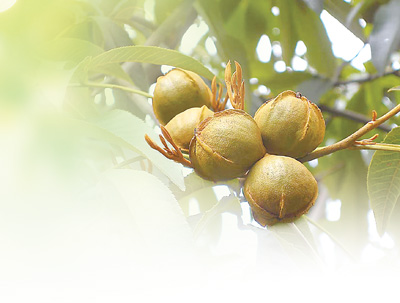
Walnuts are the product of peace, growing and processing for centuries. In 2019, the piansan walnuts were registered with the ministry of agriculture and rural development as a product of geographical indications of agricultural produce. Today at peace, the walnut forest covers 570,000 acres。
Earlier in the year, local villagers saw walnuts as “rich trees” — producing more walnuts in order to make money; in recent years, walnuts had become “ecological forests” — culinary soil and soil, woven green barriers. There is a growing awareness that scientific stewardship is necessary to achieve long-term gains. Little walnut, witnessEcological cultivationIt's a concept that takes root。
From rough management to green care
"the mountain watch is the job. This is the right road."
Once upon a time, the eyes were only on the production of walnuts, like those of the surrounding countryside。
"where we can grow, we grow walnuts. In order to produce more fruit, fertilizer is not less applied." according to aoi, “the production was up at the time, and it was later discovered that the soil was becoming more acidic, its nutrients were becoming more unbalanced, its walnut trees were becoming weaker, pests and pests were growing and earning less than a year”
“only staring at the current harvest, the mountain left behind by the ancestors is ‘breeding'!” it is urgent and guilty。
In 2019, p well-established ecological management of mountain walnuts and woodlands was fully launched in pine zone, implementing a ban on all use of herbicides and all destruction of other trees in mountain walnuts and forests, promoting soil fertilization and net harvesting techniques and promoting ecological restoration of mountain forests。
Governance measures have become clear, and the concept of ecological cultivation has slowly taken root, and attempts have begun to change。
The son and the father went into the forest with organic fertilizers and lime to contain soil acidification; fermented the walnut shells and sheep dung and slowly nourished the forest; raised the net to harvest the fruit, neither hurting the branches, nor damaging the fruit, nor protecting the vegetation under the forest; and artificial weeding without herbicides
Three years later, the mountains changed. Forest fertility has slowly recovered, trees are growing better and soil erosion has improved。
“the mountains are well, the trees are healthy, the fruit is good, the income is more stable. The mountain guard is a job, and this is the way to go。
“we have implemented a series of policy initiatives, such as the restoration of forests, the promotion of a moderate flow of forest land, the development of a modest scale of family farms and cooperative operators, the promotion of green-care technologies such as net harvests, fertilization of soil formulations, and complex forest plantations, and the transition from extensive management to sustainable ecological operations.”。
From monoculture to complex
"now, it's more ecological, it's better, it's better."
In port-au-pan district, the army chief of the ming family farm took the villagers under the mountain walnut forest to guard the yellow sperm. Artificial weeding, roofing, increased organic fertilisation and mobility。
The people of the army recalled that 10 years ago he would not have managed the forest so carefully, let alone planted other crops under the forest。
The single structure of vegetation has been a long-standing constraint on upgrading the walnut forest industry in zimbabwe. The wealth of mountain forest resources means vast under-forest space, and how can ecological cultivation be accompanied by increased economic efficiency? Inspired by agricultural experts, the army decided to plant yellow under the forest。
“the walnut canopy canopy provides a suitable semi-wetting environment. The combination of walnuts and yellow walnuts forms an efficient and stable complex ecosystem.” the army said that yellow cover of the surface was effective in reducing soil erosion compared to monoculture of walnuts, and that yellow leaves could also be used as fertilizer for walnut trees when they fell and rotted。
There have also been setbacks for the people of the army since the beginning of cultivation. In the first year, seeding was tested because of a lack of technical skills, poor growth of yellow and higher inputs, and the fact that farm incomes did not rise or fall. The neighborhoods did not understand, and he was advised that: “it's enough to keep the walnut tree under control, to grow medicine, to spend time and money, and to end up empty”
The people of the army did not retreat. He followed agrotechnologies to the woods, to learn technology, and went over the combinations of solin and ecological care. Through several years of care, yellow walnuts have flourished under the forest, and the quality of the walnuts has improved. The mature yellow harvest has brought about a steady income, leading to fruit in the trees and to a living in the forest。
Composite operations make industry more dynamic and preserve the good ecology of mountain forests. “it's better to start with production, input, now ecology, quality, and days.” the people of the army look at the yellow words under the forest。
From lack of technology to precision
“scientific planting of trees that preserves ecology and promotes growth”
The ecological cultivation of walnuts is crucially supported by technology。
Many foresters want to change, are willing to do so, lack the technology, have no means, and do not know how to do it. Agricultural technologists in the zone have been in the mountains for many years, with their hands and hands on forest farming to solve difficulties。
For many years, the chief of the lint station at the agricultural forest promotion centre in pine district, wang walnuts' chief agricultural extension expert, led the team of mountain walnuts to the forest land, to see and analyse in situ the soil, tree positions, pests and diseases of mountain walnuts, and to provide on-site guidance to the forest farmers on forest land management。
“scientific protection of mountains, scientific planting of trees can preserve ecology and boost harvest.” wang says. He travelled with his team to the walnut-producing area of ansan to map the forest land and develop an ecological planting programme。
“propagation of soil formulas for fertilization, with precision programmes for whatever is missing and how much is applied, and a steady increase in the fertility of woodlands.” zhiang fengtao, pong zhuang zone, planted zhao zhengping。
When the people of the army first started growing yellow, the problem was also the first time to find wang yingwoo. A team of technical experts from the centre for agricultural and forestry technology promotion, organized by wang towoo, conducted field-based research, tailor-made programmes and step-by-step mentoring。
“in the beginning, it was the experts who taught us, from seed to care, that every step was clear and clear, and the heart was getting closer.” the army said that it was not only him, but that many of the forest farmers in the surrounding area had problems and had approached agro-technical experts, who had gradually acquired the knowledge of ecological farming。
The team of experts also focused on ecological restoration and green control of pests and diseases. They repeatedly tested, selected high-quality, disease-resistant walnut varieties, promoted forest growth from the source, promoted biocontrol, eco-regulation techniques, and screened crops suitable for under-forest cultivation to assist in natural restoration of forest lands。
The team of experts also made several visits to the forest site of hae-hee's father and son to “take a pulse check”. “improve the plant pattern under the forest and adjust the application of organic fertilisers to make forest land more ecological and to steadily improve the quality of its production.” according to twist。
From old experience to science and technology, with the combined efforts of agro-technical experts and foresters, walnuts in the adjoining zone will leave the cultivation model. Today, the walnut forest in pianto is both a green barrier to soil and water and a treasure for foresters to grow. “escaping a win-win path to eco-efficiency, industrial upgrading, and increased harvests for foresters provides a living sample for the green transformation of mountain-specific industries.” wang guang, wang guang。
Daily people's journal (19. 05. 15, 2026)









