


There are now a large number of small rural institutions, first-floor courtyards and roof courtyards, mostly in idle condition. There is either a pile of junk, or there's a weed that's bald, and it's a waste of space. Many people who want to plant tree vegetables have been afraid to do so, but the core concerns are: ordinary fruit trees are too tall to have hold space in a small courtyard; maintenance troubles require trim, pharmacing, careful management; growth cycles are long, with no results for two or three years; and climate incompatibilities prevent survival, low results and poor taste。
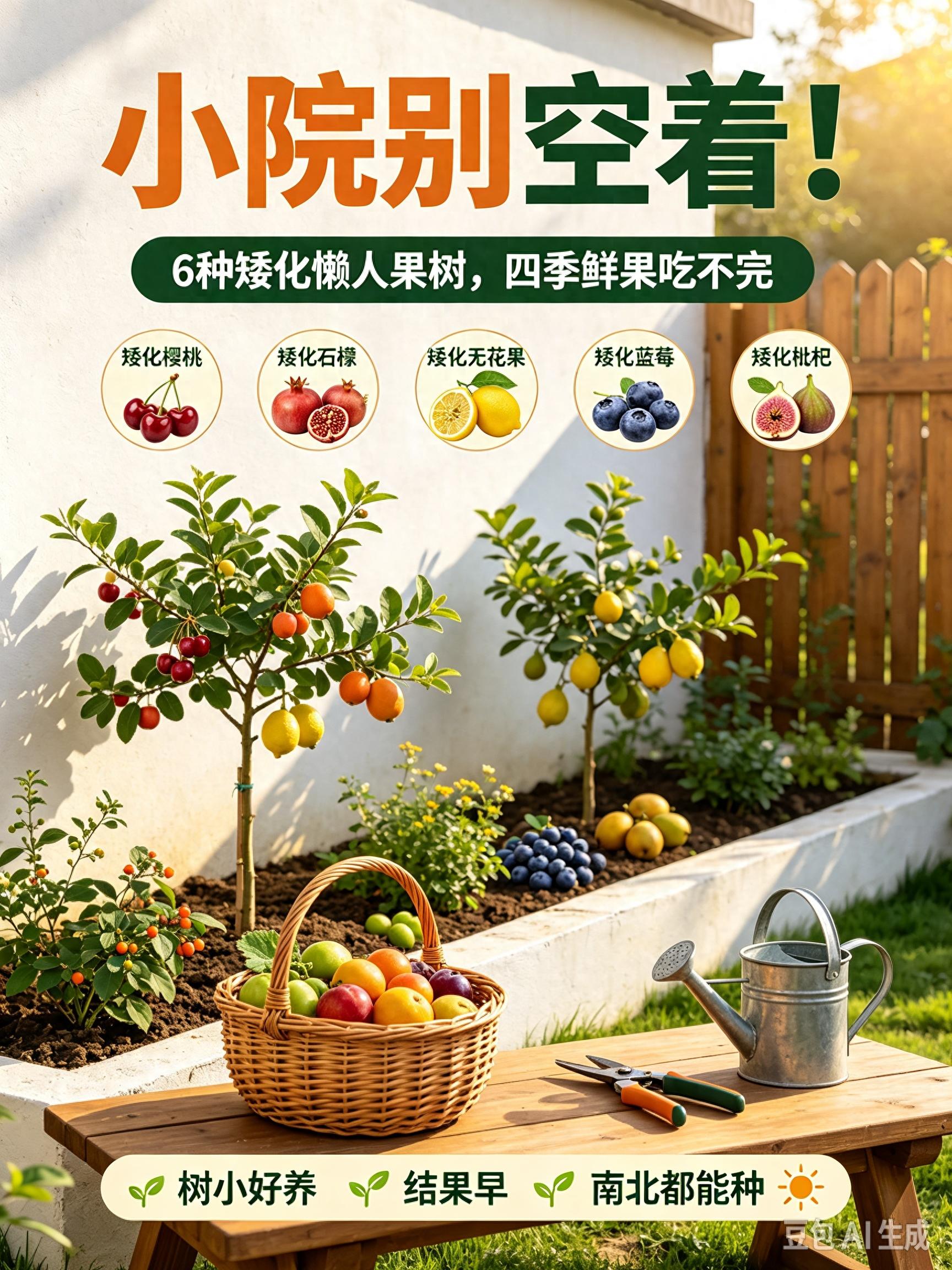
There's no need to worry about it at all. Today, the market's dwarfed, improved, lazy fruit trees are perfect for all planting problems. The horticulturally improved dwarf species are small, uninhabited, cold-resistant, disease-resistant, barely sophisticated, and can easily be fed by new workers。
Most crucially, the six fruit trees are staggered, the spring, summer, autumn and winter rounds are not frequented, fresh fruit is collected from year to year in the yard, clean of pesticides, safe to eat, and beautify the courtyard, clean the air, which is far more expensive than idle and plant grass。
Today, we share in detail six very high-priced, sluggish fruit trees, suitable for all gardens, balconyes and small gardens in the north and the south, with complete planting, watering, fertilizer and maintenance of dry products, so that they can be planted directly and the new ones will fail。
I. Shrimp pelvis cherries: small tree results, first wave of fresh fruit in the early spring
Many feel that cherries are the exclusive fruit of the north, that they can only be grown in tall wood, and that the small yard cannot. It's a big mistake. It's now a dwarfed cherry, car tumble-basket plant, and it's a new one for home courtyard improvements。
The height of the adult tree is about 1. 5 metres, with no stairwelling, no cutting, less than a square metre of land, with small courtyards, flower basins and horticulture, and open winters in both the north and the south, completely breaking the limits of cherry cultivation to the north。
The core laziness advantage
1. Precautions: unlike normal cherries, which take three to five years, they are constricted, planted in the same year, ready for the next year, with three years of fertilization without long waiting。
2. Very simple conservation: highly resistant to disease, very few sick pests, almost non-pharmaceutical use, natural growth and truly harmless fruit. Drought-resilient and cold, low temperatures of 20 degrees below, and high temperatures in the south can grow in the summer。
3. Stable production: small but very high levels of broccoli, a small adult cherry tree that can produce more than a dozen pounds of fruit a year, full meat, high sweetness, thick skin, and a better taste than the cherries that are purchased on the market。
Practising skills in small gardens
Cherry root is afraid of water and is its sole conservation priority. When planting, preference is given to high terrain and smooth drainage, avoiding low-lying roots. The soil is so plain that there is no deliberate purchase of nutrient land。
Before the spring sprouts at the beginning of each year, a small amount of compound fertilizer is dispensed, with no artificial pollination during the flower season, and open-air cultivation depends on wind and insects can sit naturally. The outcome period is not deliberate, but is ready for ripening。
The first spring, april-may, matured, was the first group of fresh fruits to start springing in a small courtyard, with a high taste and a good taste for both fruit and flowers, appreciation and practicality。
Ii. Pomegranates: both north and south, year by year, hot and dry
Pomegranates are definitely the all-embracing fruit tree in the family yard, and dwarfed soft seed pomegranatesLandlord plantingThe preferred. The traditional pomegranates are highly complex, cumbersome, condensed, condensed and condensed in short varieties that optimize all shortcomings, are well-streaked, are controlled at a height of 1. 2 to 1. 8 metres, tree beauty, four seasons green, flowery and dense。
The core laziness advantage
Extreme tolerance: the life capacity of pomegranates in all fruit trees. High-temperature, drought-resistant, infertile and mild salinization can be perfect, whether it is rainy in the south or dry and cold in the north. Even if you forget to water for ten and a half days, you won't dry the leaves。
2. There is no need for physiology: pests and pests are rare and cost-effective for conservation. Without frequent trimping, the natural tree shapes are organized, and they don't have to be plastic。
3. Softseeds are free: improved softseed varieties, fruitseeds can be swallowed directly, older children can eat, sweetness, juicy pomegranates are far above normal hardseeds。
Practising skills in small gardens
Pomegranates are radiant, and the place where they are grown is given priority over the small courtyard, where the light is full of light, the more flowers and the sweeter the fruit。
It is characterized only by the fear of drying and flooding, the daily watering of which follows the principle of “dry permeability”, and the timely drainage and avoidance of water accumulation in rainy days. Only two fertilisations per year, spring fertilizers, autumn fertilizers, ordinary farmers and compound fertilizers。
The flower period is may-june, and the flowers are extremely attractive and the fruits mature from september to october. A pomegranate with a pomegranate in the ferocious season can grow more than 20 pounds a tree, produce more than 20 pounds a year, do not have problems of age and age, and the results are stable each year。
In addition to this, the pomegranates, which are known as many sons, dafu, red fire, are planted in small gardens with both practical and blessed meanings and are the preferred species of fruit trees in the garden。
Iii. Shortening of the four seasons of lemon: year-round berries, pick and eat, fragrance house
Shortening the four seasons of lemons is essential if the yard is to have fresh fruit for four seasons a year. Ordinary lemon trees are large in size and have short durations, while four seasons of condensed lemons are a variety of perennial cycling results, with flowering, side-effects, edge maturity, and continuous year-round。
Small, compact, 1 metre high, potable, small yard and balcony, the highest-priced four-season fruit tree。
The core laziness advantage
1. Results for the whole year: without a fixed maturity period, spring, summer and autumn winters continue to bloom, with ready demand for pick-up, no accumulation and freshness。
2. Resilient: highly adaptable, growing in both the north and the south, with the northern winter moving into a small shelter, the balcony reaching the winter, and the south growing up all year round。
3. Self-sorture: the leaves and fruit bring their own natural fragrance, which cleans up the air in the courtyard, removes the aroma and is extremely rewarding。
Practising skills in small gardens
Lemon is a radiant plant, and sufficient light is key to abundance. Day-to-day maintenance is extremely simple, and the soil is dry and draught to avoid prolonged damp。
Small, long-term application of organic fertilizers without frequent application. As a result, nutrient consumption is even and does not require complex maintenance。
Lemon fruit is fragrance, sour, sour, sob, sour, sour, sour, sour, sour, sour, sour and sour, so healthy. A little tree, enough for a family to use all year round。
Shortening figs: the established “king of the slugs” reaps the harvest
Those who know how to grow know that figs are one of the best, fastest-growing and zero-failed varieties of all garden fruit trees. Shortening figs, on the other hand, is an improved variety for small homes。
The traditional figs are fast, easy to go crazy, take up a great deal of space, have a perfect control over the dwarf species, are small in size, have tight branches, do not grow randomly, and are perfect for small courtyards。
The core laziness advantage
1. Survival rate of 100 per cent: super-skin, heat-resistant, infertile, drought-resistant, readily buried in the soil, with few cases of death. Even if the newcomers don't know how to grow, they can easily feed。
2. Results are very rapid: the fruit can be tasted in the first year without waiting for the results of the year of planting。
3. Non-pestless: figs with special liquid smell of juice, no insects, no sickness, no pesticides for the entire journey, pure natural growth, soft and sweet fruit and sweet for all ages。
Practising skills in small gardens
The sole focus of conservation of figs is the increased sun and the more light the light, the more sweet the fruit。
The water is not intruded, drought-resilient, and can grow without water for a long time. A simple trim once a year, with no fine trim。
The maturity period is concentrated in the months of june-november, with a very long outcome period, with batch maturation and continuous extraction for six months. Fruit and meat are juicy and highly sweet, and are pure natural fruits。
Also, the figs are stable, productive, growing once a year, reaping year after year, with almost no follow-up inputs, and are the fruit trees of lazy people。
V. Shrimped blueberries: a small balcony can be planted, high nutritionally high
Many people love blueberries, but they're too expensive to feed, but they're already home-cultivated, and they're out of their pompous labels, and they're the top lazy fruit trees in the yard。
Shortened blueberry strains are small and round, with an altitude of 0. 8-1. 2 metres, free of space, tree beauty, spring blooms, summer results, blue purple fruit is full of branches and highly valued。
The core laziness advantage
1. A wide range of adaptations: modified dwarfed varieties, adapted to the north-south climate, cold-resistant and heat-resistant, open-air growth without greenhouse maintenance。
2. Maintenance is simple: pests and pests are rare, growth is slow and stable, do not grow crazy and do not need frequent cutting and cutting。
3. High nutritional value: self-carrying vasectomy, pure natural healthy fruit, home-grown pesticide-free, uncorrigated, safe and secure。
Practising skills in small gardens
Blueberries prefer micro-acid soils, which are suitable for ordinary courtyard soils, and alkaline soils in the north can occasionally be tempered with diluted vinegar water without complex operation。
The light is afraid of flooding, and the location of the plant ensures sufficient light, discharges in a timely manner and avoids the accumulation of roots. Small, long-term fertilization is sufficient without frequent maintenance。
The fruit matures in june-august, with full fruit, sour sweet mouths, own-grown blueberries, with a high sense of taste over the supermarket to import frozen blueberries. It's always green, it's green, it's green, it's green and it's green。
Vi. Shrimping: autumn and winter flowering, early summer results, cold weather tolerance
Most of the fruit trees are the result of spring and summer, and the condensation is just as ripe as it is, perfectly filling the early summer fruit gap in the small yard, combining the five above-mentioned fruit trees, and truly achieving four seasons of fresh fruit。
The epilepsy is the only type of courtyard improvement that has been abandoned by the large and large disadvantages of the traditional pyrotechnic tree, which is condensed, with a height of about 1. 5 metres, and is growing at a smooth and easy to manage。
The core laziness advantage
1. Refrigeration resistance: autumn and winter flowering, early spring growth, early summer maturity, extreme resilience to cold, safe winters at below 15 degrees and open planting in the northern complex。
2. Restraint: tree formation, with little need for frequent trimping, very few pests and pests, little management, and extensive maintenance, can lead to productive years。
Tastes soft: sweet, sweet and juicy fruit, pneumatic larynx, which is an age-appropriate fruit, full of branches and a very high price。
Practising skills in small gardens
It is better to have enough light, to have a better shape, to have a slight shaded environment, and to have minimal environmental requirements。
The daily water is wet and dry, avoiding the permanent accumulation of water in the soil. The application of organic fertilizer once a year in winter helps to flourish without excessive intervention。
The fruits matured in may-june and coincided with the turn of spring and summer, when most of the fruit trees were not yet ripe, and the dwarfed thaws were just filling the fresh fruit gap and freeing the small yard for four seasons。
CourtyardA dwarf treeGeneral maintenance dry cargo, first-hand
Many newcomers failed to plant fruit trees, not by mistake, but by lack of conservation details. These six lazy fruit trees, which share the same overall conservation logic and capture several core points, ensure that there is no decline in production from year to year。
First, light first. All garden fruit trees are radiant plants that are planted as far as possible in areas where light is abundant and well ventilated, and where sufficient light is the core guarantee of sweetness and yield, which leads to low results, poor taste and easy to lose。
Second, tight water harvesting. The vast majority of family fruit trees are afraid of flooding, and the root causes of death are the primary causes of death compared to drought. During the rainy season, drainage is done in a timely manner, and low-lying institutions are able to carry upsoil planting。
Third, hard work. Lazy people grow without frequent fertilization, two to three times a year. In the spring, sprouts, summer bulges, fall poachers, ordinary complex fats, goat dung, and farm fats are used without high cost fertilizer。
Fourth, light trim. Short fruit trees do not need to be re-cut, and every winter they simply cut dead branches, weak branches, cross-cutting branches, and keep the trees permeable, ventilated and lighted to reduce the growth of pests and diseases。
Fifth, there is no need for frequent drug use. These six improved varieties are highly resistant to disease and insects. They do not use pesticides on a day-to-day basis, and they grow in nature, so that they can truly grow without harm。
Why do you give priority to dwarfed fruit trees instead of ordinary trees
There are many people who struggle to plant trees in small gardens and who do not know whether to choose the wood tree or the reduced and improved species. Here, the difference between the two is clear。
The normal tall fruit tree, which grows very fast, can grow to three or five metres high in just a few years, blocking the small yard for light, blocking ventilation, spreading roots, easily destroying the walls of the compound, the ground floor, late triming, and picking extremely difficult trees, and high tree canopy can attract mosquitoes, birds and nesting, affecting the living environment。
Moreover, ordinary fruit trees have long cycles, with trees growing in vain in previous years, no profit from the space occupied, cumbersome maintenance, professional trim and medicine, and poor management by ordinary people。
The dwarf fruit trees are all artificially modified and controlled. The small size of the tree, which does not cover the ground, does not destroy the foundations, results in short cycles, stable yields, minimal maintenance and a much more rewarding view, perfecting the farming environment of the family complex, balcony and yard。
The key is that the six fruit trees are completely staggered: the first spring cherry, the first summer, the summer blueberry figs, the autumn pomegranate, the four seasons of lemon, and the results of the year-round cycle are truly free of the four seasons of fresh fruit, free from the cost of fruit and a healthy economy。
These six lazy fruit trees can only be seen in idle gardens, where they both beautify the garden environment, enhance the beauty of the complex, purify the air and harvest pure natural fruit every year, and are useful and priced directly。
The simple retrofitting of ordinary homes, which does not take a lot of time and does not require a large investment, can produce four seasons of harvest in the form of extensive maintenance, which is at the heart of the growing number of people who are retrofitting the yard and planting contusions。
Topical discussion
Is your yard currently empty? What kind of lazy fruit tree do you want to grow? What else do you knowPlantationAnd the fruit-rich tree? The sharing of information in the comment area is welcome, and the interest in planting dry goods in the courtyard is appreciated, as is the continuous sharing of low-cost, high-yielding courtyard improvement techniques。
Disclaimer: this is a generic horticulture technique with varying climatic and soil environments and slightly different planting effects. It is recommended that it be adapted to local realities。









