


Most of the friends in life who like to grow flowers, grass, fruit and vegetables share a common regret: most fruits have fixed maturity periods。
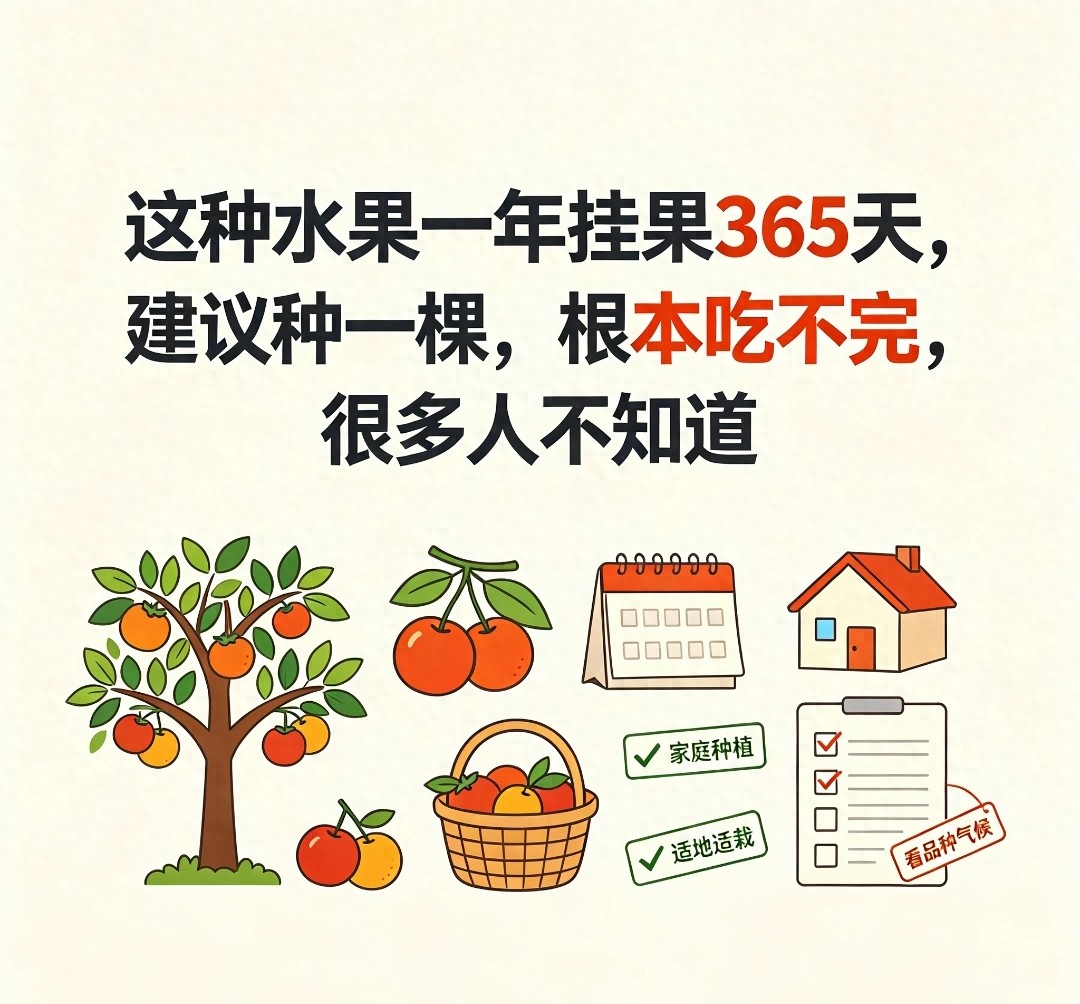
In spring, when the flowers bloom and the summer fall results, one or two months a year, and after the season, only money can be spent. Moreover, the high price of anti-season fruit on the market, the low level of taste, and the fact that fresh and natural fruit is a real inconvenience。
Today, we share a truly 365-day cycle of fruit, a month of flowering and four seasons of fruit. It does not have to wait for a particular season, and if it is properly preserved, the spring, summer, autumn and winter branches will always have flowers and fruits, growing one at home, fully free of fresh fruit and producing so high that they will never be eaten。
Even more critical is the very low threshold for this type of fruit cultivation, the resistance to cold disease, the absence of a site, the survival of the balconies, small courtyards and the ease with which new workers can feed themselves. Unfortunately, many ordinary families do not understand it, and have missed out on this high-yielding quality fruit tree, which is the rubies quail balla, also known as the quarter heart pomegranate。
Many people have had ordinary ballet, but 90 per cent have not seen ruby ballet with uninterrupted results throughout the year. Ordinary ballet produces a maximum of two to three results a year, concentrates on maturity, can't be eaten easily, and loses its harvest after the season. The ruby ballet, which is an improved, high-quality new breed, completely breaks the seasonal limit and is now recognized as a “high-yielding fruit all year round”。
I. Real year-round fruit, 365 days per month, produced far more than ordinary fruit
The vast majority of fruit trees in the market have hibernation periods, leaves fall in winter, no results, and spring and autumn concentrates on fruit. However, ruby ballet does not have a significant hibernation period, and in an environment where temperatures are appropriate, it continues to grow throughout the year, blooms and results, and branches tend to be in a state of “uncuted, fresh flowers blooming and full of juvenile fruit”。
Data on the multi-year planting of special orchards in hautlin county in guangxi are borne out by the fact that there is no centralized harvest season, that the rubies are matured throughout the year and can be harvested on a monthly basis, and that they are locally recognized as rich in four seasons, and that the orchards are always fresh and ready to come to the market without hoardings or other seasons。
Compared to normal fruit trees, the advantage is simply full:
Common apples, oranges, pears: one result per year, 1 to 2 months maturity
Ordinary cherry, strawberry: one season a year, with a short six-month pick-up period
(a) normal ballet: two or three times a year, concentrated and matured, with no success
Ruby four seasons of ballet: 365 days of cycle results throughout the year, no gap
And it's fast, and it doesn't have to wait long. Most of the ordinary fruit trees take three to five years or more to produce, and ruby-pallows are grown that year, in which case they can be contained in small quantities. The second year of cultivation is productive and the third year is fully stable。
An adult ruby ballerina with an average annual output of 80-120 poundsFamily cultivationOne, which is fully adequate for the whole family to feed and send their relatives and friends, produces so much that they cannot eat at all. Many growers grow two or three of them, with fresh barbs for four seasons a year, with extra sunnuts and pickles, and no waste。
The most pertinent point is that it is a series of mature, faulty results that do not accumulate in large amounts at once. The picks today, the next week, and the gradual maturity, have perfectly avoided the problem of common fruit, which is “cooked in a pile of shit”, and the freshest fruits are available throughout the year。
Ii. Taste sweet and nutritious, better than normal ballet
Many people don't like ordinary ballet, mainly because they feel stale, tedious, sour, and have lots of seeds. However, ruby quail balla has completely improved these shortcomings, and both taste and taste have been completely upgraded, which is a high-quality type of ballet。
The ripe ruby ballet, the light and smooth of the fruit skin, the permutable platinum red, the fragrance of the fruit and sweetness, and the absence of a hard and green taste. Sniffy, juicy and sweet, naturally sweet, with a unique smell of fruit, completely subverts the stereotype of ordinary ballet。
Its fruit is soft and soft, its old people eat their teeth, its children are tired, it eats sweet and sweet mouths directly, it tastes better after the ice, it eats fresh and dry in the summer, it eats warm and juicy in the winter, and it eats for four seasons。
In addition to its impressive tastes, ruby-pallows have a nutritional value well above most common fruits and are well-established “high nutritional parity fruit”。
As is well known, the vitamin c content of the pomegranates is at the top of the fruit chain, with ruby palae as a high-quality species, with three times the size of oranges and more than 10 times the size of apples, rich in dietary fibres, fruit glues, minerals and amino acids needed for humans。
Every day, there's a lot more to it:
1. A rich diet of fibres, which promotes gastrointestinal creeping and relieves abdominal swelling and is suitable for a group of people who sit frequently and whose stomach is not smooth
2. Low calorie, high abdomen, moderate sugar, and easy to eat during lipid reduction and sugar control
3. The fruits are warm and unstimulating, and are not cold and can be eaten by the elderly, children and pregnant women in appropriate quantities
4. The drying of the mouth can be well mitigated by bringing its own natural fruit fragrances, drying of water and eating during the dry season of autumn and winter。
Most importantly, home-grown ruby-blank ballet, with no precipitants, no swelling, no waxing, natural maturity, natural growth, and clean-up, can be eaten directly, with no pesticide residues, no additives, and absolute peace of mind。
Most of the ballet bought on the market is pre-maturity, long-distance storage, hard taste, insufficient scent, and possibly fresh agent residues. It is a state of natural maturity in which the taste and nutrition of the species are not available at supermarkets。
Iii. Super good feeding, no new ones fail, and the balcony can grow
Many people are afraid to grow fruit trees, fearing that they will not be able to grow them, fearing that they will not be able to survive. However, rubies, four seasons of ballet, known as “the exclusive fruit tree for the lazy”, are extremely viable, adaptable and hardly easy to plant。
1. No soil, no environment
The rubies are well developed and dynamic, with very low soil requirements. Small gardens and gardens, general gardens and balcony nutrients are able to grow normally, without the deliberate improvement of the soil, frequent fertilization and poor soils。
The cold-resistant heat-resilient, open-air growing throughout the year in the south, can grow normally in the northern winter, with simple movement to the balcony, indoor wind protection and temperatures above 5°c。
2. Drought and drought management
It is far more resistant to drought than an ordinary fruit tree, and does not water or clean up. The daily application of the “dry-and-wet” watering principle is sufficient, with the drying and watering of the soil and the occasional neglect of the water without atrophy, the loss of fruit, the yellow leaf and the year-rounding of conservation。
It is also particularly resistant to disease, with very few problems such as pests, rotting roots, falling leaves, high levels of pesticide spraying, green natural growth throughout the entire process, and conservation savings。
3. Smallness and plasticity
The ruby ballet plant is a medium-sized plant that does not go crazy indefinitely。
The family has a small yard, a vacant area, is planted directly, is growing faster, has higher yields, is full of trees, has four seasons of green, and is green and can produce results and be adorned
If they live in a building, without a yard, with a large flowerpot, a foam box plant, a balcony, a balcony, a window stand, and no indoor space, they can produce normal flowers with sufficient light。
And it belongs to the permanent green bushes, with green leaves and bouquets throughout the year, blooming with little white flowers, fresh and fresh, and extremely radiant, which reward flowers and see fruit and eat fruit。
Ordinary green plants, such as lunar seasons, green roses, etc., can only be seen and not eaten; and peach trees, pear trees, are too seasonal and difficult to conserve. Ruby-painting is the best option for family cultivation。
Iv. Family high-yield maintenance techniques and new ones can hang year after year full jing
If you want home-grown ruby ballet, you can keep the fruit hanging, produce more and taste better throughout the year, without complicated technology and with a few simple conservation techniques。
1. Ensuring sufficient light
Ballet is a radiant fruit tree, and the more light the light, the more flowers bloom, the thicker the clots and the more sweet. Day-to-day maintenance is as far as possible in the best position to light, ensuring direct sunlight over four to six hours per day. The problem of low flowering, high drops and acidic acoustic acidity can arise from insufficient light, which is central to the year-round outcome。
2. Rational trim and new branches
The fruit tree results are mostly based on new branches, including ruby-black. The simple daily trimmed branches, weak branches, long branches and cross branches reduce nutrient consumption and contribute to the growth of new branches. The more new branches, the greater the flowering results, the faster the trim, the more the nuts flourish, and the more the results are actually cut。
3. Fertilization with hard work and continuity
For sustained results throughout the year, a small amount of sustained nutrient supplement is required. Without complex fertilizers, household conservation can eject universal compound fertilizers and organic fertilizers once a month, with a small addition of potassium phosphorus fertilizer for the permafrost period, which can effectively improve fruit sweetness and yields. Too much fertilization at a time to avoid burning a seedling。
4. Appropriate ointment and quality of fruit
During the booming period, when the branches are too dense, they can shun the weak and the deformity and preserve the strong. This allows for the concentration of nutrients, allows for larger and sweeter reserves of fruit, while avoiding over-consumption of nutrients, and ensures that plants continue to grow and do not suffer from sprainage due to over-nuts。
With these simple skills, it is possible to achieve the year-round cycle of fruit, with a fruit tree feeding the whole family four seasons of fresh fruit。
V. Super high value for money, closed eyes for family cultivation enter
Many families now prefer to grow green fruit on the balcony and in small gardens, but most of them have low value. Flowers can only be seen to be uneatable, and common fruits are too short seasonal, conservational and production is extremely low。
And rubies, four seasons of ballet, perfect to avoid all shortcomings, have a strong advantage:
Three hundred and sixty-five days a year, no season, no month, no month. Eat
The results were high in the year of planting, the second year of production, without long waiting
Drought-resilient, disease-resilient, new hands lazy
It's a plant, no field, no north-south match
It's not agricultural. It's sweet. It's nutritious
The four seasons of flowers and flowers are so beautiful that they can grow green
It's too high. One is enough for the family to eat
A lot of people grow once in a lifetime to fall in love, buy fruit every year, not eat anti-season cold fruit, and be free at home, fresh, healthy, and cheap。
Many small rural institutions and urban balconyes are now growing large areas of this quartet, although most people are not aware of this high-quality variety and have missed out on high-yielding fruit trees。
Six. Multiple eating methods, four seasons a year
The ruby ballet is not only delicious, but it also eats a lot. It's good to eat fresh, to eat fresh, and not waste fresh fruit all year round。
1. Direct fresh food: the most healthy way to eat is to wash fresh ripe fruit, to eat it with skin, sweet and juicy, and to unearth the stomach
2. Ice-cooled food: cold in the fridge in the summer, cold and sweet, hot and thirsty, 100 times healthier than cold drinking
3. Homemade milk shakes: mixed with milk, yoghurt, honey juice, full of nutrients for all ages
4. Drying of sunnuts: drying of unfinished slices of fresh fruit, drying up of barley, no addition of natural origin and pursuit of snacks
5. Pickled jam: preparation of ballet jam, with bread, buns and better breakfast
6. Soup gravy: sweet fruit and meat, with ribs and thin meat gravy, sweet and sweet and warm。
A year and a four-week cycle is one of diversity and freshness and a complete solution to the problem of waste of fruit and fruits。
Concluding remarks
Growing a ruby four seasons of ballet is tantamount to having a “blank of all year's results”。
There is no need to wait for the season to change, no need to care carefully and no need to pay for fruit every year. In spring, summer, autumn and winter, fresh and fresh fruits can be eaten at the expense of the family environment and the freedom of the four seasons of fresh fruit, at a price far higher than the green and ordinary fruit trees of all families。
It is suggested that one tree be planted, whether it is urban or rural, and that it be built on its own, with friends who have a roof and a roof. One-time cultivation, with its year-round production and its long-term benefits, is the type of high-quality fruit most deserving of family cultivation。
Interactive topics









