


LilyRecent developments in research on applications and reproduction
Lin su ling and others
Lilium spp. Is the total name of the liliaceae lilyum l. Sex cooler, colder. Mainly in the northern temperate regions of eastern asia, europe and north america. There are now more than 100 species globally and 55 of our origin. The lilies are big, they're colorful, they're elegant, they're unique, they're very valuable. It contains rich nutrients such as carbohydrates, dietary fibres and mineral elements, and is a new type of vegetable with health effects. In addition, it contains a wealth of active ingredients such as acetone, bioalkalin, sugar and soap, has anti-tumours, anti-inflammation, enhanced immunization, blood sugar, fungi and antidepression, can be used to treat bronchitis, tuberculosis, lung cancer, neurosis, chronic stomachitis, and has broad application prospects in the fields of clinical medicine and research and development of antioxos products (such as cosmetics, health care, etc.). At present, however, our limo cultivation is small enough to meet export needs and the domestic market is short of demand. The available lilies continue to be dominated by fresh food balls, with fewer products processed into lilies, medicines and antioxidants。
To this end, the paper provides an overview of research on the application, consumption and medicinal use of lilies, as well as seeds, plastering and tissue breeding, and identifies problems in this area and analyses the direction and focus of future research with a view to informing the exploitation and breeding of lilies。
1 main application
1. 1 observation applications
Lily is the world-renowned root garden flower, with its variety and variety, long flowering, colorful, fragranceful and resilient, and in the garden, with joe, the irrigation, the lawn, and the landscape. Often large areas of pure or other flowers are planted on flower grounds, fields, etc. L. Davidii, l. Tsingtauense gilg, l. Perertum & hemsl., l. Lancifulum thunb., l. Specium var. Gloriosides, l. Regale, leaf lily (l. Pumilum dc.), l. Bakerianum collett & hemsl., etc. Lily is also an important plant flower, and many developed countries around the world, such as the netherlands, japan, and the united states, have partnered in one of the main directions of the lily industry, and have introduced many new varieties. The netherlands, the home country of the ball, supplies up to 10 new plant varieties each year. The variety is rich. Abroad, pellets have become one of the main commodities on the international market. At present, the united states is the largest consumer market for plant lilies, accounting for 80 per cent of the market, especially on easter. According to statistics, in 2014 for easter, the total volume of the lilies was $24 million. At home, the plant lilies are mainly produced in guangdong and account for about 90 per cent of the country's output。
Mainly based on the sale of the pastime pellets, at least 1 million bahts were listed during the evening. In addition, lilies are famous cut flowers, which can be used as decorations and displays of bouquets. Because of its spasms, it has the meaning of a “cave” and “hundred-years-old” meaning, it is popular and it has a prominent place in trade, both within and outside the country. At present, the annual trade in lilies and cut flowers has reached more than $2 billion globally, with more than 2 billion annual trade. Of these, approximately 1. 8 billion are produced annually by the netherlands, over 70 per cent for export. About 95% of the lilies supplied are for cut flowers. In the united states, cut flowers are sold second only to roses, aristocrates and kamrans, and in 2019 their sales totalled $58 million, representing 18 per cent of the market share of cut flowers. In our country, the use of lilies is long-term dependent on dutch imports. Since 2012, there are more than 200 million lilies imported annually. In 2023, the country imported 335 million lilies and imported $954,992 million, with freshly spent lilies amounting to $35,11 million (data from the national analysis of flower imports and exports, 2023). The most common liviculture hybrids are the oriental hybrids, asia hybrids and loNgiflorum hybrids) and complex hybrids such as la, ot etc. In recent years, new eugenics have been cultivated through a combination of artificial trades, with diverse and colourful varieties, which have greatly enriched the market for lilies。
1. 2 food
The main part of the limo is the root. The lilies are rich in flesh, fine and soft, odoury, unique in taste, and have nutrients such as starch, protein, fat, sugar, amino acid, vb and minerals. It is reported that lilies contain 70. 78% ~71. 90% dry weight; total soluble sugar content 80 g/kg; dietary fibre content of 3. 95% ~ 6. 49% dry weight; protein content of 2. 23% ~ 4. 63% dry weight; and fat content of less than 1%, similar to that of low-fat vegetables (such as pumpkins, vegetable flowers, etc.). The lilies contain 17-19 amino acids and contain a variety of elements, including calcium, magnesium, iron and potassium. In addition, lilies contain a rich biologically active ingredient, which has the effect of feeding the venom, pacifying the spirit, fighting fatigue, increasing immunity, reducing blood sugar, etc., and is a new type of health-care organic vegetable. According to the chinese plant register, there are more than 10 species of lily consumed, such as l. Brownii, shandan (l. Pumillum), kawaori, voltan, northeast lily (l. Distichum), waldam (l. Concolor), maui (l. Dauricum kergawl.), l. Brownie var. Viridulum baker, l. Lancifolium var. Yixing, lanzhou
L. Davidiiduch. Var. Unicolor (hong) cotton
L. Speciosum var. Gloriosides baker, l. Candidum, etc. At present, the country is growing more than 300,000 acres of lilies and is growing. The main plant varieties are lanzhou lily, dragontooth lily, kawasawa lily and ilya lily. Overseas countries, such as japan and north korea, eat the lilies of volts, lilies, lilies, lilies, lilies, lilies, lilies, lilies, lilies. Studies have shown that hybrid new varieties of " muskland" ( " musk " , " lily " ) are edible and edible; `california ' , `batistero ' , `danche ' (the asian lily `brunello ' x wild mountain), `bt-1 ' , `bt-2 ' , `yx-1 ' and `yx-2 ' ) are rich in nutrients and have a nutritional value equal to or greater than the traditional edible lily, which provides excellent material for the development of gravitational and lily new varieties. At present, lilies are used mainly as vegetables, lilies and supplements directly, with only lily powder, lily vinegar, lily beverages, lily beves, etc., and with a small variety of products and a lack of sophisticated processed products. In addition, health-care food formulations are often traditional, such as lilies, lilies and capsules, while new health-care foods such as fermentation are lacking。
1. 3 drugs
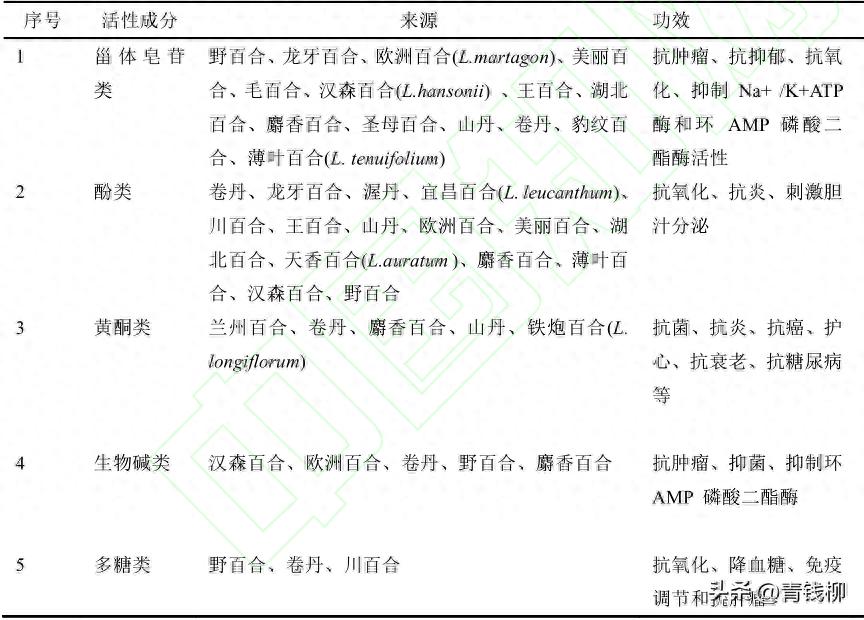
It has been recorded in ancient grassbooks that lily is used for pneumatic coughing, hysteria, steroids, etc., mainly to treat pneumatic coughing, pneumatic coughing and insomnia. The traditional chinese medicine uses lilies, mainly voltans, shandans (liver lily), voltans and lilys (l. Brownii var. Viridulum baker). It has been reported that the drugs contain a wide range of active ingredients, such as soap, phenols, ketone, bioalkalis and sugars, which are derived mainly from the symptoms of tuberculosis, lung cancer, gastricitis, bronchitis, neurosis and so on (table 1). Traditional chinese medicine is used to treat diseases with lilies, lilies, lilies, lilies, lilies, lilies, cures, lilies; modern medicine is used to produce formulas with lilies, e. G., centiples, lingentious pellets, clams, tulips, relief of tulips, second-mother sauerkrauts, saliva, etc., and is used for high clinical safety and stable therapeutic efficacy。
Table 1 partial lily active ingredient and efficacy
2 mainReproduction techniques
2. 1 seed reproduction
The low natural sprout rate of some species of lilies limits the way in which lily seeds can be used to obtain seedlings, and addressing seed sprouts is a key factor in the breeding of lily seeds. It has been reported that a suitable light-temperature combination can be effective in promoting the growth of lily seeds and reducing their onset time. Studies have shown that the optimal temperature of lilies is typically 20-25°c, and that neither too high nor too low is conducive to seed growth; weak light or 24 h light is conducive to lilies (table 2)。
Table 2
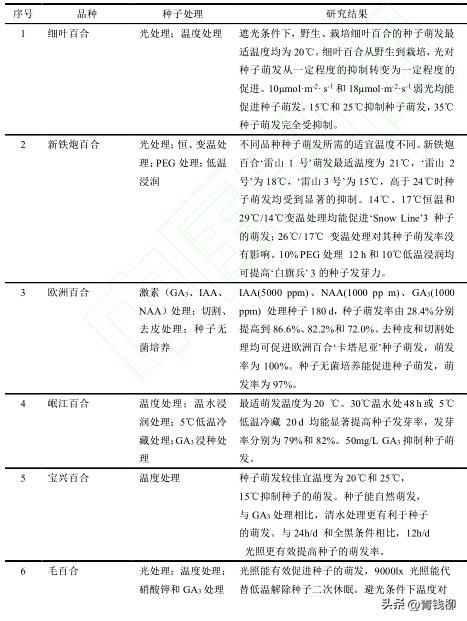
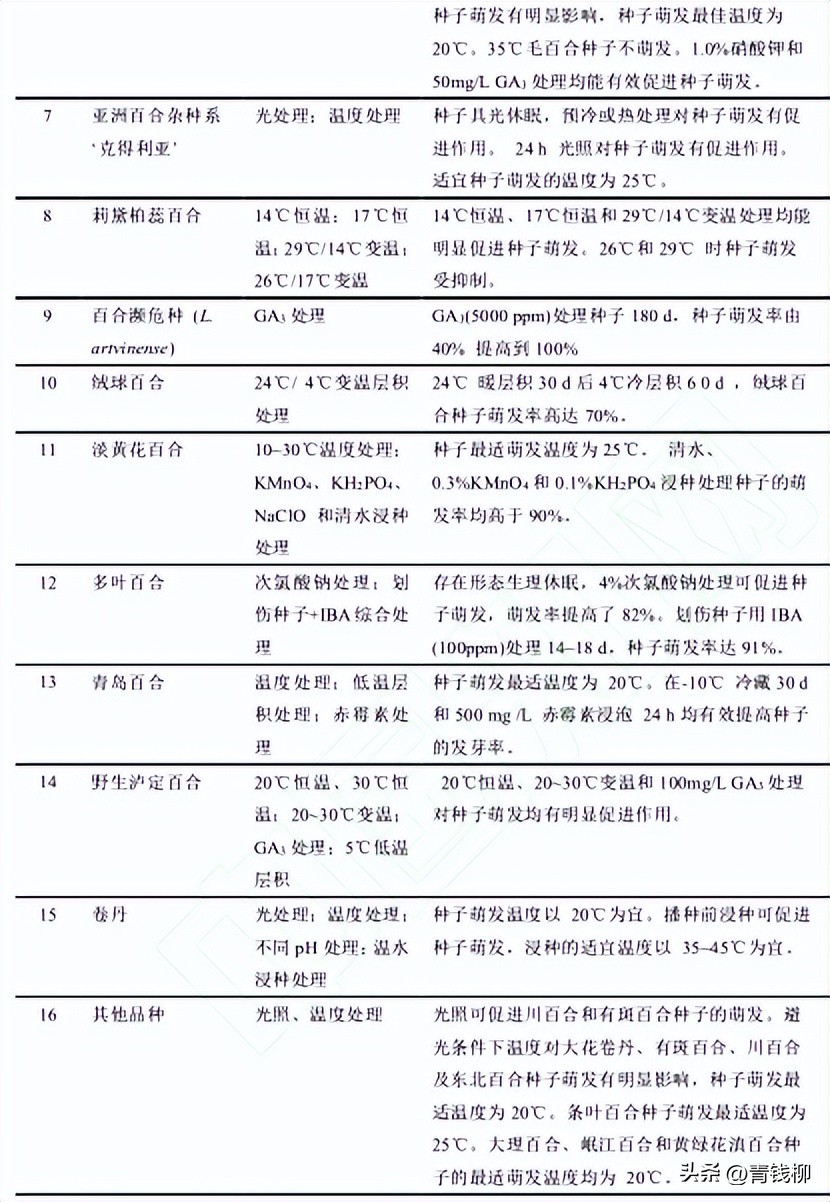
In response to low seed start-ups, hormones can be used as a catalyst. Studies have shown that hormonal types, concentrations and processing times vary depending on the type of seed, the onset properties, etc. For example, the introduction of low concentration (50 mg/l) ga 3 for gross lily seeds can effectively contribute to the growth of their seeds 8 h; for qingdao lily seeds, a medium concentration (500 mg/l) ga 3 treatment of 24 h is needed to effectively increase their seed growth rate; while some varieties such as lily endangered species (l. Artvinense) and european lily seeds require a high concentration (1,000~5,000 mg/l) ga 3 treatment of 180 d to achieve better results. Cutting and decorating can also be effective in promoting the growth of lilies. For example, the growth rate of `catania' seeds in europe, which are treated by skins, has increased by 100 per cent, and that of `l. Bosniacum' seeds has increased by 77 per cent. The precipitous rate of the cut-off of mixed eastern lilies can be as high as 100%. Slashing l. Polyphyllum seeds and treating 14 ~18 d with iba (100 mg/l), with a 91% seed rate. Studies have also shown that low-temperature accumulations (including cold storage) or demersal accumulations can contribute significantly to the growth of lily seeds, such as l. Regale seed at 5°c, 20% cryogenic cold, 82% seed sprouts, qingshima lily seeds - 10°c, 30% seed sprouts, 97. 5%. L. Popponium seeds grow as high as 70% after 30 d of 24°c. The new cannon lily `snowline' and l. Ledebourii seeds are warmed by 26°c/17°c, with a marked increase in seed germination。
2. 2 speculator-plug breeding
2. 2. 1 plug-in methods
The lilies are an important means of commercializing the current sphere. The lilies are suitable in the autumn or early spring, with the choice of strong, thick and thick scales (with some of the base organizations) to disinfect them and dry them for backup. The length of the scales is 1/3 ~1/2, and the length of the scales is approximately 3 cm. The most common agents used to sterilize the tablets are multiborges, methyl tobuzin, bacillus and krabdane, with a common concentration of kmno 4 (passium permanganate) of 1000 times the fluid and other agents 500-800 times the fluid。
2. 2. 2 factors affecting adhesive reproduction
The factors that affect the prophylactics of lilies have a variety of properties, parts of scales, temperature, matrix and hormone treatment. Varieties characteristics are the most important internal factor influencing the growth of platinum plugs. There have been experiments to show that there is a marked difference in the size of the scales, the coefficients of reproduction and the number of balls, due to the genetic composition of the different species of lily, the thickness of the scales and the nutrients they contain. The asian lilies series is generally considered to be more viable and suitable for platinum-plug breeding. The productivity of the scales varies from one part to another. It is generally considered that the productivity of the outer, meso-scale scales is strong. Because of the severe mechanical damage to the outer scales, the number of bacteria and the high rate of decomposition, the mid-level scales are the preferred plaster plugs。
Temperature is an important environmental factor affecting the reproduction of lilies. The most suitable temperature for lilies is reported to be 20 ~ 25 °c, and excessive or low temperatures can affect the growth of scales. For example, 25°c culture has taken root in favour of qingdao lilies and fine leaves. The musk lily `white american' and the eastern lily `sorbonne' can be separated under conditions of 20°c and 25°c, but not under conditions of 15°c. Eastern lily `sorbonne ' , `merea star ' , `siberia ' and lanzhou lily have the highest rate of fragmentation of the platinum ball at 20-22°c; musk lily has the highest number of plumes under 23°c culture; eastern lily `sorbonne '
And asia’s lilies’ “precisions” have the best effect on the growth of the plume under 25°c culture. There are also studies that show that the growth of the lilies is more favourable in the 20-25°c heating culture than in warmer conditions, such as `nove cento ' , `romano ' , `elite ' and `con amore ' , which have a significantly higher fertility rate than the temperature of 15-25°c at 22°c. In addition, studies have shown that lily balls are more effective in increasing the growth factor, the number and quality of ball formations after low temperature processing. For example, in asia, the lily `toro' and the eastern lily `siberia' increased significantly in terms of the growth coefficient of the plasters after 1 month of low temperature treatment at 2-4°c; after 3 treatments at 2-4°c, the plasters increased significantly in terms of the quantity and quality of seed balls formed. `sorbonne' has significantly increased the diameter of the seed ball formed by the `sorbonne' after a 5°c cryogenic process of 120 d. The matrix is also an important environmental factor affecting the reproduction of lilies. The matrix requires laxity and ventilation, which can be made from a mix of peat, pearl rock, river sand and corrosive soil. The matrix composition and ratio vary according to the variety. It is reported that the most appropriate pyrotechnics are peat: sand = 1:1 and peat = 1:1; eastern lily `muscadet' is peat: river sand: pearl = 4:3; eastern lily `sorbonne' and `siberia' are sawn ground = 3:1; ot lily `profundo' is sand: peat = 1:1; and effectively increases in the fertility factor of the blades. However, studies have also shown that a single matrix can achieve the desired results. For example, peat, as a platinum plume, can effectively increase the productivity of the platinum plume of eastern lily and asian lily; pearl rock is drained, ventilated and well-breathed, and contributes to the rooting and breeding of the plume, which is the most rational platinum plume in qingdao; and the plume is the most suitable platinum plume for new iron cannons. It follows that the matrix should be selected according to the characteristics of different species in lilies。
Exogenated hormone treatment can alter the balance of the lilies, and the application of suitable hormones can effectively increase the productivity, fertility coefficients, staggering, and number and quality of stammers. Appropriate hormone types and concentrations vary among different varieties. In the naa study, experiments have shown that 300 mg/l naa treatments significantly increased the fertility factor of the cannon lily `rorina', the eastern lily `siberia' and `sorbonne' plaster plugs, and increased the weight of the lanzhou lily plaster plugs to form a small root; 500 mg/l naa handles the highest number of lily hair roots in lanzhou. However, there have also been experiments to show that low concentrations (100-150) mg/l naa treatments can effectively increase the root rate, incidence and fragmentation of embroidery plugged in asian lilies, hair lily and edible lilies; 50 mg/lnaa treatments can increase significantly the number of musk lily sprouts and the growth of sprouts. But ning yunfeng and others believe that naa has not contributed to the squirt; and liu fengjun and others believe that naa will lead to an increase in the scavenger rate. In terms of iba studies, studies have shown that the iba treatment of 300 mg/kg is conducive to the formation of lilies; the treatment of 200 mg/l iba is conducive to the increase in the number of `sorbonne' quilts and roots and to the increase in the number of `precision' quilts. However, cao yi and others consider low concentrations (50 ~ 100) mg/l iba treatments to have a significant effect on musk lily sprouts; sun hongmei and others consider 100 mg/l iba to have a significant effect on the improvement of the `sorbonne' fertility factor and alignment in the east. In the context of ga 3 studies, studies such as hutao and sun hongmei found that 100 mg/lga 3 treatments can contribute to the expansion and increase of the `sorbonne' quilts in a relatively short period of time; cao zhou and others believe that 50-150 mg/liba treatments can contribute to the growth of musk sprouted roots. It follows that suitable hormone types, including hormone concentration, treatment time, etc., should be selected for the lilies in accordance with the characteristics of different varieties。
2. 3 organization of reproduction
2. 3. 1 outplanting body
In lilies culture, multiple organs, such as scales, seeds, petals, stubs, etc., can be selected as extremities. The ability to induce division varies from one implant to another, often with the strongest ability to induce fragmentation. For example, zou hae-chun, among others, found that the ability of the eastern lily to induce division varied from strength to weakness: the root point of the cape. Pan woo-chul and wing-min have organized the formation of a different species of lily in the state of lanzhou, and have found that the sequins are more seductive than the roots, the tubs and the leaves. Takayama and misawa compare the division of vasectomy, varnish, petals, mackerel, vasectomy, and ionoids. It is found that the division of edifice and edifice is the best. Luo fengxia and others found new iron cannon lily seeds with the greatest ability to induce division, followed by plaques and filaments. However, given the genetic differences among the diverse individuals, the scales are considered more suitable as an implant than seeds. In addition, the ability to divide different parts of the scales varies。
For example, yang li has found that the mid-level scales of the voltan are better than the inner and outer scales. Tang dong clericals and others found that the eastern lily had a significantly greater ability to divide the scales than the inner scales. Tang weng jin and others found that the luminous lily produced larger masts and better developed roots than the inner masts. The ability to divide different parts of the same scales is different. For example, pan yuo found that lanzhou had the best ability to induce parts of the lily tablet, followed by the centre and upper part, and that the best part of lanzhou lily tablets was found in the lower middle, with 95. 2 per cent. Zhao qingfang and others found that the ability of eastern lily to create the lumber was strong to weak: below. Li jin found that the infection rate of the outer scales as extremities was significantly higher than that of the inner ones. Therefore, the lower part of the lilies is best suited as an implant。
2. 3. 2 cultures
The basic culture base most commonly used by lilies is ms. There are also studies using b5, white, sh, etc. As basic cultures, but the results are not as good as ms. For example, yang pae-yun and others have found that ms are more conducive to the multiplication of lilies than improved ms and b5 cultures. The study of five different types of implants, such as luo fengxia, found that ms cultures are better than sh. Luchi found ms better than b5, white culture foundations to promote the dichotomy of dragon-tooth lilies and buds。
2. 3. 3 plant hormones
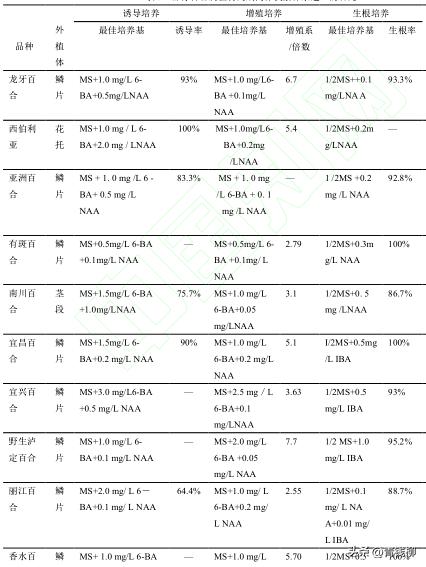
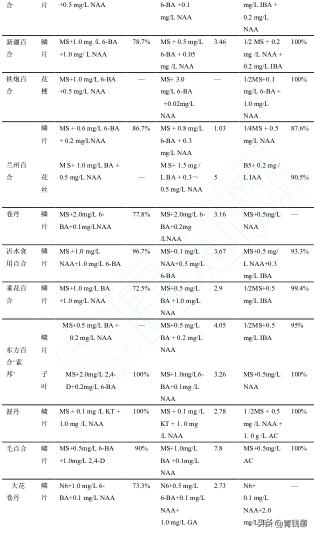
Plant hormones are necessary to induce the formation of plaster healing tissues, figs, sprouts and plants. The hormones often used in lilies are 6-ba, naa and iaa. Among them, naa is a broad spectrum of plant hormones that promotes cell division and induces the formation of uncertain roots, while the 6-ba role is mainly to promote cell division and cell size expansion, which contributes to the formation and growth of growing wounds. The 6-ba and naa combinations are commonly used in lilies induction and breeding. Studies have shown that 6-ba+naa combination hormones have a significant impact on the muscular tissue, the induction and breeding of unsettling sprouts (table 3). For example, koiqiang, among others, found that 3. 0 mg/l 6-ba+0. 3 mg/lnaa hormone combinations had facilitated the induction of the lanzhou lilies healing organization, with a induction rate of 96. 3 per cent. Roshibo et al. Found 1. 5 mg/l 6-ba+0. 2 mg/l naa hormone combinations, with a induction rate of 90. 0 per cent for the magma magma tissue. Young yong-hoon and others found 0. 5 mg/l6-ba+1. 0 mg/l naa hormonal combinations that have contributed significantly to the attraction of lily `mona ' , `yowteng', `barbara' and `sorbonne' spasms, with a induction rate of 96. 5 per cent. The wang's great equality found 2. 0 mg/l 6-ba +0. 05 mg/l naa hormone combinations to have a significant contribution to the growth of wild lilies with a multiplier of 7. 7. Shin yuhua and others found 1. 0 mg/l 6-ba+2. 0mg/l naa hormone combinations can also have a good effect on siberian lilies for healing and indeterminate seduction, with an induction rate of 100%. Pang xinxia and others found that when naa was 0. 1 mg/l, 6-ba concentrations between 1. 0 and 2. 0 mg/l would cause the eastern lilies to grow with a high multiplication and robust growth。
In libertarian root culture, naa or iba or both are commonly used (table 3). Studies have shown that the best root cultures are 1/2ms+0. 5 mg/ml naa, 1/2ms+0. 5 mg/lba, 1/2ms+0. 5 mg/l iba and 1/2ms+0. 3 mg/l naa, with 100 per cent root rates; the best root cultures are 1/2ms+0. 5 mg/lba + 0. 2 mg/l iba, with 100 per cent root rates, respectively. There are studies that show that adding iba to the ms culture base can also be very effective. For example, watching the lily `mona ' , `yan tianbao ' , `barbara ' and `sorbonne'sprouted in the ms+0. 5 mg/l iba culture base, with 100% roots. In addition, an appropriate increase in hormones would also facilitate the generation of small saps of the limo. For example, the best concentration of 0. 69 mg/l was found for naas to induce eastern lilies to produce small tubers. The tang dong cui, lee hong woo, zhao zhongfang study found that selenium tablets in the east were induced to produce the best hormone type and ratio of small empanzees, 1. 0 mg/l 6-ba + 0. 5 mg/l naa + 1. 0 mg/l2, 4-d, 1. 0 mg/l, 1. 0 mg/lba +0. 5 mg/lga 3 and 0. 2 ~0. 8 mg/lkt+ 0. 05 ~0. 5 mg/lnaa, respectively. Zhang chang and others found that the most hormonal irritation that induces the fragrance lilies to produce small styres was 1. 0 mg/l 6-ba+0. 3 mg/lnaa. Currently, the studies of some of the lilies that have been successfully established are summarized in table 3. As a result, plant hormones have a significant impact on the formation, indeterminate induction and breeding of lilies, and there is a close relationship between the success of lilies and the appropriateness of hormone selection。
Table 3 research on the development of efficient ionization systems for selected lilies
3 discussion and outlook
Lily is an expensive “medicine reward” for the same-sourced economy and has great potential for exploitation. However, there are three main problems with the development of lilies and the use of research related to reproduction: the first is that the lilies are still concentrated in the field of cut flowers, and very little is being done in the field of landscape greening and pelvis viewing, especially in recent years, where there has been almost no research. With its vast mountain forest resources, lilies are highly adaptable to the environment, easy to grow and valuable, and should be further exploited in the future, with potential for development, in the form of a combination of varieties of lilies, and in the form of increased research on seed selection, reproduction and extension, which will contribute to the development of the lily economy under the forest, as well as to the development of the local economy in the green-american rural landscape. In addition, research should be strengthened in such areas as the selection of plant lilies to enrich the lilies market. The second is that lilies contain rich nutrients and bioactive ingredients, and that much of the research is currently on chemical components, and that research on their pharmacological activity and clinical applications is scarce and should be strengthened in the future. At the same time, research on lilies for deep processing technology should be strengthened, which could contribute to the development of lily deep processing products. In addition, the chemical components of the lilies have been further developed to provide insight into the mechanisms of their biological activity and the structure of their effects, and the results of the research have contributed to the development of the lily's clinical pharmacological products, health products and cosmetics. Thirdly, while organizational culture technologies play an important role in mitigating the degradation of lilies and the detoxification of seedlings, and there are great prospects for their application in areas such as lilies, mutagenic breeding and multi-sporting, at present our research on lily culture is insufficiently systematic and has not yet resulted in a well-established standard production protocol, even though some lily varieties have succeeded in establishing a fast-growing system, but are still at the research stage and are not yet used for production. Future research should therefore be optimized and made more replicable, with the result that the results of scientific research could be put to the ground and the production of limo scale。









