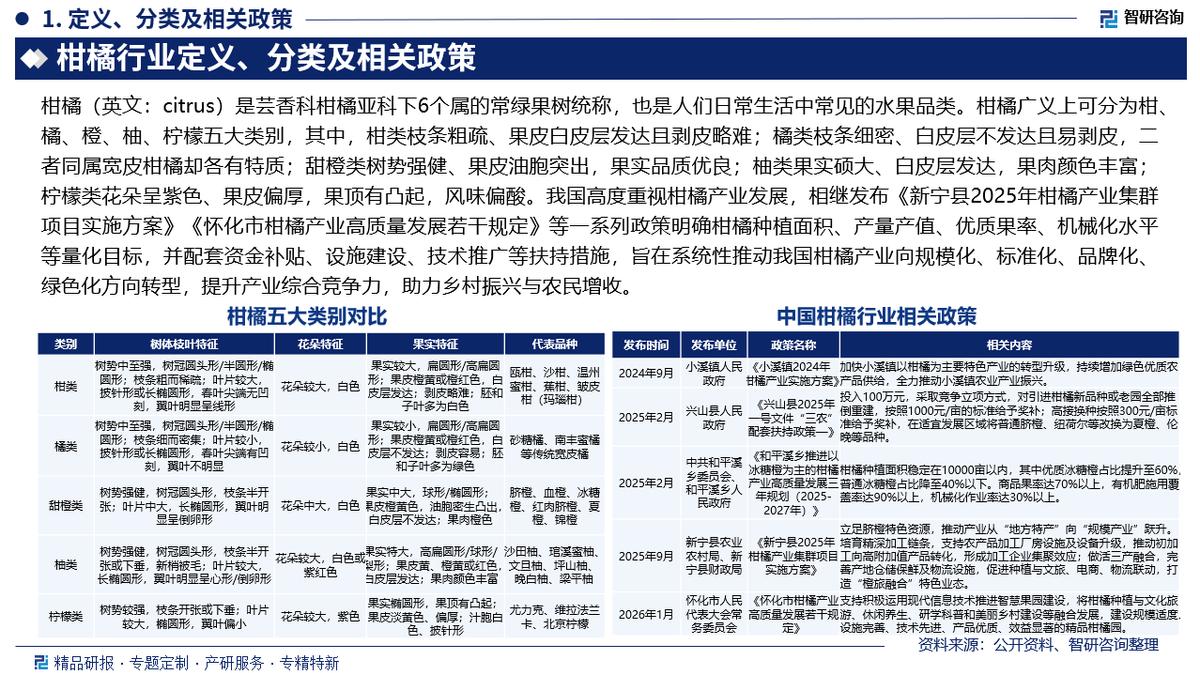
Citrus (in english: citrus) is a common term for six of the permanent green fruit trees under the oscillation citrus and is a common type of fruit in people's daily lives. The fruits are fruity, oily, aromatic, white-lined, pelvised, pellets of heart skins, with juicy pellets and seeds, and single-leaved, leafy and transparent oil cells with white or purple fragrance. Citrus nutrients are rich in vitamin c, carrots, dietary fibres and various essential minerals such as potassium, calcium and phosphorus. They also contain organic acids such as lemon acid and apple acid, as well as natural antioxidating active ingredients such as acetone, orange peeling and franchise. They are frequently consumed by citrus, which can supplement everyday vitamins, enhance resistance and promote gastropic creeping and help to digest it, as well as antioxidation, relaxing fatigue and protecting cardiovasculars, among other effects。
Consultant, chinaOrange industryI've been a peer and witness for over a decade. We look forward to working with industry partners to promote progress and prosperity in the citrus sector with accurate information insights, professional advisory services and individualized solutions。
The point is:
Enabling factors for the development of the sector: the country attaches great importance to the development of the citrus industry and has issued, in turn, the ten measures for the promotion of quality development of the fruit industry, the plan for the renewal of the orange industry in the jiangjin region (2024-2027), the programme for the further development of the high quality development of the orange industry in the kanang region, the programme for the implementation of the high-efficacy action project on green orange production in chounchang county, 2024, and the programme for the implementation of the orange industry in little creek, 2024, the “three farmers” support policy for the first year of 2025 in hingshan county. A series of policies, such as the programme for the implementation of the orange cluster 2025 project in nuining county, " provisions for the high quality development of the orange industry in the city of huail " , define quantitative objectives such as the area under citrus cultivation, yield value, high-quality fruit rates, mechanization levels, and support measures such as financial subsidies, construction of facilities and technology promotion, aimed at systematically promoting the transformation of the country's citrus industry in the direction of size, standardization, branding and greening, improving the overall competitiveness of the industry and contributing to the revitalization of the countryside and the growth of farmers。
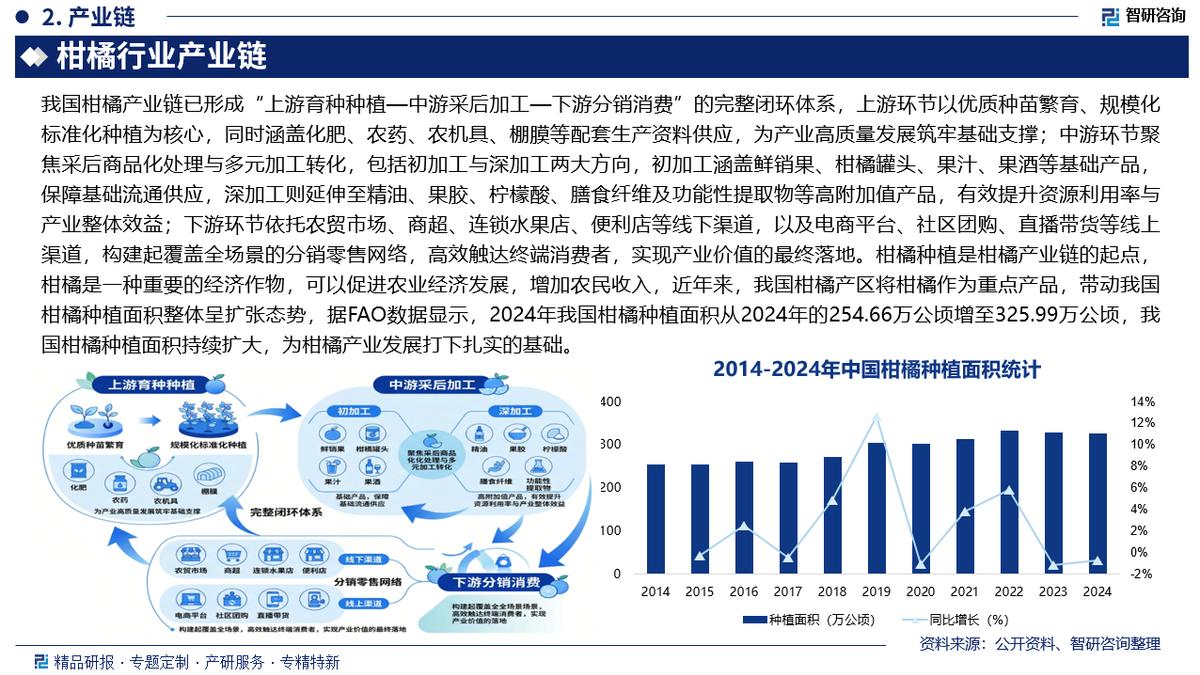
Industrial chainCore nodes: the chain of our citrus industry has developed a complete closed ring system of “upstream breeding - post-middle processing - downstream distribution” with high-quality seeding, scalding and standardized planting at its core, covering the supply of complementary production materials such as fertilizers, pesticides, farm tools, shrubs, etc., to support the high-quality development of the industry; commercialization and multi-processional transformation of the mid-train chain, including primary processing and deep processing, primary processing covering primary products such as fresh fruit, citrus cans, juice and wine, and deep processing extending to high-value products such as oil, fruit rubber, lemon acid, dietary fibres and functional extracts, effectively increasing the utilization of resources and the overall benefits of the industry; lower-tramper sub-channel channels such as agro-trade markets, commercials, chained fruit stores, convenience stores, and electronics, community buys, live-links, etc., and building distribution networks that cover the entire area of distribution and distribution, efficiently reaching end-end consumers。
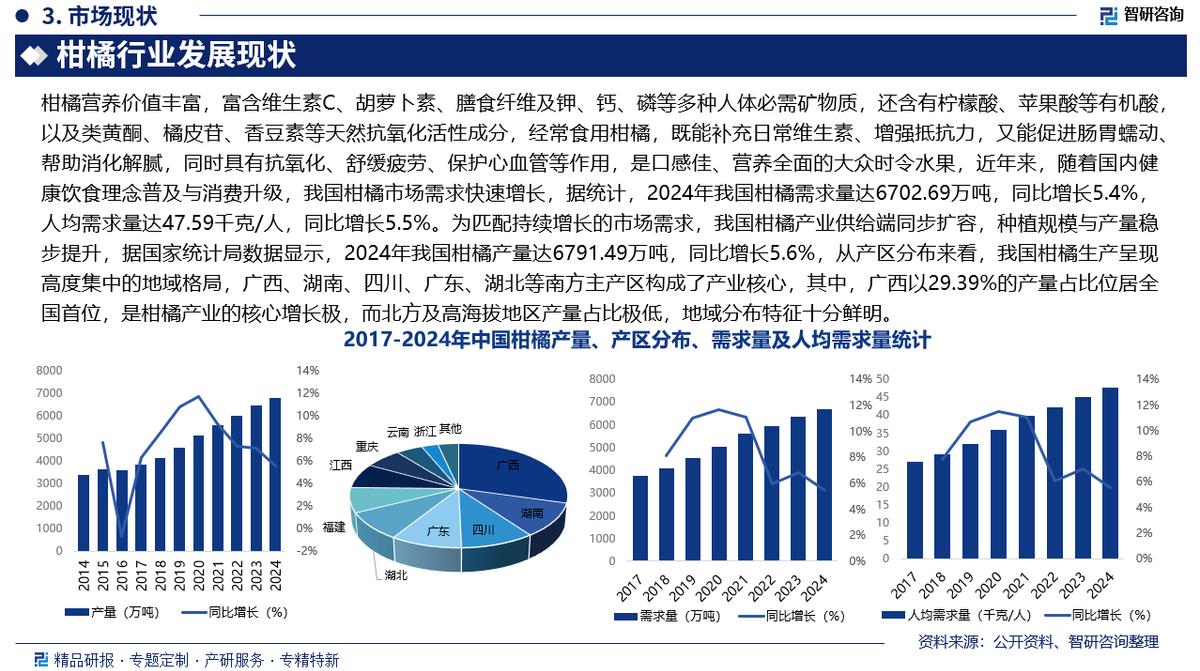
Demand: citrus nutrients, rich in vitamin c, carrots, food fibres, potassium, calcium and phosphorus, and organic acids such as citrus acid and apple acid, as well as natural antioxidant components such as yellow acetone, oranges and fracants, often eating citrus, can supplement everyday vitamins, enhance resistance and help to digest intestinal morbidity, as well as antioxidation, suffocation and the protection of the cardiovascular system. In recent years, demand in our citrus market has increased rapidly with the spread and consumption of healthy diets in the country. In 2024, demand for citrus rose by 67. 069 million tons, compared to 5. 4 per cent, and per capita demand increased by 47. 59 kg/person, or 5. 5 per cent。
Production: in order to match the demand of the growing market, our citrus industry has grown steadily in terms of both supply and production. According to the national statistical office, the country's citrus production reached 6,791. 49 million tons in 2024, an increase of 5. 6 per cent over the same period. In terms of distribution of production areas, the country's main citrus production is highly concentrated. The main regions, such as guangxi, hunan, sichuan, guangdong and hubei, constitute the core of the industry, with 29. 39 per cent of the output in guangxi and west being the highest in the country. It is the core growth of the citrus industry, with production in the north and the high-lying regions being extremely low and characterized by strong geographical distribution。
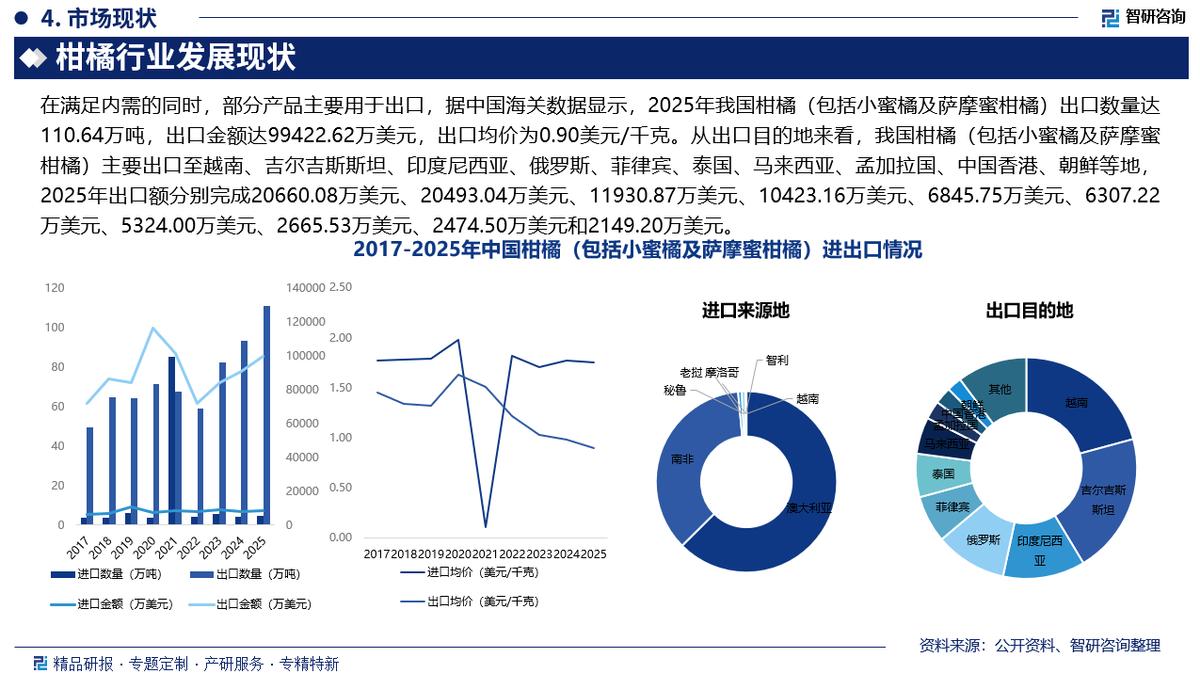
Trade: while meeting domestic demand, some of the products were mainly exported, according to chinese customs data, our exports of citrus (including small and samite citrus) amounted to 1. 106 million tons in 2025, with exports amounting to $994,226,200, with an average export price of $0. 90 per kg. From the point of export destinations, our citrus (including small citrus and samite citrus) is exported mainly to viet nam, kyrgyzstan, indonesia, russia, the philippines, thailand, malaysia, bangladesh, hong kong, china, and the democratic people's republic of korea, respectively, with $206. 6608 million, $20. 49304 million, $119. 387 million, $1,042. 16 million, $68. 4575 million, $6. 307. 22 million, $53. 24 million, $2,665. 3 million, $247. 5 million and $214. 9 million in 2025。
Business distribution: the country's citrus-related enterprises are concentrated mainly in guangxi, hunan, sichuan, guangdong, hubei, fujian, jiangxi, chongqing, yunnan and zhejiang. As a result, the country's citrus-related enterprises are also concentrated in these areas. The core production areas are based on a large number of growing, sorted, processed, cold-chained and branded businesses, which form a sophisticated industrial ecological system, with more than 1,000 citrus-related enterprises, which constitute the core clusters of the country's citrus industry, while the number of non-dominant enterprises in the north and north-west and north-east regions is less than 100。
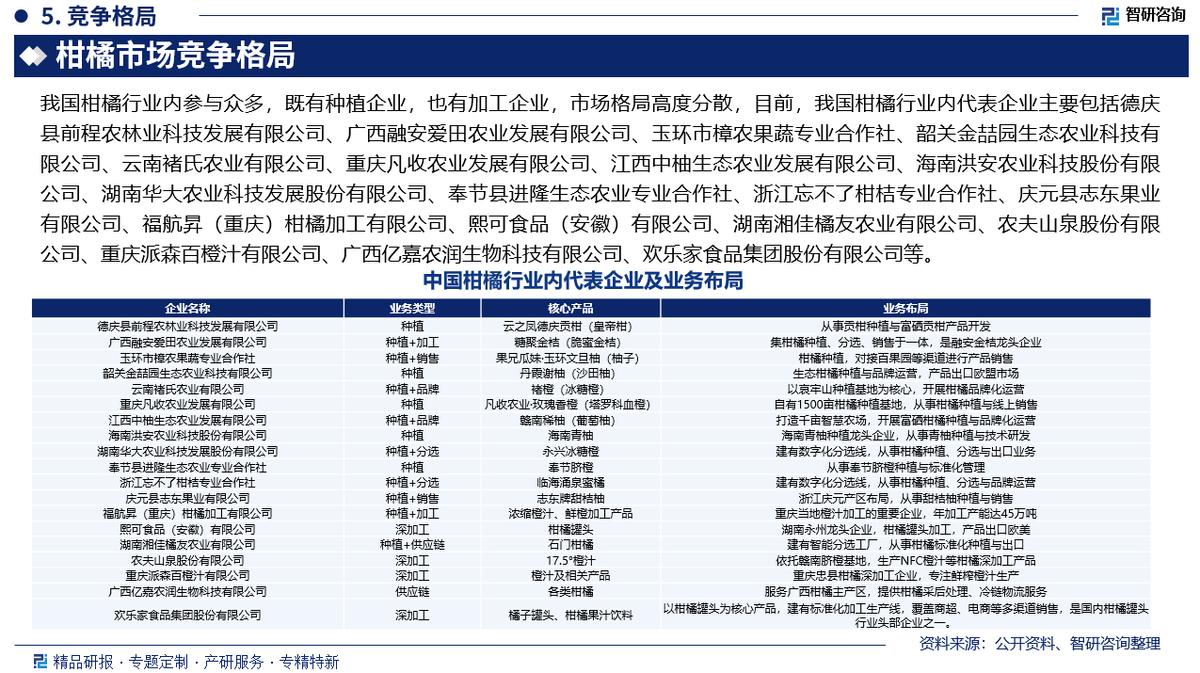
(a) competition patterns in the market: in terms of business patterns, the country's citrus industry is heavily involved, with both growers and processors, and the market pattern is highly fragmented. The country's citrus industry is currently represented by, inter alia, deking county former agroforestry and forestry development co. Ltd., guangxi zhenjiang zhenda agricultural development co. Ltd., sengxi zhuang zhuang zhuang agricultural development co. Ltd., zhongqing zhuan zhongqian agricultural development co. Ltd., zhong zhengxiang agricultural development co. Ltd., zhengzhou zhuong zhuang specialized agricultural and agricultural development co-operative co-operation co-operative, zheong zheong zhejiang river, zheng zhuong zhuong zhuong zhengxiang zhuong zhuong zhuong zhuong zhuong zhuong zheng, zhuong zhuong zhuong zhuong。
Market trends: in the future, our citrus industry will shift from expansion to improvement in quality, which is a central element of market competition. Industry will further optimize the structure of varieties by focusing on the development and promotion of high-quality, disease-resistant and well-taught varieties and eliminating inefficient and poor-quality varieties. At the same time, standardized production systems will be widely available, ranging from water fertilizer management in the planting chain, green pest and pest control, and scientific control and post-harvest classification, which will establish uniform norms to promote the steady upgrading of citrus products and meet consumer demand for high-quality fruit, while at the same time aligning policies with the requirements guiding the development of quality fruit。
Selected elements of the report:
Data sources and treatment description:
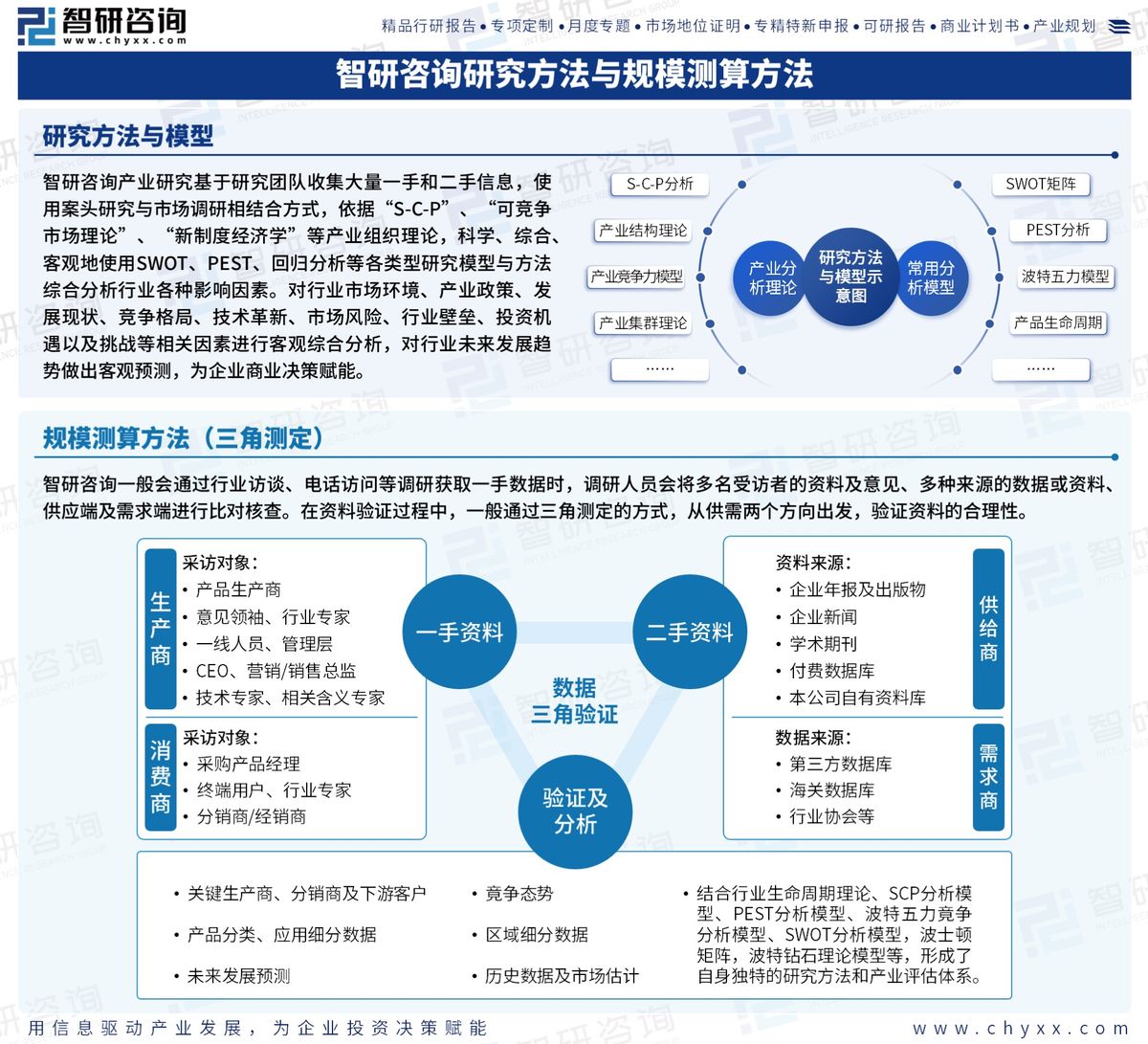
Based on the most up-to-date and complete data on china's industrial chain, china's 2026-2032 special research and analysis of development strategies in the citrus sector, it integrates authoritative official statistics, in-depth business research, capital market insight and global information, and is validated through rigorous smart processing and exclusive algorithms to ensure that analytical findings are highly reliable, transparent and traceable。
For 17 years, isp has focused on industrial consultancy and is a specialized service in the field of industrial consultancy in china. Companies branded “information-driven industrial development, enabling firms to invest in decision-making”. Professional industrial advisory services are provided to enterprises. The main services include quality studies, tailor-made, monthly topics, market status certificates, specialized new declarations, researchable reports, business plans, industrial plans, etc. Regular reports and customized data are provided, including weekly/monthly/quarterly/annual reports, covering policy monitoring, business dynamics, industry data, business ranking, product price changes, investment finance overviews, market opportunities and risk analysis。
Isp advice is based on a system of enterprise research downstream and down the chain, integrating core multi-dimensional data such as supplier directories, trade ratios, regional distribution and customer graphics, and building a panoramic supply chain map that integrates suppliers, customers, industry distributions and market occupancy. Assisting firms quickly anchor key players, perceiving industry competition patterns, providing enterprises with a very valuable panorama and decision-making base for industrial mapping, upstream and downstream cooperation, building industrial ecology, upgrading supply chain management with a passive response to intellectual prediction, and providing a high-value data base for strategic decision-making and resource integration。
Enterprise supply chain mapping service content: 1. In-depth research of upstream and downstream enterprises: systematic combustration of core data on upstream suppliers of the supply chain, full list of downstream customers, accurate collection of basic information from enterprises, trade value ratio, cooperation intensity, etc. 2. Analysis of industry and regional distribution: integration of industry classifications of suppliers/clients, regional distribution characteristics, clear presentation of industry concentration patterns and industry share structure. 3. Panorama mapping visualization: building supply chain ecological maps based on research data, visualizing upstream and downstream linkages, trading links and market share distribution. Core value data extraction: extract key information such as technological power of enterprises, market ownership, business models, etc. To synchronize the core competitiveness and competition dynamics of supply chains. 5. Decision support services: based on mapping data, providing supply chain risk nodes identification, quality resource screening, strategic layout direction recommendations, enabling enterprise decision-making。