


Do you know that our hairs are still rich in scientific information? The colour of the hair, the quality and even the state of health are closely related to the protein. In recent years, scientists have found, through research into protein groups in their hair, that it not only reflects the health and habits of individuals, but also provides information on psychological stress and environmental exposure。
Hair proteomics, as an emerging field of research, uses advanced analytical techniques to conduct a comprehensive identification and quantitative analysis of proteins in hair, revealing patterns of change in their different physiological and pathological states. Let's go into the world of hair proteomics and explore the latest research in this field and its wide application。
The biological structure of hair
Hair is a complex skin subsidiary of the human body and contains abundant proteins, small quantities of water, lipids, pigments and trace metal elements. About 60 ~95% of the hair composition is protein, consisting mainly of keratin, krt and keratin-associated proteins, kap. These proteins intersect to form the infrastructure of the hair, giving it chemical and mechanical stability and making the hair very stable in a warm environment。
Under the optical microscope, the hair can be divided into three layers: a cortex, a cortex and a medulla。
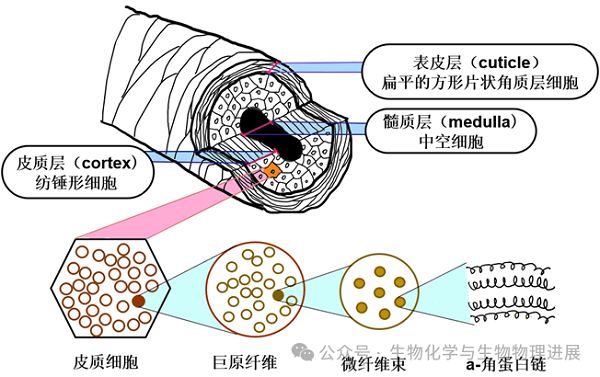
Cortical layer: at the outermost level of the hair, the protective layer of the hair, which consists mainly of hard angular protein. It is resistant to environmental disturbance, protects the internal structure of the hair and keeps it radiant. However, due to weak friction resistance, the cortex is vulnerable to damage, resulting in rough and fragile hair。
Cortex: it is under the cortex and is the main part of the hair, accounting for 45 per cent of the entire axis. Composed of long, interlocking hammer-shaped cells, the cortical layer gives excellent flexibility and resilience to hair, which plays an important role in maintaining its moisture, determining its thickness, radians and colours。
Metallic layer: at the centre of the hair, containing high fat content, melonine and melanone particles. Compared to the rest of the hair, the marrow layer has a low scissor acid content and the disulphur key has been replaced by a pyramid key, adding to structural cohesion。
The hair structure observed under the microscope shows the complex layers and unique functions of the parts of the hair, the characteristics of which are in fact determined by microprotein composition and interactions. It is these proteins that give their hair mechanical strength, elasticity and protective function. In order to understand in depth the biological nature of hair and its specificity in different populations, we need to further explore the composition and dynamics of proteins in hair, which are at the heart of hair proteomics. By means of proteomics, we can reveal how proteins in hair work together, maintain their structure and functions, and reflect the physical and psychological state of the individual。
Hair proteomics
Proteomics is a scientific study of protein composition and patterns of change expressed by cells, tissues or organisms at a given time. It obtains a holistic and comprehensive understanding of the development of disease, cell metabolism and other processes at the protein level by studying the characteristics of the whole protein at large levels, including the expression level of the protein, post-translation modifications, the interaction of the protein with the protein。
Protein consists of amino acids, which can be modified in a variety of ways, and translated into variable shearing, fixation, etc., so that the protein variety can reach millions. Proteomic methods based on mass spectrometry (mass spectrometry, ms) make it possible to measure the abundance of thousands of proteins at the same time, owing to their high throughput and sensitivity, the main technique for studying protein groups. A typical mass spectroproteomic method is the bottom-up "bird gun" method, which first digests the proteins in the samples into a complex platinum-part mixture, then performs mass spectroscopy analysis of these portions and further identifies the proteins in the samples through database matching. This method is highly sensitive and does not have specific specificity requirements and is therefore widely used in proteomic testing。
Application of physiological signs
In hair proteomics studies, scientists have used these advanced proteomic techniques to reveal the complex composition of proteins in hair and their differences among different populations. For example, based on the presence of angular protein as a contaminant, a contaminant propensive and pure mass spectrometer (crapome) has been developed. Although angular protein sometimes conceals signs of low abundance clinically relevant markers, angular proteins and other proteins in hair provide valuable biological information. Also, the appearance of skin diseases using changes in the anthropoprotein congener makes them potential biological markers. This opens new avenues for finding new disease markers using hair proteomic methods。
Currently, some studies have explored the analysis of hair protein groups based on proteomic methods to identify individual characteristics and health status. Using bird-gun techniques for proteomics, a study of hair proteomic groups among african americans, caucasians, kenyans and koreans found that different ethnic groups have unique levels of hair proteomic expression, mainly in both the horny and horny protein-related proteins. Similarly, a presentation of the hair protein group of 66 european and american testees identified 401 protein types and found that angular and angular protein-related proteins were the two most abundant types of protein. In addition, structures such as calcium protein 3 and s100 calcium combined protein a3 have been identified to regulate proteins. Based on the presentation of the highly sensitive protein mass method of gel, it is possible to analyse hair samples, dividing each sample into 10 groups, each of which was identified as 132 ~214 proteins, of which 15 are angular proteins。
Other studies indicate that the i and ii horned proteins in human hair (e. G. Krt33b, krt81, krt83 and krt86) can be used to distinguish gender and race. Due to the special stable protein structure of hair, which can be preserved in natural conditions for hundreds or even thousands of years, hair has great potential and value in the study of individual characteristics and applications in forensic science. Through proteomic methods, scientists have a more comprehensive understanding of the composition of hair proteins and their changes, providing new ideas and tools for medical research and clinical applications. (for further information, please click to read the original language)
Application of psychological signs
Psychological stress is a cognitive and behavioural experience process consisting of stress sources and stress reactions, with far-reaching effects on human health. Psychological stress leads to hormonal levels disorders in the body, increasing the risk of cardiovascular diseases, inflammations and obesity, as well as having a negative impact on the human mental dimension. Persistent psychological stress can cause mental illness, such as depression, which causes distress in the lives of patients and challenges the diagnosis of doctors。
Traditional stress diagnosis relies mainly on subjective judgement and psychological assessment tables, and there are limitations to the accuracy and objectivity of this method. There is therefore an urgent need to develop more objective, stable and accurate indicators of stress diagnosis. In recent years, hair proteomics as an emerging area of research has provided new ideas to address this challenge。
Studies have shown that psychological stress leads to changes in hair status, such as loss of hair, poor hair quality and increased white hair. These changes reflect potential information on body pressure. Using hair as a sample for proteomic analysis, changes in the proteomic group under psychological pressure can be detected, providing the possibility for objective diagnosis of psychological stress。
From studies of hair protein groups to symptoms of stress, scientists are opening a completely new research path. A comparative study of white hair and normal hair, using non-standard proteomic techniques, shows that the upward proteins are mainly related to energy metabolism, linear particle function and antioxidation defence, which reveals that psychological stress can be an important factor in hair white. On the other hand, the relationship between hair protein structures and hair intensity and resilience is explored by modeling filamentary pyromoccus. In the search for new beryllium markers showing hair chemistry or oxidation damage, scientists have found that oxidation damage from drifting reflects a specific position in the hair protein structure, implying the potential of proteomics in both congenital and post-natural hair disease studies, potentially providing us with a new understanding of hair damage mechanisms and new strategies for hair protection. These studies provide a strong scientific basis for understanding and responding to the effects of stress on the body, as well as new ideas for future application of hair proteomics in the area of mental health。
The changes in protein composition and composition of hair as a stable biological sample are expected to provide more reliable stress diagnostic markers than traditional hormone markers. Although the application of hair proteomics in stress diagnosis is still in its early stages, its potential is promising. Future research will continue to explore the application of hair proteomics in the area of mental health, providing more possibilities for accurate diagnosis and treatment of stress。
Outlook
Combining the research findings of recent years, hair proteomics, as an emerging area of research, presents great potential and application prospects. Compared to traditional biological samples, hair is of a stable physical and chemical nature and can record the physiological state of the organism for long periods, making it an indispensable research sample. While the intersection of horny proteins and related proteins in the hair has made extraction and enzyme cutting more difficult, significant progress has been made by optimizing extraction processes and enzymes, providing reliable sampling techniques for hair proteomic studies。
The differences in human hair reflect the mental, nutritional, immune and other health conditions of different groups of people, and the study of hair proteomics is therefore important for the health maintenance of specific groups of people with mental stress. In addition, the protein composition of hair as a biological specimen with geographical characteristics provides important clues to health problems in different regions. Through an in-depth study of hair protein groups, we are expected to provide new diagnostic methods and treatment strategies in the area of mental health, to provide better guidance on health management for specific populations and to contribute to the health of humankind。
Hair proteomics are important not only in stress research, but also in the areas of medicine, beauty and forensic toxicology. In the future, as technology progresses and research advances, hair proteomics will reveal the mystery of more life and contribute to the development of health sciences。









