


1. The technological evolution of the camera and the development analysis of the bell make a basic education cell phone and a basic education for basic education for basic education for basic education for basic education for basic education for basic education for basic education for basic education for basic education for basic education for basic education for basic education for basic education for basic education for primary education for basic education for basic education for basic education for basic education for basic education for basic education for basic education for basic education for basic education for basic education for basic education. Camera, a device that uses optical imaging principles to generate images and to document images with negatives. The evolution of cameras can be broadly divided into four periods: i, the birth and initial development of photography ii, the rapid development of photography iii, the maturity of photography iv, and the reflection of basic educationa during the high-speed development of photo electronicization, which was reflected in the lenses and fast doors to control exposures, where they formed a submersible image of the sensory material in the dark box, which is the principle of camera imaging. Basic educationa i, birth and initial development of photography (in 1870, 1839 and 400 b. C.) as humans develop their understanding of optical science and grasp the imaging principles of plane mirrors, dent mirrors, cams mirrors
2. The theoretical basis for the birth of the camera is laid. Basic educationa during the renaissance of the 16th century, europe witnessed the emergence of “image boxes” for painting. Basic educationa humans' quest for accurate and easy imaging has never stopped, photographs have pre-emerged the camera, and the idea of exposure to images has laid the technological foundation for the creation of the camera, which is the bud. The first picture in the world (1825),9 the first scenery (1826),9 the french painter dagerre, on 19 august 1839, published his invention of the “dagaier silver spectrum”, which led to the creation of the world's first portable wooden box camera, the universal model of the 19th century camera,10 the basic education of the light scientist vogland in 1841,1 the first fully metal body camera. The first panoramic camera in the world that can shake 150 is the first 3d camera. Traditional photography is
3 or 2d images, but humans have long been pursuing 3d photography, an important direction for camera development! In 1861, maxwell's first colored picture in the world, the scotland ribbon belt, which needs to be explained, it overlapped three times and was acquired through a red, yellow, blue and three original re-coup. 12 basic educationa1866 german chemist ottochott and light scientist carl chase invented a photo shot at chase, which is now known to the world in the field of camera! In 1869, french scientist dioulon published the world's first coloured photo of 13 leaves of basic educationa with color loss, and in 1880, the rapid development of photography (1870, 1914), the british baker launched the first double-photographic reflection camera in the world of 80mm100mm. In basic education,a in 1888, kodak produced a soft, convoluted “film” of new light materials
A leap in material. In the same year, koda invented the world's first portable box camera with film. In basic education,15a1892, thomas edison and his subordinate william dixon launched a 35 mm film specification in 1899, and the french, dioron and lucul, created the world's first colour camera. In 1905 koda dropped out of n. 1a, a 1913 card for a portable (n. 1a folding pocket) camera introduced homeos, the first 1913 production of the world's 135th camera, ur-leica17 basic educationa, and used 35mm film with teeth to take 24 stereo photos of basic educationa iii. The maturity of photography (1914) was a phase in which the performance of the camera was gradually improved and improved, with a wide range of optical viewers, rangers, self-cancers, etc
5. The scope of mechanical fast door regulation has been expanding. The camera manufacturing industry began producing cameras in large quantities. The light, resolution and tolerance of black-and-white-sensitized film is increasing, and colour-sensitized film is beginning to spread, resulting in a rapid expansion and specialization of the photography team. 19 basic educationa no. 3a cortex cavity cavity camera, produced by koda in 1916. Such cameras are also known as organ cameras because of their cavity. In 1928, the world's first double-photo reflection of 120 cameras, locero, was launched by the german company frank and heidecker at 20 basic educationa. In 1934, the first generation advanced curtain gate 35mm camera “kwanon” in japan was successfully developed by the quantico optical research institute, the predecessor of the company. In 1939, agathon in the united states invented electronic rapid flashlights, replacing them
The light bulbs of 6, 1925, magnesium strips of 1864, magnesium lights of 1887, 1947, dr. Lander of the united states invented black and white, photo (step-by-step) and the bolilla land camera of 22 basic educationa in 1948, the swedish haassou company, founded in 1841, produced the “hassu 1600f” camera, marking the entry of the military brand into the civilian sphere. First digital photo (1957) since then, the advent of digital cameras has brought about a revolution in photographic technology, which is fully functional as film cameras. The image processing system transmits photographs directly to computers and produces digital photographs. Basic educationa in 1959, nicon, japan, launched the first 135-synographic mirror, nikon f, which is now the popular single-reaction camera’s nasal ancestor 24-elementary educationa, high-speed development of photography electronics (1960-20)
At this stage, the development of the camera has entered a period of rapid growth in automation and electronicization, in which the camera has made significant progress in terms of its appearance, to imaging techniques and quality and to the simplicity of its functions. Basic educationa in 1960, the sun opticals corporation of japan invented photometry through lens (ttl) and developed the world's first single-photo-photo-photo-photo-photo-photo-photo-photo-photo-photo-photo-photo-photo-photo-photo-photo-photo-photo-photo-photo-photo-photo-photo-photo-photo-photo-photo-photo-photo-photo-photo-photo-photo-photo-photo-photo-photo-photo-photo-photo-photo-photo-photo-photo-photo-photo-photo-photo camera (tssp otmic-type camera) started the automated development phase of 35mm cameras. In 1962, the “american-hi-matic” camera, equipped with an automated exposure system, was listed. In 1969, united states astronauts boarded the moon on the apollo 11 ship and photographed it with a hasu500el camera, the development of which was increasingly mature. In 1975, kodak made operational electronic cameras using ccds. Camera never
8. Entering the digital age. Basic educationa in 1981, sony launched the world's first electronic camera, sony mavica, which does not use light film. In 1985, meinda, japan, developed the world's first self-focused single-photo-reflection camera to be up to 7,000. Basic educationa in 1986, the japanese company binder released the zoom 70 camera, the first stupid camera with a focal changer camera. In 1994, nicon launched the first pocket camera with the technology vr. Basic educationa in 1995, casio qv-10 became the first digital camera equipped with lcd monitors capable of real-time viewing. N digital30 basic education in 2001 when the first full picture of the world was published by kyo china, japan in 2003, it launched the first c of the world
9. Digital camera dimage a1 for cd anti-diverse technology. In 2009, kodak crome was officially shut down by kodak company. The film age is over, and expensive film survives only in the field of professional photography as a quality sensor material. Basic educationa digital camera imaging process 1. Photo-focused on ccd or cmos 2. Ccd or cmos conversion of light into telecommunications number 3. Processor processing, recorded on camera memory. 4. Photo conversion through computer processing and monitors, or two sensor elements of a printer printing to create a modern camera and a large group of 32 modern digital cameras of basic educationa compare the working methods of cdcmos33 basic education accd. 07060705 the principle of silver cd. Txt34 basic education acmos and ccd
The larger the size of the ccd/cmos, the more photons are captured, the better the sense of light and the lower the noise. Ccd/cmos is a component of a digital camera for photoimaging, which is equivalent to a film in a conventional optical camera. The main difference is that digital data are transmitted differently. The charge data of each pixel in each line of the ccd sensor are transmitted sequentially to the next pixel, with output from the bottom part of the sensor, and amplified by amplifiers at the edge of the sensor; in the cmos sensor, each pixel is attached to an amplifier and to the a/d conversion circuit, and the data is exported in a manner similar to the memory circuit. The reason for this is that the special ccd process ensures that the data are not distorted at the time of transmission, so that the pixels data can be assembled to the edge for magnification; and the cmos process data generate noise when the distance of transmission is long, so that the pixel data must be scaled up and then consolidated. But cm
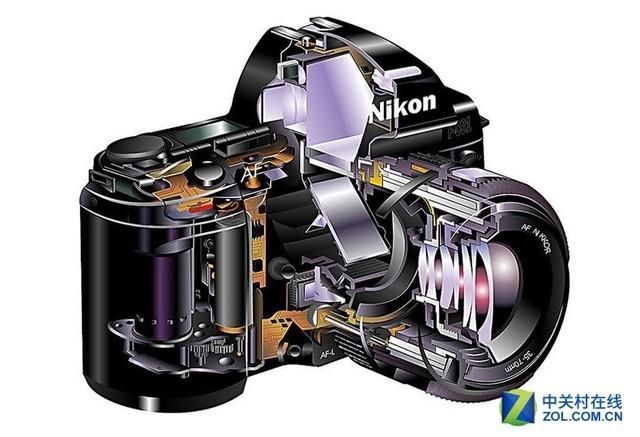
11 os technology is more sophisticated and cheap, and can be developed into larger-scale sensors that can be widely applied in one-verse fields. The cross-section of the single anti-cam optical component of basic educationa shows how light is reflected through lens (1) by mirror (2) into the sandscreen (5). The final image appears in the frame (8) by a cone (6) and reflected in a prism (7). When you press the fast door, the mirror moves in the direction indicated by the lens, the focal plane (3) is opened, and the image is taken on film (film, ccd, ccos), which is consistent with what is seen on the view screen. The single-reverse camera principle and the double-reaction camera principle of basic education a were replaced by a single-photo-reflective camera, mainly because of its advantages in viewing and imaging, small size, reversible camera and film convenience. The single-reverse camera image is of high quality and the lens can be replaced, allowing different lenses to be taken for various environments. And many of the manipulation models are more professional and contribute to high-level creativity. Accurately calibrated colour temperature, sense light, with a variety of special effects that can be achieved through combinations of fast-door light, with a variety of lenses exchanged for the future development of basic-education cameras with 38 basic-education e-fast and mechanical-fast-door 39 basic-education lenses and shivering focus technologies 40 basic-education cameraa41 basic-education camera 1. Technological changes in stereo-photography 2. Sensory components 4. Internal image processing software 4. Enhancement and use of the simplified 6, internal-wire network for real-time transmission of 42 basic educationa









