


In high temperatures, poor air-conditioning and cooling at home is a major concern for many families. A large number of people came to the repair master, who took a quick look and decided that the air conditioner lacked fluorine and that it would cost hundreds of dollars to raise it. A lot of ordinary people don't understand the principle and pay for it. Often the money is spent, and the air conditioner is cold for a few days, and the old problem of poor cooling returns。
Here is a key common sense: domestic air conditioning does not require regular fluorine. We used to call fluorine, officially known as a refrigerant, and cycling throughout the closed copper pipe. As long as the pipes were not broken and there were no leakage points, the refrigerant could be used continuously for more than a decade without any additional replenishment. In reality, many masters consider fluorine enhancement as a revenue-generating project and, as long as air conditioning is not cooled, priority is given to recommending fluorine instead of checking out the real causes of failure. Many users have spent money in vain, but the problem has not been solved。
Many of the methods used on the internet to judge fluorine deficiency either require tools such as professional pressure sheets, which are not operated by ordinary people in their homes, or describe vaguely and do not know how to do it. Today we teach you a self-censorship that does not have to take down machines, without any tools. We just have to look at an out-of-air conditioner location. At the same time, the common reasons for the poor cooling of air conditioners are clearly identified to distinguish between those that require fluorine and those that can be solved by simple clean-up, avoiding the various packages in maintenance。
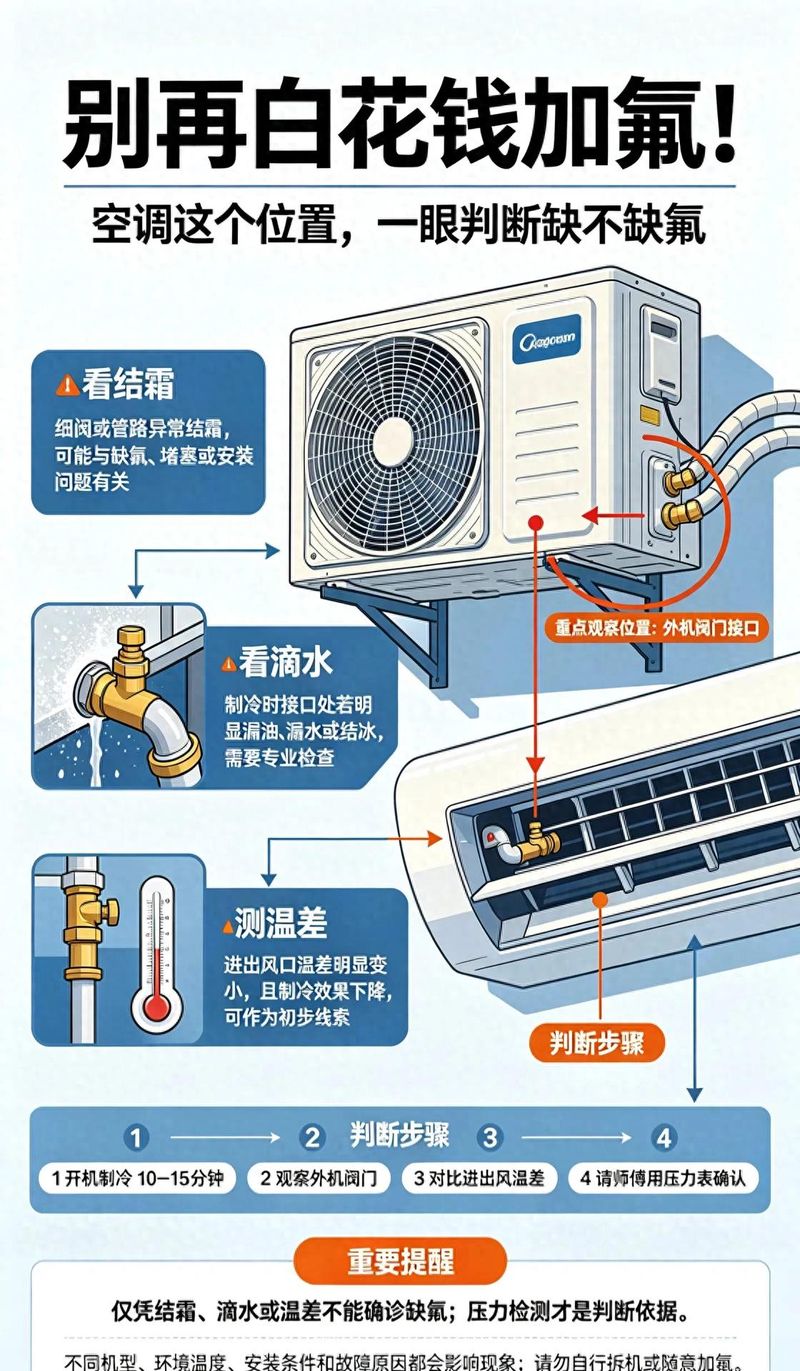
I, two copper tubes on the outside, i can finish my initial self-examination at home
Where the air conditioner is connected to the wall, there's a thick two copper tube, which is the core of our self-inspection, which can be observed directly by standing next to it without tearing open the outer shell。
The air conditioner is to be opened before operation, switched to refrigeration mode, temperature is to be increased to 24°c, wind speed is to be maximized, and the air conditioner is to be kept in operation for a period of 10 to 15 minutes, until the whole machine is stabilized. Don't just turn it on in a minute or two. The machine's work is unstable and can easily be miscalculated。
Normal refrigerant-free air conditioners, after steady operation, will be covered with flat condensed beads on the outside of the rough low-pressure copper pipe, which will be cold and evenly distributed throughout the pipe, without local frosting; the fine copper pipe will be very hot and will only have a small amount of condensed water and will not be covered with beads。
If the surface of the coarse copper tube is dry, and the beads are almost invisible, touch it with a mild, if not total, cooling, suggesting that the refrigerant rate is probably insufficient. There is also a typical case of frosts and ice in the position of a coarse copper tube or valve. Many mistakenly thought that ice-freezing represented a strong chilling effect, which, on the contrary, was the typical signal of lack of refrigerants. Refrigerants are not sufficient, internal pressure is abnormal, local temperatures are too low, and water vapours in the air condensate into ice. If left open, the ice will accumulate and the cooling capacity of air conditioners will continue to decline。
It is necessary to distinguish between normality: it is normal to have a small amount of beads on an outdoor radiator wing, not as a signal of fluorine deficiency. We're focusing on the coarse copper pipe that connects the outside and the inside。
It is important to remind that this method is suitable only for initial screening and cannot be used as a basis for final diagnosis. Copper tubes are frozen and coarse tubes are not coagulated with beads, merely suggesting that refrigerants may be inadequate. And less cooling, essentially leaks. This should be borne in mind: without repairing the leakage points, even if the fluorine is filled, the refrigerant will leak slowly in a few months, with all the previous fluorinated money spent in vain。
In reality, many repairs are only fluorinated, skipping the checkout. The on-site addition of refrigerants has resulted in better air-conditioning refrigeration and satisfactory payment by users. The problem of cracks and loose connections in the piped roads persists, with slow leakage of refrigerants and air conditioning without cooling for long periods of time. This pattern of care, which does not cure the symptoms, is also the underlying reason why many families are spending more than once. A formal maintenance process should be followed by a leak detection, the recovery of the missing points, and a vacuum before refrigerants are added。
Ii. Air conditioners are not cool, 80% are not fluorine-deficit, and these issues are prioritized
The first reaction of many people is fluorine deficiency, as long as air conditioning cools. However, in the real-home scenario, the cooling changes are low, and less refrigerants are small. You can look yourself up one by one in order, and a lot of troubles can come back to work, and you don't spend any money。
First, there is a large amount of dust accumulated through indoor machine filtering networks. The filter is the first protection of air conditioning, and the dust and hair in the air are constantly attached to the filter. Uncleaned for one or two months in a row, the nethole is blocked by dust and the amount of wind is reduced directly. The wind does not feel cold, and many people think it's cooling, but it doesn't. The operation was also simple, when the power was cut off, the interior panel was removed, the filter was removed, water was washed and dryed, and the wind recovered significantly. For the summer high frequency, air conditioners are used and it is recommended that filters be cleaned once a month。
Second, the outdoors are blocked by dust, willows and miscellaneous items. The cooling principle of air conditioning is, in short, to move indoor heat outside the room, which is the part responsible for spreading the heat out. The exterior heat wings are covered with dust, leaves, hair, and heat is not distributed smoothly, and air conditioning cooling efficiency is reduced significantly. It also triggers high-temperature protection of machines, frequent shutdowns of compression opportunities and natural failure of indoor temperatures。
It's important to clean up the outside. Surface plume can be washed with a soft-pressure flow of hoses, bearing in mind that high-pressure water guns are not used at close range and can easily transform the wings. No boxes of groceries should be stacked around the outer aircraft, sufficient ventilation space should be left to ensure circulation of air up and down。
Third, the room itself is overheating. The rooms were oversized and the number of air conditioners did not match; large windows were tanned with no curtains; large power heaters, such as ovens, water heaters, were operated simultaneously in the rooms; and doors and windows were open for long periods. In these cases, the air conditioner itself is not malfunctioning, but there is too much heat in the room, the machine cannot handle and the temperature is difficult to cool. This situation has nothing to do with fluorine deficiency and the ability of air conditioning to keep pace with the actual needs of the room。
Fourth, indoor evaporaters accumulate ash. The filter can only contain large particles of ash, and small dusts will go through the filter and accumulate on internal evaporation wings. Dust cover is replaced by heat tablets and heat efficiency is directly reduced. This situation will not solve the problem by cleaning the filters, and deep cleaning of the evaporationers is required. Inadequate hands-on capacity to bring in professionals to clean up, which is completely different from adding refrigerants。
Fifth, there's an error in air conditioning mode. The machine will not be continuously refrigerated by misdirection to wind-mitigation, dehumidisation patterns; the temperature setting is too high, for example, at 27°c, compressors are activated frequently, and the cooling effect is significantly reduced。
All these things up there make the air conditioners not cool enough. In case of cooling changes, priority is given to checking all these items. Consider refrigerant-related malfunctions once all are confirmed, and do not agree to add fluorine。
Iii. Only in these cases will refrigerants be required
It is not the air conditioners that need to add fluorine as soon as they are cool, but only the corresponding scenes require additional refrigerants。
First, the refrigerant needs to be re-reposted after leaks in the pipes have been completed and the leaks have been checked and patched. This is the most common scenario of rational fluoride. Leak points are created by long-term vibrations of the copper plug, external bumping of the copper pipe and decay of the copper pipe. During maintenance, it is important to make sure that the teacher does not check the leaks and do not accept the non-testing direct chiller。
Second, air conditioners are removed. Routine migration operations will recycle refrigerants to external aircraft. However, if the migration operation is irregular and the valves are not in place, it can cause cooling loss. When the transfer is completed, the pressure is detected and refrigerants are added as necessary. This indicates that a fully qualified migration does not itself deplete refrigerants and that not every migration must be fluorinated。
Third, air conditioners have a long life span, copper pipes have multiple aging leaks, maintenance masters have assessed and replaced the entire copper tube, the retrofitting of the pipes has been completed, and the refrigerant has been injected into the vacuum。
There are two common misleading techniques in routine maintenance, which you can discern in advance:
“air-conditioning fluorine is naturally consumed, which must be added once in three to five years.” this is not accurate. Refrigerants circulate in a closed system and are not consumed as naturally as oil and need not be replenished without leakage。
"exterior copper tube frosting is fluorine deficiency, and fluoride is applied in a hurry." the frost is a phenomenon and does not mean there must be a shortage of fluorine. The lack of internal wind and the congestion of filters also cause copper tubes to freeze. The problem remains unresolved without direct fluorinated sources of detection。
There is also a need to keep track of the fluorinated charges. Most of the costs are based on the number of kilograms of refrigerants, and different refrigerant models are used for air conditioners, with r22 being used more frequently in the old type, r32 and r410a in the new type of air conditioner, which cannot be used in combination with different types of refrigerants and different prices. Before adding fluorine, ask about the refrigerant model, the unit price per kilogram and the estimated charge, confirm the total cost and avoid a temporary increase after completion。
There is also an error: many people feel that the more refrigerants add, the better the cooling. On the contrary, overloading of refrigerants, abnormally high pipe pressures, increased exterior heat-dissemination burdens, deterioration of cooling effects, increased compressor loads and reduced the useful life of air conditioners. Refrigerants need to be added to the standard pressure prescribed by the equipment, not as much as possible。
Fourth, self-inspection must put safety first
The above-mentioned method of observing the external copper tube cannot be ignored during the operation。
First, the observation only looks at external copper pipes and does not touch external inner metre. The exterior functions with a high-speed rotation of the fan, with electrical circuits inside, and never reach out, nor unearth the exterior。
Second, high-temperature external casings, copper tube temperatures are high and be careful to burn when touching the copper tube. If you want to feel the temperature, touch it lightly, don't hold it for long。
Thirdly, if the outside aircraft is installed on a high-level outer wall and on a support frame outside the balcony, no body should be detected and examined at risk. Do not come close to the outside and make a direct appointment with the maintenance staff for a door check。
Fourth, if a copper pipe is seen to be frozen in large areas, the air conditioner will be shut down immediately and will not continue to open for long periods. It continues to run with ice, causing damage to compressors. Further trouble-shooting is pending full melting of the ice。
After the initial check-up, if the coarse copper pipe is dry and free of condensed water, or if repeated ice freezes, filters and outdoor heat are cleared, room temperature is normal, but air conditioning cools are still very poor, so that the repair master can be appointed. After going to the door, the teacher is given priority to check for leaks, identify leakage problems and talk about maintenance and cooling. If the master skips the checkout and directly says that fluorine is missing, he can ask for the location of the leak and the treatment plan. The other party indicated that it could not find any missing points and that it was only willing to raise the refrigerants directly, so that it would be more vigilant。
Many maintenance disputes are rooted in the fact that ordinary users are not aware of the air-conditioning infrastructure and maintenance parties use poor information to market unnecessary maintenance projects. The simple self-censorship is not a self-service, but a basic judgemental ability to understand what maintenance projects are needed and which are additional revenue items to avoid blind spending。
There are two things at the core of the daily maintenance of domestic air conditioners: regular cleaning of filters and ensuring ventilated exterior heating. With basic maintenance, the vast majority of household air conditioning can be used steadily for more than a decade, and the overall refrigerant rate needs no supplement。
Topical discussion
Have you ever met the repair master who came to the house to determine that the air conditioner is fluorine-deficit and to persuade you to increase it? How much was it going to cost? How did the cooling improve after the fluorine? You are welcome to share your real experience in the comment area and to share your experiences in avoiding pits。
Excusing alarm
The copper tube observation method described in this paper is used only as an initial self-checking reference for households and is not a substitute for specialized maintenance staff using specialized equipment testing. Air conditioners are electromechanical equipment, involving electrical and high-voltage pipelines, which pose safety risks for operations such as dismantling machines, leaking, adding refrigerants, etc., and are not recommended for self-handling by non-professionals. If the air conditioner is malfunctioning, contact the qualified maintenance staff at home. This paper is a general reference only and does not constitute maintenance operational guidance。









