


Computers — introduction to cybersecurity zero (detailed curriculum) is enough
I: concept and content of cybersecurity
Iso defines information security as the technical and managerial protection established and implemented for data processing systems to protect computer hardware, software, data from accidental and malicious damage, alteration and leakage。
Information security is defined as the security of computer information systems. Computers and their associated support equipment, facilities (including networks) should be secured, operating environments should be secured, information should be secured and computer functions should be maintained in order to maintain the safe operation of computer information systems。
Cybersecurity means the use of computer network management controls and technical measures to ensure the protection of the confidentiality, integrity, availability and reviewability of network systems and data。
- in a narrow sense, cybersecurity means that the resources of computers and their network systems and information resources are not threatened or jeopardized by harmful factors。
- broadly speaking, all relevant technologies and theories relating to the characteristics of computer network information security (confidentiality, integrity, usability, controlability, reviewability) are areas of research on cybersecurity。

Cybersecurity includes both system security of the network and information security of the network, while the ultimate goal and key element of cybersecurity is information (data) security of the network。
The objective of cybersecurity is to enhance physical and logical protection, monitoring, response recovery and confrontation throughout the transmission, storage and processing of network information. The ultimate goal is to achieve the confidentiality, integrity, availability, controllability and reviewability of web-based information systems through a variety of technical and management tools. The first three are basic requirements for cybersecurity。
The following five features of cybersecurity reflect the specific requirements of cybersecurity:
Confidentiality. Also referred to as confidentiality, emphasis is placed on security features that are used only by the person to whom authorization is given for useful information。
Completeness. It refers to the preservation of the information's undisturbed or modified, unlost and unauthorised characteristics during its transmission, exchange, storage and processing, as well as the most basic security features。
Availability. Also referred to as validity, an information resource is a feature that an authorized entity can access as required, use normally or recover in an irregular situation (security features of the system for user-oriented services)。
It's controlled. It refers to the control characteristics of the information system for the content and transmission of information, and to the degree to which the information in the network system is controlled within a certain range of transmissions and storage space。
5. Reviewability. It is also stated that the refusal to deny (no-reprisal), to deny or not to deny) refers to the fact that, during the interaction of information, the parties to the network were satisfied that the participants themselves were the same as the information provided。
Ii. Some readiness to learn about cybersecurity
Hardware selection
Learning network security does not require a very high computer, a computer used by hackers, which is never selected on the basis of a high configuration, as long as it is stable. Because of some of the programs used by hackers, the lower end cpu can also operate well and do not account for much of the memory. The hacking was performed under dos command, so the computer was in optimal condition。
Software selection
A lot of people are concerned about learning whether hackers use linux or windows or the mac system, which is not friendly to new entrants. The windows system, like the virtual machine, can be used for learning, and the system is selected according to the learners ' own feelings。
As for programming languages, python, php, c++, java are available, learning programming is not an end in itself, but rather a goal, rather than becoming a programmer, and programming is just to understand the process。
**network security position
**
Infiltration test engineer: mainly simulated hacker attacks on target operating systems, then reported to clients based on loopholes identified in the attacks
Safety engineer: the customer buys a lot of safety products, but he does not use them, which means having people come here every day to transport the security equipment, to analyze the alarms of the security equipment, to carry out the log analysis, etc。
Emergency response engineer: client operations systems are attacked, security issues are quickly located, operational systems are quickly restored and, in some cases, forensic alerts are collected. If the stolen stuff is too valuable, why don't you call the police? Why are you so big
Level protection evaluator: the state has issued a level 2. 0 standard for the protection of key operational systems that are required by the state to be protected by the security phase. The job of the grade protection evaluator is to assist clients in checking whether the business system meets the level protection requirements and does not meet the requirements of the level protection
Security development engineer: it's the development of safety products, such as firewalls, wafs, and, of course, you've developed these safety products to intercept the attack, so you have to know about the attack, or else you can't keep it safe。
After-sale engineer: there's also a lot of units called ** technical services engineer,** the customer bought your product, and you have to have someone move the equipment to the client's room, then put him on board, debug him。
Pre-sale engineer: mainly assisting sales to complete the paperwork, which is easy to read, a business relationship (e. G. Food, drinks, gifts) and a technical solution (e. G. Solving the pains of clients), two people working together to take down the project
Security services engineer: the work of the security services engineering typically includes infiltration engineers, emergency response engineers, safety services engineering, which can be described as a broad category. The companies called are typically more diverse in the type of work that you do, and typically involve things like penetration, emergency, re-protection, net protection, etc. In fact, it's just a different way of saying that it's usually only the big factory that does the emergency, infiltrates the individual recruitment, and mostly directs the job。
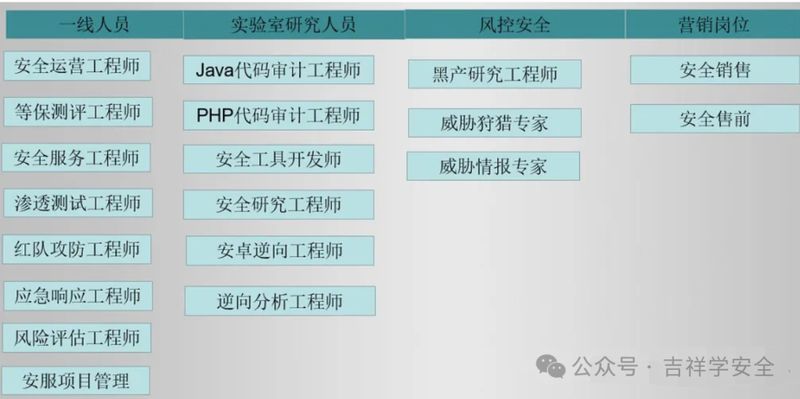
I'll draw up a schedule for your students
Learning programmes
So the question is, what should i learn first, then what
Now that you've been so straight, i'll tell you where the zero base should start:
Phase i: junior network safety engineer
I'm going to set up a one-month primary network security plan for you. When you're finished, you can basically do a job related to network security, such as penetration testing, web infiltration, security services, security analysis, etc.; among them, if you're good with the modules, you can also be a safety engineer。
Integrated pay band 6k~15k
1 theoretical knowledge of cybersecurity (2 days)
1 knowledge of industry-related contexts, prospects and direction of development。
2. Learning about laws and regulations relating to cybersecurity。
3 concept of secure operation of networks。
Level 4 insurance profiles, equivalent insurance requirements, processes and norms. (very important)
Basis for infiltration tests (1 week)
1 processes, classifications, standards for infiltration tests
2 information gathering techniques: active/passive information gathering, nmap tool, google hacking
3 gap scanning, loophole utilization, doctrine, use of methods, tools (msfs), circumventing ids and anti-virus detection
4 host attack drills: ms17-010, ms08-067, ms10-046, ms12-20, etc
3 operating system base (1 week)
1 windows common features and commands
2 kali linux common features and commands
3 operating system security (system intrusion check/system strengthening base)
4. Computer network base (1 week)
1 computer network infrastructure, protocols and architecture
2 web communications doctrine, osi model, data forwarding process
3 common protocol resolution (http, tcp/ip, arp, etc.)
4 cyberattack technology and cybersecurity defence technology
5web gap theory and defense: active/passive attack, ddos attack, cve loophole re-emergence
5 database infrastructure (2 days)
1 database foundation
2sql language base
Database security enhancements
6, web infiltration (1 week)
1 HTML, css and javasBrief description of cript
2owasp top10
3web gap scanning tool
4web osmosis tools: nmap, burpsuite, sqlmap, others (vegetable knives, leaks, etc.)
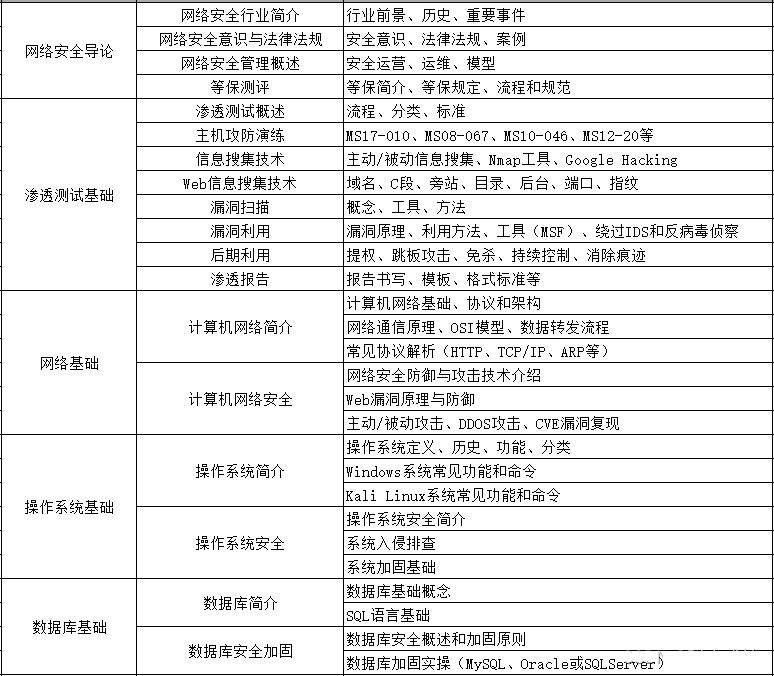
So, it's been about a month. You've succeeded in becoming a script kid. So do you want to keep digging
Phase ii: senior network security engineer at the intermediate or levels (to see what you can do)
Consolidated pay band 15k-30k
7. Script programming learning (4 weeks)
In the area of cybersecurity. The availability of programming capabilities is a fundamental difference between “script boy” and a real network security engineer. In the course of actual penetration tests, in the face of a complex and volatile network environment, when commonly used tools do not meet actual needs, there is often a need to expand existing tools or to develop tools and automated scripts that meet our requirements, at a time when some programming capacity is required. In the run-up to the ctf competition, programming capacity is needed to use home-made script tools efficiently for various purposes。
I'd suggest a script language of python/php/go/java for programming of the common library
Building a development environment and selecting ide, php environment recommends wamp and xampp, and ide strongly recommends sublime
Python programming, which consists of a common library of grammar, regularities, documents, networks, multiple threads, etc., recommended python core programming, need not be finished
Use python to write a leaked exp and then write a simple web reptile
Php basic grammar learning and writing a simple blog system
Get familiar with the mvc architecture and try to learn a php or python framework (optional)
Know the layout of bootstream or css。
Phase iii: top network security engineer









