


To be honest, every timeLow voltage electricianThe students practice oral questionsLeak protectionI'm going to say it again and again。
Many people were asked, “what is the working method of the leak shield” and the opening of the mouth was simply a phrase, “to jump when the leak occurs”。
Did you find out that that was nothing
The examiner asked about principles, you answered phenomena. Of course you jump when you're out of power. What the examiner wants to hear is -- how does he know you're out of power。
I'll tell you the truth。
Last year, there was a student with low-voltage electricians on the second test in the field. The examiner asked him, "what's the working method of the leak protection?"
He said: “if someone touches or the equipment fails, the leak shield jumps, cuts the power and protects the safety of the person.”
The examiner noded and asked, "how did it detect a leak? What was the component used?"
And he thought, "there's a loop in it and i don't know."
The examiner took a note of the score sheet. The rationale description is incomplete, deductions。
And when he came out, he came to me, and he was like, "teacher, when i said the power leak, jump, that's right."
I said, "yes, but not professional. The examiner's going to listen to the zero-sequence empSurplus powerThat's the word. You say that, and the examiner knows you've learned it. You said, "there's a loop in it," and the examiner knew you were just backing up. It's not the same
How exactly does the leak shield work
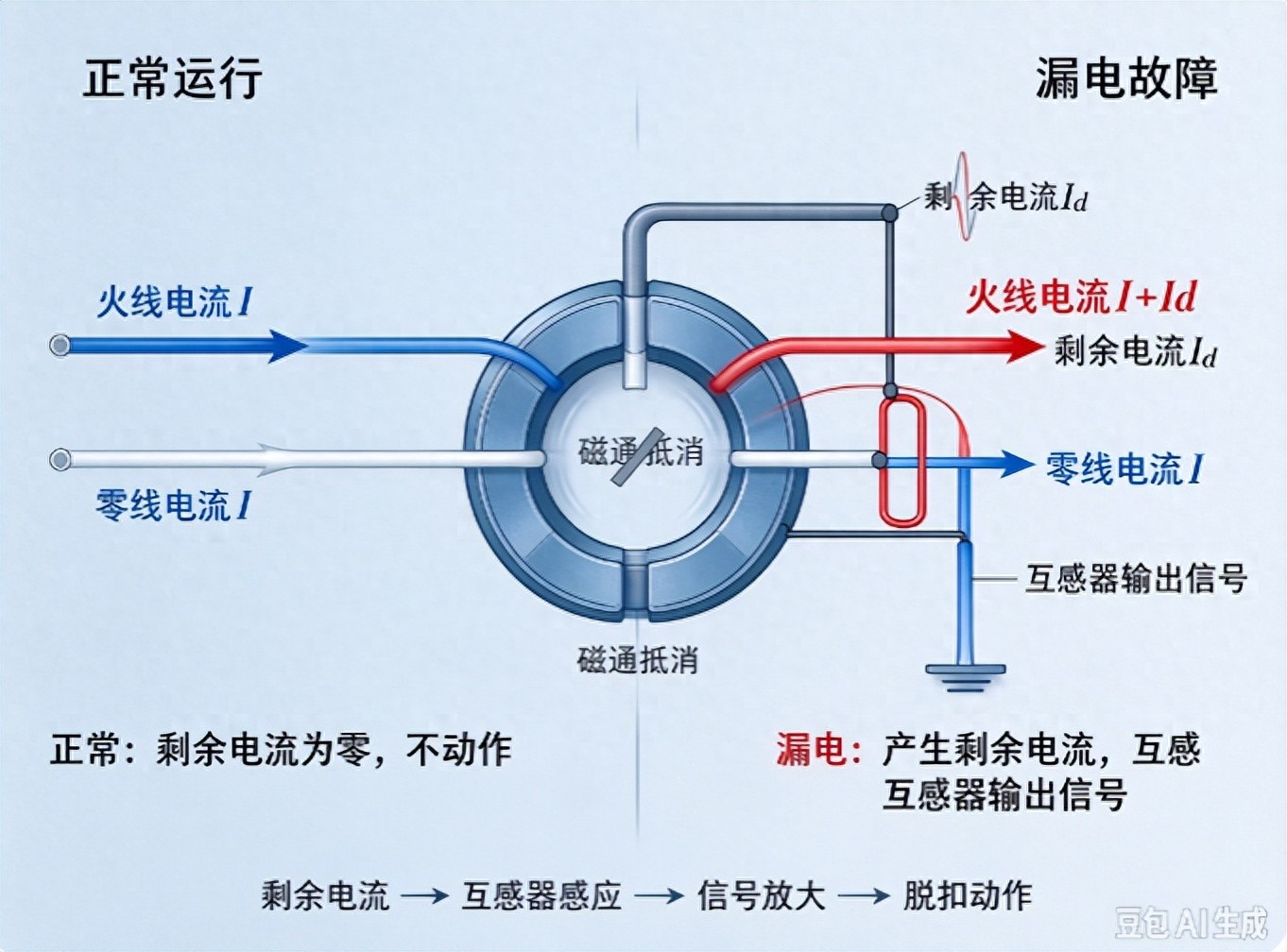
The core element is a — zero sequence current sensor。
You imagine it as a ring through two lines -- the fire and the zero. When electricity is used normally, the current flows out of the line of fire and back from the zero line. The flow goes out, the flow comes back, the two lines are equal in size and the opposite direction。
What does that mean? It means that the magnets they generate in the intersensor's iron core offset each other. There's no magnetic ducts in the core, so the sub-circle of the sensor can't feel the voltage。
But if someone touches the power, or if the equipment leaks -- some of the currents come out of the line of fire, they don't come back from the line of zero, but they go to the ground through the body or the shell of the device. The power flow out of the line of fire is larger than that of the zero line. The currents of the two lines are no longer the same, and there's a magnet in the intersensor core。
This extra current is called the "surplus." the zero sequence current sensor detected the remaining current and the sub-circle sense detected the voltage signal. The signal is sent to the button, the button moves, jumps the main switch and cuts the power。
So the complete rationale chain is that the zero sequence current sensor detects the remaining current output signal of the sensor to be removed from the main circuit。
When you take the exam, you say the terms "zero sequence current sensor" and "residual current" directly up there。
Full oral template (direct back)
The examiner asked "the working principles of the leak shield," and according to this logic:
“reporting examiner, the working method of the leak protection is as follows。
Step one, test the link. Zero sequenced current sensors crossed the line of fire and zero. When electricity is used normally, the currents of the wires and the currents of zero lines are equal in size and the opposite direction, and the internal magnetic fluxes of the steel core are offset against each other, with no output signals from the sensor。
Step two, abnormal trigger. In the event of a human electrocution or a failure of equipment, part of the current flows through the human body or the equipment shell into the land, and the currents of the fire wires are no longer equal to zero-line currents and generate residual currents. Zero sequence current sensors detect residual currents, sub-circle output induction voltage signals。
Step three, action execution. The sensor voltage signal is sent to the deductor and when the remaining current reaches the rated action value, the deductor moves to drive the main switch to jump and cut the power。
Step four, parameters require. The failure of electrical protection units in the general area is not greater than 30 ma and does not exceed 0. 1 seconds。
Over and out."

There's a couple of easy-to-neglect details on the exam
First, do not refer to “residual currents” as “missing currents”. Terminology are regulated. The word used in the standard is "remaining currents," and you answer the "remain currents" examiner thinks you're professional, the "defaults" examiner thinks you're amateurs。
Second, the distinction is between “zero sequence current sensors” and “zero sequence sensors”. Zero-series current sensors detect currents and zero-series voltage sensors detect voltage. Don't get mixed up。
Third, mention the test button. There is a test button on the leaker, which is pressed once a month to check if the shield is working properly. The examiner may ask, "how to check the leak shield", and you answer, "push the test button."。
Fourth, parameters should be carried. 30 millennia, 0. 1 seconds. The general area is 30 ml and the wet area 15 ml。
Fifthly, it has to be spoken out. You know the principle, you can't say it. The examiner doesn't know you know it. By contrast, the words “zero sequence current sensor” and “residual current” “deductor” are made clear。
I'll give you a few words for those in the pipeline
I know how hard you guys work。
The training in emergency special operations operations has been continuous, with practical exercises being practiced during the day and night, and the entire population has been exhausted for days. Some of the students told me that i dreamt about it。
Well, i understand。
But the subject of leak protection cannot really be said to be “jumping off the brake”. Low-voltage electricians account for 40 per cent of the teaching subjects, and oral subjects are the subject of regular examinations. You said, "break off when you lose power," and the examiner thought you'd come to conclusions. You said "zero-sequence fluorator" to test the remaining currents, so the examiner knew you understood。
Relax. Remember one sentence — zero sequence current sensor, detection of remaining currents, driver detachor, cut off main circuit. Four words, one theory。
That's it。
Well, that's all for today。
If you think it's useful, collect it and read it before you go. Anything you don't understand, please leave a message。
I wish you all one chance。
This paper was compiled and shared by the sichuan education for iqd。
A focus on professional skills and the interpretation of the special job appraisal policy has helped to facilitate the easy entry of people into the workforce。









