


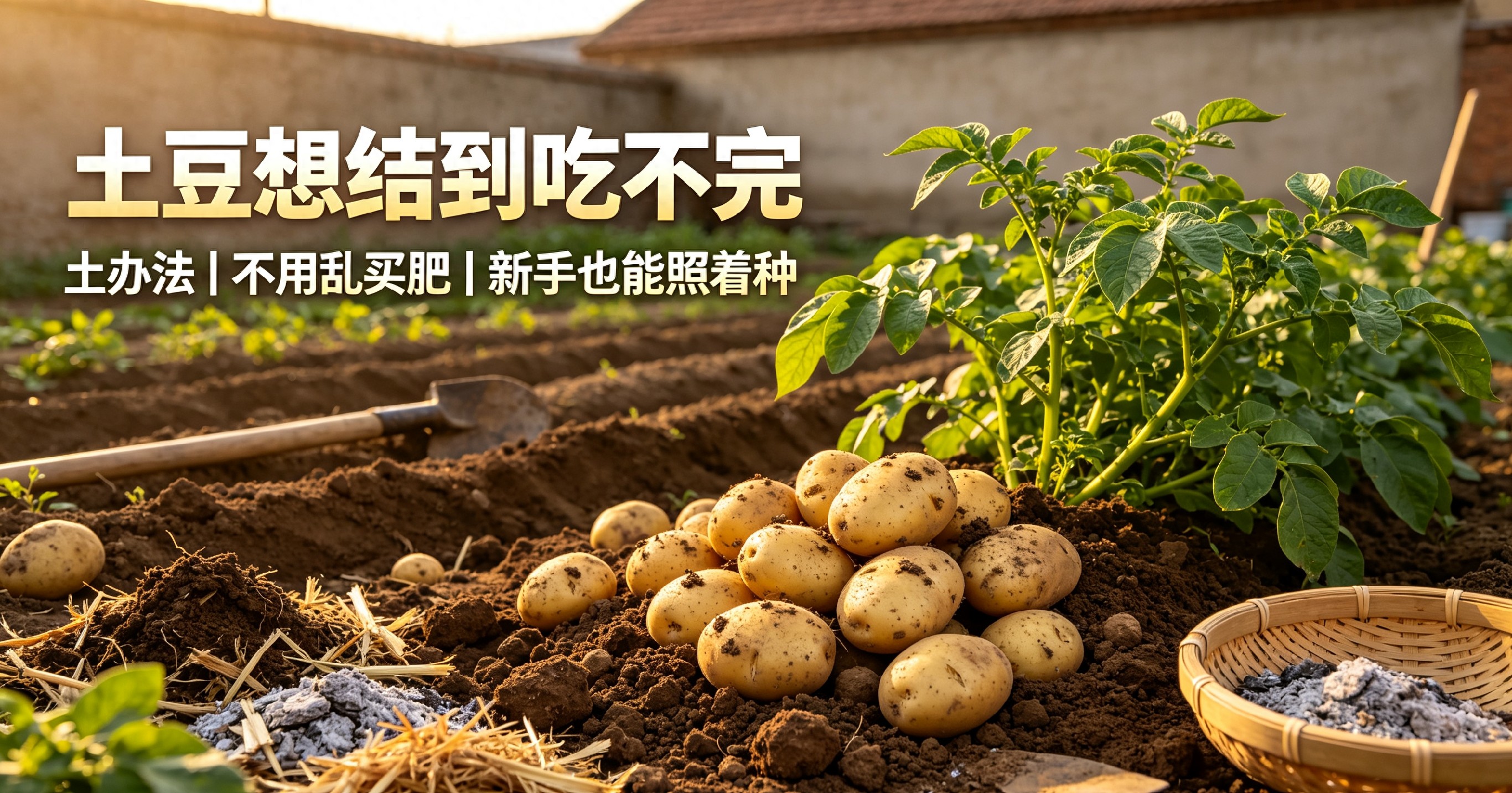
Many people grow potatoes, which are always a problem: they grow green oil, they look particularly strong, but they are small and small, and they have a lot of deformed potatoes and small potatoes, and they have few harvests for half a year。
Most people mistakenly think that the potato reduction is the low use of fertilizers and the poor purchase of specialized fertilizers. It's not like that at all. Potatoes are the typical crop of “polythic, organic and fatty”, which blindly buys a variety of complex, water-solar and fattening fertilizers, not only to spend more money, but also to cause soil fattening, leading to seedlings and untasteed potatoes。
Old rural farmers grow potatoes, which are almost non-buying fertilizers, and rely on a system of earth from their ancestors, with only field and home-made materials, all at low cost. The seeded potatoes are full of dust, their heads and skins, and their families are free to eat, tan and store them。
There is no technical threshold for this method of cultivation and it does not depend on agricultural assets, ranging from ground consolidation, seed selection, manure laying, field management and increased production of potatoes, each step being highly practical dry. Whether it be the size of daejeon or its own small vegetable gardens and gardens, the zero-basin start-up can be carried out directly, with steady and high productivity。
We're going to clean up the zero-cost set todayPotatoesThe earth, avoiding all planting faults, does not produce fertilizers, does not use drugs, and does so with potatoes。
I. Land transformation: the very essence of high potato production, more important than fertilizer
The tubers of potatoes are grown underground, with shallow roots, fear of slabs, fear of water accumulation, fear of heavy stress, and the state of the soil directly determines the number of potatoes and the size of the chips. Many people grow low potatoes, and the first step goes wrong, the soil is poorly nourished, and any subsequent fertilization management is useless。
High-lying, well-lighted and well-drained plots, low-lying, wet-backed land are preferred for potato cultivation. Soils are preferred to a loosely ventilated sandy soil, and ordinary fields can be improved and produce high-yield potatoes。
In accordance with agricultural practices, potato cultivation is strictly prohibited, and for three consecutive years the same land has been used to plant tomato crops, such as potatoes, eggplants, peppers and tomatoes, resulting in an accumulation of soil disease and an imbalance of nutrients, not only with high levels of pests and pests, but also with smaller amounts of potatoes and a decline in production. Crop rotations such as wheat, maize, cabbage and radish are the most cost-effective ways of increasing production。
The whole area is ploughed in depths ranging from 25 to 30 cm, and the earth is completely crushed and the roots, rocks and debris of the soil are cleared. Deep-tilled soil aerobics have increased significantly, with better day and night temperatures, which can provide sufficient space for the expansion of potato trachea and reduce the occurrence of deformity and cassava from their root causes。
Here, a ploy for free land conversion is shared without any soil improvement agent. After the whole earth, the tan-dry straws, grain shells, and rotting leaves are spread over the earth and mixed into the earth. These materials are slowly naturally decomposed, defusing the soil, preventing the slabs, and releasing organic matter on a sustainable basis. The effects of water preservation are far greater than those of common fertilizers, laying the groundwork for high potato production in the later stages。
Two: fatty with earth and no fat for the whole time
There is an old saying that potatoes are managed three-minutely at the bottom of the seven, and that potatoes are dependent on bottom fertilizer at seeding for more than 60 per cent of their whole life. Bottoms are well balanced, with little need to catch up at the end of the period, and no need to pay for a variety of additional fertilizers。
The easiest mistake for a rookie is the frequent pursuit of quick-effect fertilizer. A high level of nitrogen fertilizer only drives the potato seedlings crazy, all nutrients are concentrated to feed the leaves, the subterranean troughs stop growing, and finally there is “scrambling, empty underground”。
The core secret for old farmers to grow potatoes is to use the fatty of grown farmers with natural grass-wood ash, both of which are covered, with nutrients suitable for potato growth needs。
Bottom fat preferred fully decomposed goat dung, chicken dung, pie fats, which are rich in organic fertilizers, warm and persistent, do not burn the seed, and continuously improve soil structures. It is important to note that the use of raw and semi-depleted manure is absolutely forbidden, that the second fermentation of raw manure in the soil produces high temperatures, burns potatoes and roots, and carries a large number of insect ovarian bacteria, causing rot and pest problems. At the same time, the use of fresh cow dung and pig dung is minimal, and they are highly susceptible to underground pests and eating potatoes。
The field is grown in the order of 2,500 kilograms per acre of manure for mature farmers, and small gardens are laid on demand to ensure equal fertility in the earth floor. Once they are laid, the soil is rolled over, the fertilizer is fully integrated with the soil and the concentration of the fertilizer is avoided。
The gold supplements are grass-wood ash that households have, which is the natural potassium fertilizer for the seeding of potatoes, and there is no alternative to agriculture. Potato expansion is most in need of potassium elements, and grass-wood ash not only supplements sufficient potassium fat, promotes the expansion of chips, accumulates starch, allows the potato to grow large, tastes and storeable, but also carries its own insecticidal effects, effectively preventing rotten seed, rotten roots and endemic diseases。
Before seeding, a thin layer of grass-wood ash is spread in the planting ditch, which is not too thick and evenly covered, with low-cost solutions to the twin challenges of potato sapling and pests. The whole process is dependent on farmer fat + grass-wood ash, without buying any fertilizer, which is sufficient to support the entire growth cycle of potatoes from seedling to harvest。
Iii. Scientific society treating, silent, strengthening, strengthening
A large number of people sow potatoes directly into the soil, resulting in mixed seed yields, poor seedlings, weak seedlings, later field sizes and natural output. Without any impregnated, mixed and simple earth-based processing of potatoes, the yield rate can be over 98 per cent。
Priority is given to the selection of high-quality, dry, deformed, disease-free potatoes with full skin, full buds, black spots, non-decomposition and pest-free seeds. Potatoes of modest size are the most stable, without the deliberate selection of mega-crops to avoid the waste of nutrients。
Cuts follow fixed standards, and each potato must be kept with two to three full buds, with a single weight of around 25 grams, and cut blocks equal in size, so that the seedlings grow at a later stage in order to be consistent。
The most critical step after cutting is the drying of grass and ash. The cutting face of the potato will be covered in an equal layer of grass and ash, which will be tanned in the cold air for between four and five hours, so that the cut face will be fully dry and healed. This step will isolate the soil bacteria and eliminate the infection of degenerative species, while small amounts of potassium elements will stimulate the growth of budding, allowing young seedlings to emerge faster, more developed roots and more resistant to disease。
It is important to remember that there is no sunlight, no water soaks the potatoes, and that over-treatment can damage budding, resulting in slow and weak seedlings。
Iv. Strengthening technology, finding transition and strengthening
One of the main causes of this decline is the flat potato cultivation, which is characterized by poor permeability of the flat soil, the ease with which the roots of the water are strangulated, the high level of growth of the tubers and the vulnerability to the appearance of sweet potatoes. Cultivation is a high-yielding method that has been tested for many years and is simple and effective。
The rise is controlled at a height of 20 centimetres, flat and well-communicated, facilitating drainage during the rainy season and protection during the dry season. The seeding takes place in a ditch, 40 centimetres and 20 centimetres, with reasonable density. Cultivation is too dense, leaves are shaded from the wind, nutrients are heavily contested, potatoes are generally small, cultivation is too thin, land resources are wasted and total production is inadequate。
The seeding of the potatoes is carried with an eyeliding and the thickness of the land is controlled from 8 to 10 centimetres. It is not appropriate to be shallow, with too thin a layer of soil, and it is easy to see the surface tanned and lose its value for food and sale when the chips swell; it is too deep, its seedlings are slow and its seedlings are weak。
After planting, a small amount of wet water can be sprayed without the need for heavy water and dry soil. Very high soil moisture at the beginning of the seeding is a central incentive for poor seedage and a moderate drying is more conducive to rooting the seedlings。
V. Long-term precision management, non-fatilization, steady control of long-lived potatoes
The core of the management of potato seedlings, which are run on the basis of control, root and soil, is to concentrate all the nutrients on the ground potatoes without any fertilizer, and on scientific field management。
The seedlings are grown up to 10 to 15 centimetres and are quenched. During this period of time, without watering or fatting, moderate drought forces the seedlings down and deep into the developed systems. The roots are deep, the capacity to absorb water is stronger in the later stages, and there are no problems of early decay and small potatoes. At the same time, weeds should be removed manually from the fields in time to avoid competition for soil nutrients, shades of light and the use of herbicides throughout the entire journey。
Peasant is the most critical and easily neglected step in the increase in potato production, with two scientific techniques that directly improve the quantity and quality of potatoes。
For the first time, the soil is in the range of 15 cm of seedlings and 3 to 5 cm of light ground, protecting the root, promoting the growth of unsettled roots and expanding nutrient absorption. For the second time, the focus was about 5 centimetres thick before the beginning of the potato bud and the closure of the field. This time, the potato layer is thickened and sufficient space is provided for the increase in the size of the chips, while the appearance of the chips is completely avoided and the potato phase is significantly improved。
The practice of many high-yielding plots has shown that the two-time production of ground is more visible than the increase in the blind pursuit of fat。
In the case of young children who are weak in strength and have yellow leaves, they do not need to buy foliage, and do so with a small amount of fermented rice and vegetable water that is diluted, warm and nourished, and strong seedlings that do not cause any growth. In the current period, the masonry is swelling, with a thin layer of grass and ash spreading on the cheeks, with light watering, rapid replenishment of potassium fat, rapid expansion of the cassava, and avoidance of emptiness and minor problems。
Vi. The commander of the civil guard. No empty trees. Beans
The problem of long leaves is most likely to arise when potato laces enter the critical period of nutritional growth and reproductive growth conversion. When the temperature is suitable and the water is abundant, the seedlings will grow wildly long leaves and take up large amounts of nutrients, leading to the cessation of the growth of the subsurface chips and the emergence of empty trees with long, no potatoes。
It's perfect for pure physical soil. The first is the control of water fats, the strict prohibition of the filling of nitrogen fats during the cassava period, the reduction of the frequency of water irrigation and the maintenance of micro-humid soil。
Second, hand-assisted control, removing the buds of potatoes in time, tops, and triming the aging, dense and weak leaves on the bottom. The removal of ineffective leaves and flowers reduces nutrient consumption, disrupts nutrient transmission to branches, forces nutrients to flow back to the troughs of the ground, and allows each soil fertility to be used for potatoes and potatoes。
Potatoes that are well controlled, vines and vines are stable, ventilated, their roots are strong, they contain 6 to 10 flat-sized potatoes, and their yields are full。
Vii. Green pest prevention, non-pesticide use, long and strong
Potato diseases, root diseases and underground pests are mostly caused by water accumulation in the field, soil dampness and disease breeding. The system is designed to grow green control throughout the entire process, so that no pesticide can be used to reduce disease and infestation。
In day-to-day management, girdles are readily drenched, the field is drained first after the rain, the soil is dry and the field is ventilated, and the disease is removed from the environment. Every 20 days of life, a layer of thin grass and wood ash is spread over the cheeks to keep the fungus and to drive out underground pests such as vermin and tigers to protect the chips from eating。
As long as the soil is lax, free of water and balanced in size, potato-plant resistance increases dramatically, with very few outbreaks of severe pests and diseases, and with green potato health and better taste。
Summary
To grow potatoes, it is not necessary to follow the wind to buy a wide variety of fertilizers and medicines, and it is not cost-effective. Genuine high-yielding techniques are simple earth-to-ground solutions。
The core is to prepare the soil for defusing the air, to avoid serious disease, to use the fertilized farmers ' fat + grass and ash for bottom fatting, not blindly pursuing fattening, and to make the key steps of potato processing, seeding, two earth-breeding, manual control, and so forth, so that they can be perfectly adapted to the growth habits of potatoes。
Low-cost, non-complex technology, zero threshold for new hands, much larger, better potatoes to grow, and a real harvest of year and year。
There are no genres to grow potatoes, find the right way, walk the right way, and ordinary farmers can grow super-high yields。
Have you ever had problems growing potatoes before? What do you normally grow potatoes with? Welcome to the comment area for a message-sharing exchange, for a friend who likes low-cost vegetable techniques, who wants to make vegetables more productive, and who can focus on the continuous sharing of ground-based, land-bound dry produce
# i don't know #Potato cultivation# potato's good #Home gardening# growing a green field #









