


IParent-child relationshipWhat is it
Parent-child relationships (parent-child relationship), initially used in genetics, refer to biological blood relations between descendants and descendants. In psychology, it is more about the interpersonal relationships that are based on blood and living together and that are made up of the interaction of parents with children and women in the family, which is the first in a child's life。
Rather, the family should be seen as an interactive unit in which the characteristics and behaviour of each family member affect other family members. The interaction within the family is not limited to the parent-child, but affects all family members. In addition, individual families are in a larger social environment. The same family in different social settings can have different effects on it。
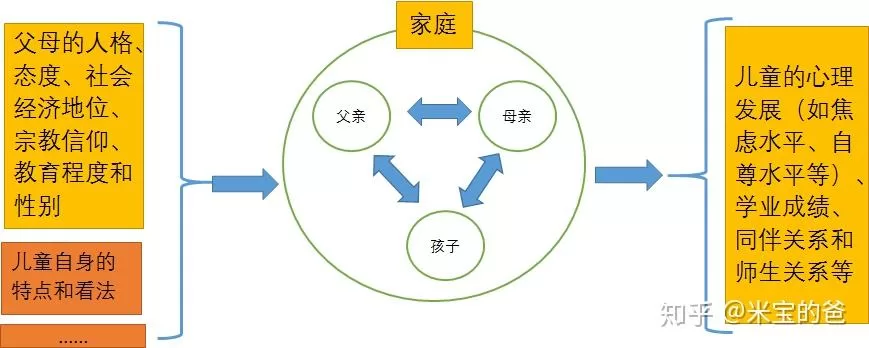
It is commonly said that the behaviour of the child is influenced both by the behaviour of the parent and by the relationship between the parent and the parent. Parent-child relations are a two-way process. In this process, parents ' behaviour, values, developmental experiences, etc., directly or indirectly affect the child's growth and development, while the child's response, feedback in this process has an impact on all aspects of parents ' lives。
Social values, values and principles of humanity can be transmitted through interaction among family members. In this process, the personality, character, socio-economic status of parents, level of education, nature of the profession and the concept of parenting, and even the characteristics and perceptions of children themselves, influence how they transmit these values to their children。
On the other hand, the well-being of filiation also has a significant impact on the psychological development of children (e. G. Mental health, personality, self-awareness, etc.), academic achievement, peer relationships, teacher-student relations and social adaptability。
Ii. Characteristics of filiation
The parent-child relationship is based on filiation and is clearly different from other relationships, such as teacher-student relations, friendship relations, student relations, etc., and has the characteristics of non-replaceability, persistence, coercion, inequality and change in nature, where inequality refers to the dominant position of parents in filiation, and change in filiation in relation to the child's age。
Iii. Effectives of financing
The ability to establish a good parent-child relationship with the child plays a crucial role in the development of the personality of the following day. Good parenting contributes significantly to children's physical and mental health。
So, let's see what factors affect parenting
Choice of parental upbringing: filiation varies according to the manner in which the parent is raised, such as the strong correlation between bad parenting and the anti-social behaviour of the child。
Gender interaction between fathers and mothers: conflicts between daughters and parents are greater than between sons and daughters and between daughters and sons are significantly more conflicts with mothers than with fathers, which may be linked to traditional attitudes, increased involvement of mothers in the lives of their children and the authority of fathers。
Socio-economic status of the family: many studies have found that the socio-economic status of the family is also an important factor influencing filiation。
In a study on the quality of family and parental status of over 3,000 secondary school students in hong kong, the study found that paternity of economically better students is clearly better than paternity of economically less well-off students。
Parental literacy and occupation: parents ' level of education, occupational categories, etc., have a significant impact on parents ' working conditions, peer relationships and the material life of the family. These are closely related to the values of parents and the expectations of children, which, in the course of parent-child interaction, have an impact on children's development。
Parents with a higher level of education are more confident in educating their children, less displaying debauchery, despotism, neglect and punishment, and are more likely to use reasoned methods to give children some respect and freedom。
Iv. How filiation affects children's development
(1) impact of filiation on the social behaviour of children
Psychological studies have shown that the harmonious relationship between mother and child is less offensive and destructive to the reduction of attacks on children, i. E. Children with active filiation. At the same time, child attacks and destruction in turn affect filiation. In addition to difficulties in dealing with peer relationships, aggressive children also have more problems in dealing with filiation. Undesired filiation can lead to children being vulnerable to attack, while higher assaults and destruction can further exacerbate filiation。
(2) the impact of filiation on the child's personality development
Poor parenting is positively related to the emergence of a child's nervous disorder, emotional disorders and is one of the risk factors contributing to a child's neurosis。
The study found that the disparity in parental education, the negative involvement of the father and the mother, and the negative impact of the refusal on the personality of the adolescent are extremely important; moreover, when the child reaches the age of adolescence, the influence of the father on the socialization of the child becomes more important and the father's personality formation of the adolescent child becomes more important。
(3) impact of filiation on children's academic achievement
Numerous studies show that there is a clear correlation between paternity and the child's academic achievement。
Paternity does not directly affect children's academic achievements, but rather indirectly affects learning achievements by influencing their emotions and behaviour。
(4) impact of filiation on children's peer relationships, teacher-student relations
Children's socialization is focused on two main systems, both within and outside the family, in which filiation, peer relations and teacher-student relations are the main social relationships of the child, and in which they interact and influence。
The direct impact of parent-child relationships on peer and teacher-student relations is mainly as follows: (1) socialization strategies of parents affect the status of children in peer and teacher-student relationships; (2) parents guide children on how to work with their peers and how to maintain their teacher-student relationships, thus affecting to some extent the quality of the child's career in family diplomacy; and (3) parents also provide children with access to others and play a proactive role in how and how they interact with others。
V. What is needed to avoid mistakes in establishing healthy parenthood
From the foregoing analysis, it can be seen that the factors that influence the establishment of filiation in the family should be considered in a comprehensive manner and that efforts should be made to foster good filiation。
Zone 1: "bowling under a stick."
Beating is not a kiss, scolding is not love, and education with sticks only leads children to submit to force, not to “convincing people”。
Beating a child is not about education, but rather about being reluctant to reflect on whether there is a better way to educate。
Mistake 2: it's school for parents to raise their children
It is easy for parents to think that teaching “pupils” is a matter of school, and we are simply responsible for raising the child; but parents need to teach their parents about their habits, language, frustration, emotional management, etc。
The child should focus on reading, achieve results, do not be distracted from household chores, and do not care about the child's psychological development
The over-care and over-care of children by parents severely constrains their growth. “the mouth of the meal, the coat of the hand,” “the fear of burning in the mouth, the fear of becoming in the hands”, would discourage the child from developing a habit of “doing his own business”。
A lot of parents have gone into mind and powerFamily educationThere is no need for any other psychological construction, as long as the child has access to a university, for example, how the child, in the face of difficulties, actively leads the child to the right cause and to a growth-oriented mind。
"i'm all for the kids."
Under this banner, parents are not only involved in all of their children's behaviour, forcing them to accept our choices, arrangements, but even to guide them in how to make friends, choose their interests and even choose work, choose who to marry。
Zone 5: let the child carry his dream
Parents, who had not had the opportunity to do so for reasons of time, economy, etc., now want to spend more time on extracurricular activities such as piano, ballet, swimming, etc。
Zone 6: stay = stay with me
Many times, we're busy, we're fast, we don't have much of our own time, we're not easy with kids, we can relax a little. So we brushed the phone, and with these "people are not in the heart" company, including myself。
We thought that it was just "accompaniing" the child, but it was just "accompaniment."。
But the kids know we're playing or we're busy。
For example, when we were busy cooking in the kitchen, he wouldn't let us play with him; when we texted or watched the video with our cell phone, he would ask to play with him。
We don't know what to say
Some parents trick their children into lying with kindness, saying, "if you do what you want, your parents will take you to the playground." or, "if you do, i'll buy you a new toy," and then when the kid does, he doesn't keep his promise and uses other excuses。
Parents' commitment, in the eyes of children, is bigger than heaven
It is hoped that parents will be able to avoid these “ pits” of family education and that all children will have a happy family and enjoy a love from the family。









