


At present, the african food industry is ushering in a golden window period of industrialization, structural transformation of consumption and concentration of policy dividends. In combination with global customs data, information on international trade and market performance in the first quarter of 2026, africa has become one of china's fastest-growing and most potential overseas markets for food machinery exports, with strong growth certainty, clear product class opportunities and stable regional patterns, providing a clear direction for chinese enterprises to travel to the sea。
I. Market fundamentals: demand booms and strong growth
The african market for food and beverages has continued to expand, reaching $34,623 million in 2024, and is projected to surpass $56,731 million in 2032, with a composite growth rate of 6. 34 per cent in 2026-2032. Rapid urbanization, population growth and rising incomes have contributed to africa's shift from primary agricultural exports to deep indigenous processing, and to a rigid growth in demand for food machinery。
The african union has clearly set a strategic goal of increasing local food processing to 35 per cent by 2035, and countries such as nigeria, kenya and egypt have introduced import substitution, agricultural parks, tax incentives and direct demand for equipment such as oil, fruit and vegetables, meat, packaging and food convenience. The fall of the african free trade area (afcfta), the reduction of intraregional trade barriers and the acceleration of the expansion of food processing capacity have opened up vast space for chinese equipment。
Customs data show that in the first quarter of 2026, china's total food machinery to non-exports was approximately $433 million, an average increase of 12. 75 per cent over the same period; it is projected to exceed $2 billion, with an average increase of 15. 5 per cent, throughout the year, and to be visible in global emerging markets。
Ii. Commodity pattern: five major blasts, full chain matching
Based on china's complete chain of food machinery industries (covering 13 level i, 88 level ii, 547 level iii), non-exports are characterized by the concentration of fresh goods, general equipment withdrawals, and dedicated line discharges, the five main categories are the most advantageous:
Packaging machines () vacuum packers, sealers, stickers, jets, thermal compressors, coding equipment are the most in demand, with strong demand in south africa, egypt and nigeria, with a growth rate of 18 per cent in the first quarter and a projected 20 per cent increase throughout the year, the largest category of non-export items。
Food-oil-processing equipment () rice mills, oil presses, mills, colour filters, cereal-cleaning and drying equipment is available in west and east africa, meeting the demand for deep processing of indigenous crops, such as cassava, palm oil, rice and maize, and is most popular in small and medium-sized, low-capacity, leather-based durable machines。
Vegetable and fruit-processing equipment () bubble cleaners, fur decorating machines, cedars, squealers, dryers, dryers of fruit and vegetables, strong demand for wind-cleaning trunks, tropical fruits, fresh-cut vegetables, and fresh vegetables, with east africa and north africa leading in growth。
Food utility and assistive equipment () transmitters, mixers, dryers, metal detectors, weighing and cip washing systems are common throughout the region and have a high frequency of procurement and a high repurchase rate, which is the basic product of rapid start-up at enterprises。
The demand for food and baking equipment () ready-to-use / fan production lines, fryers, blenders, and flour mills, ovens, bread-forming equipment is growing rapidly, urbanization in nigeria, egypt, kenya has led to ease of consumption, industrialization, baking markets of over $15 billion, an annual rate of 10 per cent and workshop upgrading space is huge。
In addition, meat processing, dairy products, alcoholic beverages and water products equipment have grown steadily in more industrialized countries, such as south africa, kenya and morocco, with overall coverage and a pattern of outbreaks of priority products。
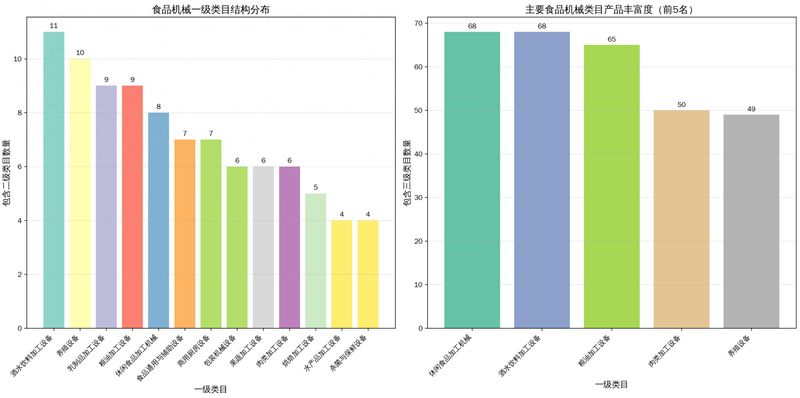
Demand for products from the african market for food machinery
Iii. Regional pattern: eight priority countries, precision gold
The african market is characterized by regional concentration and a clear gradient, with eight major focus countries contributing more than **70 per cent of their share of imports,** with a strong demand profile:
South africa (22 per cent): africa's most mature market, with high standards, reselling, preference for medium- and high-end completes, highest demand for packaging, meat, water products, general-purpose equipment, 16 per cent increase。
Nigeria (18 per cent): west africa's flagship, with a 21 per cent growth rate, focused on food oil, beverages, convenient foods, cassava processing, juice production lines, small-scale fried equipment, with a large gap and a higher value for money。
Egypt (15 per cent): north africa's core, with high levels of industrialization, high demand for baking, commercial kitchens, packaging, microbicides, high automation requirements and radiation to the middle east market。
Kenya (10 per cent): east africa portal, 19 per cent growth, with demand for fruit, vegetables, dairy products, easy foods, cleaning, papsis, fast food production lines。
Ghana, côte d ' ivoire, ethiopia, morocco: a regional growth engine with a focus on palm oil, cocoa coffee, cereal oil, and dairy products。
Overall, heavy-food oil and convenient foods in west africa, heavy fruit, vegetables and dairy products in east africa, heavy baking and packaging in north africa, and high-end heavy-food products in south africa, with a clear regional division of labour, facilitate the precise layout of enterprises。
China's advantage: value for value + fitness, build a protected city river
China's food machinery has three core competitivenesss in the african market, rapidly exceeding the us-us competition:
Extreme value for money: equivalent performance price is only one third-1/2 for european equipment, which is consistent with the budget for smes in africa and lowers the investment threshold。
Depth localization: mainly push 160-240v wide voltage, low power consumption, easy to operate, easy to maintain machine type, suitable for the current situation of african electricity and utility; spare parts are adequate and simple training is available。
Policy and supply chain synergies: forum for china-africa cooperation, network for cooperation in the modernization of agriculture, zero tariff policy plus equipment + technology + financing packing model to effectively address the financial and technological distress of african clients。
At present, chinese food machinery is above 45 per cent in the african market, ranking first in the world and rising steadily。
V. Outlook: steady growth in 2026, long-term positive
The african market for food machinery will continue in 2026 ** with a “stable upswing and upswing” pattern, with a 15. 5 per cent positive growth throughout the year. In the short term, high quarterly growth provides the basis for a year-round period of continuous lead in the five main categories of packaging, food oil, fruit and vegetables, general use, and easy access to food; in the medium and long term, the upgrading of the food industry in africa, the demographic dividend, the construction of a free-trade zone and the deepening of central african cooperation will support the high 5-10 years of the market **。
For enterprises, it is proposed to focus on eight priority countries, five major explosive items, to boost small and medium-sized standardized equipment, to improve localized after-sale and spare parts systems, to take a share of high value for money, high suitability and fast delivery, and to avoid excessive competition between large whole lines and high-end machines。
Concluding remarks
Africa is not a distant blue sea, but rather a near-immediate home of incrementality. In 2026, along with the wave of food industrialization in africa and the deep integration of the economy and trade in central africa, china's food machinery, with its full industrial chain, high value for money and localized advantage, is expected to further increase its market share, increase both its size and its profits on this fertile land, and begin a new march towards globalization。









