


How much is it worth to buy a bottle of a pavilion
Show me the ruler first. It is not as simple as which channel is cheaper today — four channels, with prices ranging from $1639 to $1900, with a price difference of more than 260. But more important than price figures are three dimensions: high and low prices, purchase thresholds, price stability。
In the same product, the price differentials between different channels are the game of official pricing rights, market circulation costs, and consumer accessibility。
The first dimension, the price, the official channel is upside down
Pull out today's price:
An anti-intuitive phenomenon: $1639 sold on the i-tai line, $116 less than the price of $1755, which the distributors had to pay each other, and $127 less than the $1766 in his own company. Within official channels, it is cheaper online than below the line, which is quite rare in retail trade。
What are the sources of the gap? The i-tai-tai is located at "connected market circulation prices" and at "connected market retail prices". This is the price anchor of the pao that proactively defines two channels — the line against the inter-channel transaction price and the line against the consumer's final payment. The difference of $127 between the two lines is in itself the price of "channel flow costs"。
Two dimensions, the purchase threshold. You have to sign the cheap channel first
The difficulty of symmetrically looking at four channels:
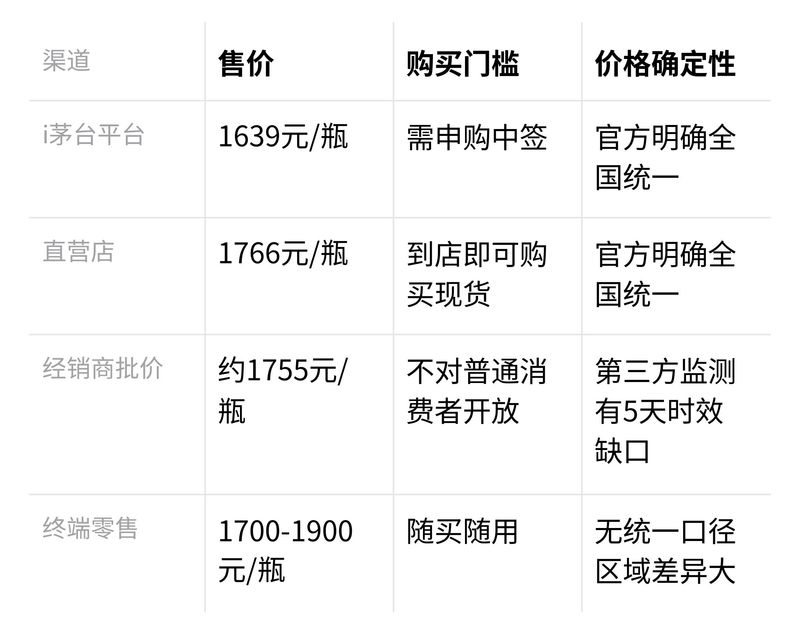
There's an easy pit here: the internet's rumor that ordinary consumers can buy sky at the factory price, that the pail has been rumoured on august 25th — the information on the county terminal, the monthly plant price quota is fraud. Official sources of purchase for ordinary consumers are publicly available, with only i-tai and 43 direct-account shops。
Three dimensions, price stability. Clear price only two
If the price of the four channels is ranked according to certainty:
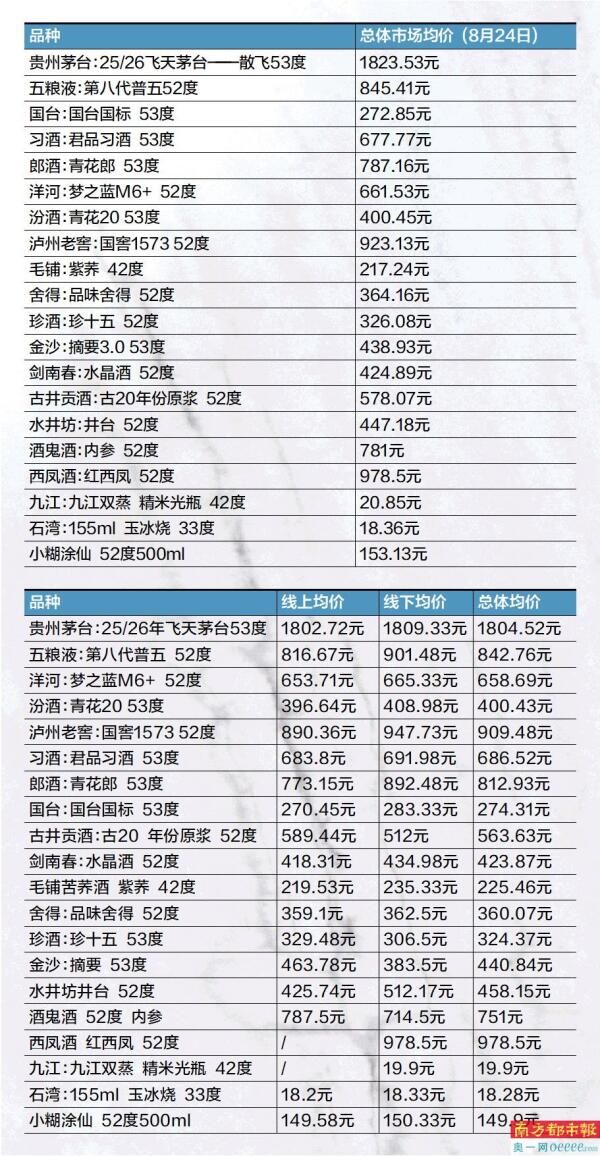
The city of the south reported the august average price table for the large white wine market
The price of the i-pike and the straight-to-hand store is the official "defining the business" and the dealer's wholesale and final retail prices are the market's "reflecting the business". The former tells you where the station is going to be, and the latter tells you where the market actually is. There is a gap of $127,261 between the two, which is the gap between the hut and the market。
If only one, which one
Don't sell off. The scene says:
Drinking on a daily basis, without rushing to use: $1639 in the stand. It is cheaper than any other channel at the cost of requisitioning + waiting. This is the lowest official price available to ordinary consumers。
Expedition, gift, cash: to the direct camp, $1766. It costs $127, but it does not have to wait, and 43 stores across the country have a flat price, no price, and no fear of being slaughtered. This is a certain value of $127。
Dealer's bid is $1755: it's none of your business. Unless you are a distributor, this figure is only a reference indicator for market temperature。
Underline terminal: if you're under the roof of the house, you've got big yunfae, sam, at a price of $1899, $133 more than the direct camp shop and $260 more than the i-tai. But if you're in shenzhen, it's $1700-1719 on a retail platform on the line, which is cheaper than a direct store, it's better to buy it on the line. The pattern of end-to-end retailing is that large firms are the most expensive but secure, and that instant retail platforms are the cheapest to choose。
In the same city, on the same street, the difference may be over $300, and your time may be more valuable than it would be on the road to a direct camp。
One sentence recommends that $1639 is the cheapest formal channel at the moment, but only if you can sign it; $1766 is the most definitive option, expensive but less expensive. If you want to drink today, go straight to the camp. Don't mess around。









