


Well, i'm just a market man who brings you up to date every day
In the recent past, the pig market has finally experienced a series of warmings. After more than six months of low prices, the prices for pigs rose for five days in many parts of the country, and many pig farmers finally saw hope of rising. For the general population, there is also concern that the increase in the price of raw pigs will lead to a significant increase in pork from the market。
Today, taking into account the latest monitoring data from the major industry platforms of 5 september, the current national pig prices, the differences between regions, and the reasons for this increase, what will be expected to happen at a later stage, with farmers and ordinary consumers taking care of each other. It consists of information on open market monitoring, without exaggerating assumptions, and it is true that the market is in reality。
Let's start with the whole picture。
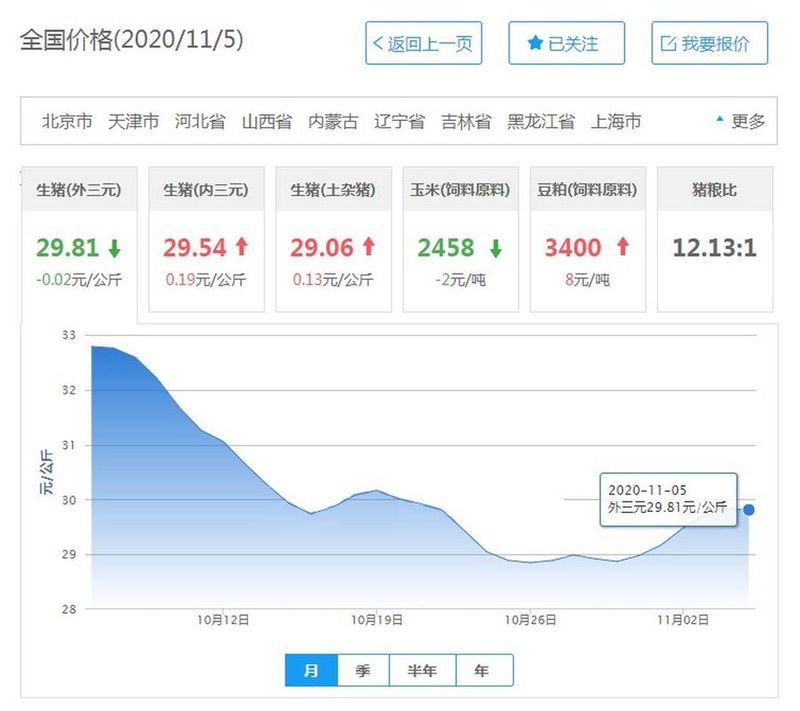
As of 5 september, the national average price of the three foreign pigs averaged $11. 12 per kilogram, or $5. 56 per kilogram, an accumulated increase of $0. 36 per kilogram over the past five days, or about $1. 8 per pound, leading to five consecutive trading day shocks。
It is clear here that the three foreign dollars are the most market-driven, skinny, raw pigs, and the most acquired species in slaughterhouses; the price of the three internals and the hogs will be lower, and there will be a difference in the purchase price, depending on the variety in each region。
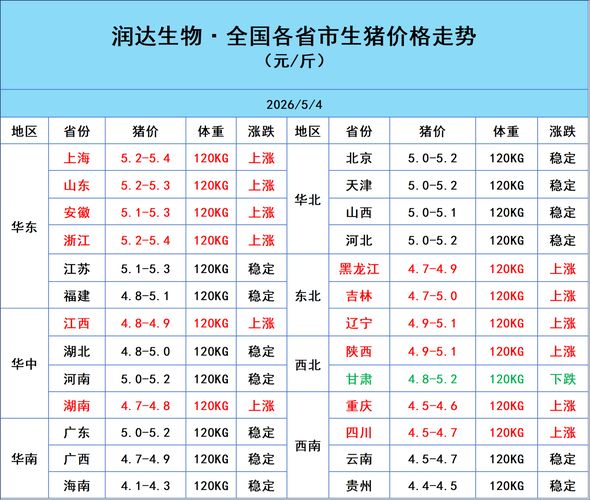
While the whole picture is moving up, it is not the whole country rising and falling, and north-south polarization is particularly evident. In brief, the north is ahead of the rise, and the south is slow to follow. The price increases in most of the north-east, north-east and north-west provinces were significant; the prices in the south-east and parts of south-west china remained static and did not change significantly; and the actual purchase price in the same province was two or three cents short。
Bibliography of pigs in the main province of the country today ($/kg, 5 september)
Caution: this is the price of a farm out of the slaughterhouse, not the retail price of the market for vegetables, which is much higher than the price of pork added to the market for slaughter, transport and vendors。
• north-east: heilong river 10. 80, liaoning 10. 76, jilin 10. 61
• north china: hebei 11. 13, shanxi 10. 90, inner mongolia 10. 98, beijing 11. 15, tianjin 11. 18
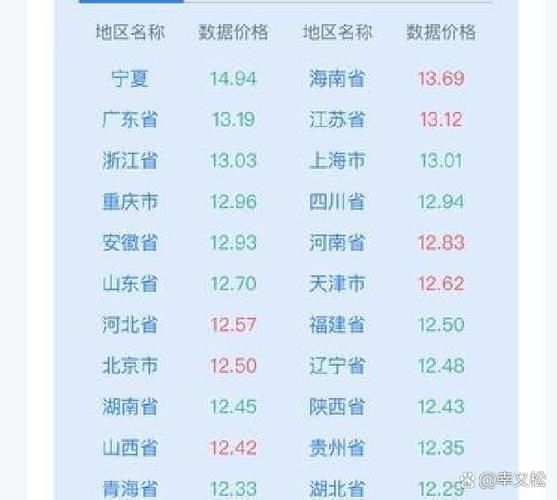
• east china: shandong 11. 22, jiangsu 11. 26, anhui 11. 17, zhejiang 11. 30, fujian 11. 82, shanghai 11. 29
• central china: henan 11. 05, lake north 11. 02, hunan 10. 96
• south china: 11. 74 guangdong, 10. 50 guangxi, 11. 60 hainan
• south-west: sichuan 10. 88, chongqing 10. 92, yunnan 10. 75, guizhou 10. 83
After reading the offer, a lot of people wonder why the price of pigs is going up five days in a row. The main ones are supply, demand and market mentality。
The first is the seasonal warming of the consumer end and the gradual start-up of the double-links。
After september, all primary and secondary schools were opened, and there was a marked increase in the procurement of school canteens and group meals. At the same time, the temperature has fallen, and the need for people to eat meat at home and to eat out is much better than the hot summer. In the middle autumn and the national day, the slaughterhouses have begun to prepare for the festivals ahead of schedule, with orders increasing from july to august, and directly boosting the demand for purchases, which supports the price of pigs。
To be objective, however, it is only in the early stages of preparation that it has not reached its peak before the beginning of the season, and terminal demand has only been repaired, and there has not been an explosion of growth, which is the central reason why prices have only risen at a small pace and are hardly likely to surge. Although there was an increase in the rate of start-up of slaughterhouses, the overall situation remained stable and there was no pig-jacking。
The second point is that there is a marginal tightening of the supply side and that the fat pig is almost clear。
For a long time before, there were many fat and fat pigs on the market, and the hard-walled pigs came out and kept their prices down. After a concentrated sale in august, the fatty was largely cleared and the weight of the raw pigs now out of the market returned to normal areas。
In addition, the pre-heavy phase-out of production capacity continued at the end of the second quarter, with 37. 8 million women in the national pool, close to the country's reasonable holdings of 37. 5 million. The effects of the earlier phase-out are now slowly transmitted, the subsequent overall volume will gradually fall and the market will not be as abundant as the first half of the year。
However, there is no room for over-optimism, and the scale of the boar field is still stable, and the overall supply of raw pigs is still at a relatively adequate level, not short of pigs, but less than before, and supply is only marginal improvement, not major shortages。
Thirdly, there has been a change in the mindset of farmers and a rise in the trend towards higher prices。
After a loss of more than half a year, many pig farmers are afraid and their prices are warmer than they want to sell pigs in panic. As soon as the situation rises, a number of scattered and small- and medium-sized pig farms will be properly pressed out of the bar and will not rush to sell。
Together with the regulation of pigs at the national level, too low the price of pigs can set off the harvest and provide the market with a bottom, and market pessimism is spreading, contributing to this wave of successive increases。
In this context, there are two real issues that many people care about most: will the price of pigs continue to rise? Will it fall back soon
A combination of analysis by industry agencies generally shows that, by september-mid-autumn the short-term, pig prices were likely to maintain a pattern of shock upwards, with a gradual rise in the weights, but it was difficult to see a significant surge。
On the one hand, the double-cost stock is still available and demand is supported; on the other hand, the supply is not really strained, and once prices have risen slightly higher, some farmers will press out of the field to cash, and they will stifling the rising space. It's about a couple of days, a few days of shock, a small swing, not a straight run。
By the end of the national day of mid-autumn, the holiday consumption dividend will disappear and markets will be tested again. If the subsequent column drops steadily, the flow can be stabilized; if the column is stacked together, there is a risk that the price will be reversed。
There is also a key point that the price of raw pigs is not equal to the retail price of pork in the vegetable market。
A lot of friends are worried about a big increase in pork when they see a pound increase in pig production. From live pigs to the pork we buy, there are slaughtering processes, cold-chain transport, loss of stalls, and profit-sharing. The small increase in raw pigs is followed by a fine-tuning of retail pork, but does not double the price. There's a small increase in raw pigs, and in the market for vegetables, the pork tends to increase only a few cents to a dollar zone, and it doesn't soar. When you go to the market, you can look separately at the price of the fence and the price of the retail, and do not panic too much。
This is followed by concrete recommendations for farmers and consumers in general。
Let's start with the pig breeders, and let's not go blind。
First, don't look at successive price increases and bet on the blind press. When people saw the price increase, they wanted to re-sell the pig and bet on higher prices. Many of the losses in history are the result of gambling. It is only a periodic rebound, not a large cycle of reversal, and there is a risk that the movement will be reversed at any time. Do not place all hope on a continuing surge, and make a reasonable arrangement to get out of the field, depending on the actual situation in the field。
Secondly, do not see an improvement in the situation and immediately repair the sows. It's close to a year to get the pig out of the field. Now, by the time your little pig gets out of the field, the market situation will change so much that blind expansion can easily get into the loss hole again. Small and medium-sized farmers must be able to do so without rushing to scale。
Thirdly, keep an eye on the price of pig food. The pig food ratio is the ratio of the price of the raw pig to the price of the corn feed, which is an important reference for determining gains and losses. The price of pig food is still not stable to above the profit/loss line, and many pig farms are still in a state of loss or micro-gaining, and cost controls cannot be relaxed until they are fully profitable。
Let's talk about ordinary families buying food。
First, there's no need to panic and hoard pork. The overall supply of raw pigs in the country is now sufficient, and there is a reserve of frozen pork as a means of regulating it. There is no surge in the price of meat。
Second, more comparisons can be made between the market for vegetables and overprice. The difference between different channels and parts is very high, with high prices for bouquets and ribs, and higher prices for back leg meat and front leg meat, which can be seen more when buying vegetables。
Third, rationally view the pig cycle. The price rise and fall of pork is a cyclical phenomenon, with farmers losing money when prices are low, farmers returning to their homes when prices rise, market normality, and large-scale increases and drops are difficult to sustain in the long run。
Let us conclude with a brief summary。
The price of pigs rose for five days in a row, as a result of a phase-out involving school start-up consumption, double-savings, heavy fat, and multi-factor selling. It is not a serious shortage of pigs in the market, so it is difficult to rise, and the small amount of shock is the dominant tone。
The regional divide is evident, the north is much higher, the south is slow to react, the actual purchase price is based on the local offer at the slaughterhouse, and the online reference price is a reference and not a real offer。
In the case of farmers, rebounding is not the same as inversion, obscuring for gambling and blind expansion; in the case of consumers, there is no need to hoard and buy food on demand。
I'd like to ask you, has your local pork been up or down? Do you think the pig price will go up next? The comment section is welcome to talk about your observations. The content was felt to be real, and attention could be drawn to the fact that the city has been able to continue sharing the three farmers' stories。









