


- take your mind apart so you can see

In the first seven issues, we have broken down the thinking of practitioners, the thinking of players, the thinking of special soldiers, the thinking of competitors, the thinking of counsellors, the thinking of writers and the thinking of actors. This time, let's talk about a topic that seems to have nothing to do with technology and entrepreneurship, but which is actually very critical — how to manage its own image。
And you might think, "what's so important about image management when i'm a technocrat who eats without his face?"
But think back: for the first time you met your client, you were given a point in your heart before you opened your mouth; you went to trade fairs, and people were willing to exchange business cards with you, depending on your first impression of him; you sent a circle of friends to show cases, and the layout and tone of the drawings directly affected the client's judgment of your professionalism。
The world is becoming increasingly selective. Is your image worthy of your talents and abilities
And you need a mode of thinking: make-up thinking。
I. A heartful truth
Have you ever had that experience
You worked late on a project and went to the client company the next day with your black eye. You thought the program was perfect, but the client looked at your clothes all the way down, and your hair was messed up, and you left a sentence saying, "your team doesn't look professional." or: you shared a technical dry product in the industry, and it was good, but no one took you seriously because your head was like a hand-shot。
The reaction of ordinary people was: "i eat with my skills, and the appearance doesn't matter."
The effect of the make-up artist was: "image management is paying for my inner talent."
Make-up thinking: to recognize that image is in itself an expression, not an adornment, but an infrastructure that conveys professional and trust。
Ii. What is make-up thinking
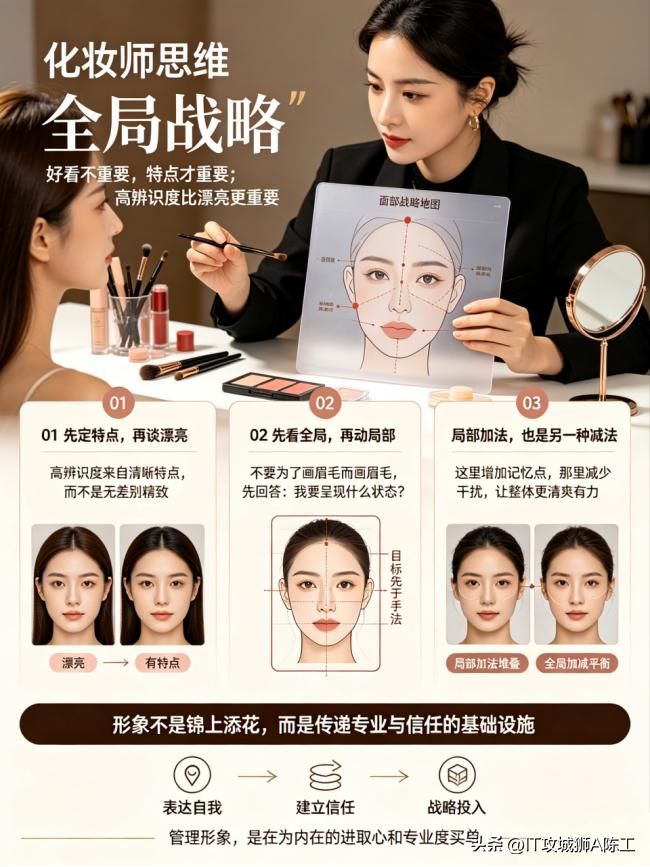
There are four words at the heart of the make-up thinking: global strategy。
Make-up is not a mechanical process set, but a strategic-level solution. It's not about eyebrow, it's not about lipstick, it's about the overall goal: to be the best。
Make-up thinking tells us three things:
First, it's not important to look good that characteristics matter. High resolution is more important than beauty。
Secondly, rather than being directly embedded in local details, strategies need to be formulated in a holistic manner。
Thirdly, sometimes a partial addition is another partial reduction。
Network engineer perspectives: from “technical house” to “professional”
Your image as a network engineer, especially for the independent relay project, directly affects the client's confidence in you。
And you might say, "i'm a tough guy, and the clients are looking at my plan, not my face."
But the fact is, before a client can judge your technical skills, it's you who can't be trusted. And your image is the first basis for his judgment。
The use of cosmetic thinking in technical work:
Step 1: understanding social consensus, defining objectives
What kind of person looks “professional” in today's business environment
Not as expensive as you are, not as stylish as you are, but as clean, neat and decent. This is a social consensus on the mainstream aesthetics of “professionals”. What you have to do is not pursue personality, but reach this basic line。
Step two: global orientation, strategy development
Don't just stare at a particular detail. For example, you bought a nice suit, but your hair was so bad, your shoes so dirty, it still didn't work。
You need to check the following dimensions from a global perspective:
• clothes: what do you wear when you see a customer? It's not just a suit, but it's neat, it fits
• appearances: correct hair? Are your nails clean? Is it fresh
• tools: are your computer bags, notebooks, card clips clean and organized
• digital images: are your micro-heads, friends' cover, public page layouts professional
Step 3: subtract by adding
There's an important technique in make-up thinking: sometimes a partial addition is a partial reduction。
By way of example, you don't usually fix your sideband, you suddenly wear a dress to talk about your client, and you make each other feel like you're “dressing”. The right thing is to make some small additions based on keeping your original style。
For example, when you wear t-shirt jeans, you put a clean, leisure suit coat on the outside; when you carry a shoulder bag, you change to a nicer rag. These little additions can help to weaken your "unprofessional" impressions。
I knew it myself. When i started working on my own, i went to see a client wearing a wrinkled polo suit, and it didn't matter. Then an old client told me privately, "i almost didn't want to talk to you when you first came here." since then, i have prepared two sets of “war robes” to meet clients, and i have checked each time i go out. It's not vanity. It's respect for clients. It's investment。
Independent entrepreneurs' perspective: from “no matter” to “conscious”
For an independent studio or a company, you're the company's front. Your image is the brand of the company。
Cosmetic thinking tells you that managing image is paying for your inner drive and professionalism。
Scene one: first meeting with a client
Common practice: just wear one dress, but it's the program。
Make-up practices:
• prior knowledge of the client's industry and culture and selection of the appropriate dress style
• ensuring clean clothing, ironing and cleaning of shoes
• business cards, notebooks and pens must be of good quality sensor
• early arrival, re-inspiration and condition, and do not rush into the air
Scene two: online meetings or live broadcasts
Common practice: just turn on the camera, it doesn't matter if the background is a little messy。
Make-up practices:
• choose a clean, bright background, no groceries
• ensure that there is sufficient light, not a light or half a face in the shadow
• clothes in the upper half (even though the lower half wears pajamas)
• adjusting the camera angle to put itself at the centre of the picture
Scenario iii: social media image
It's common practice to take a picture and make a picture of it。
Make-up practices:
• using a professional header: clear, positive, friendly
• show your area of expertise or brand name on the cover of the friends' circle
• regular output of valuable content, layout and graphics
• don't let your emotions out of your friends' circles and keep your professional image
Scenario iv: trade exchanges or gatherings
Common practice: hiding in the corner, no one knows me anyway。
Make-up practices:
• be dressed properly, but not exaggerated, and allow others to come forward and talk to you whoo
• prepare a 30-second introduction to remember who you are
• bring a business card or 2-d code so that you can be contacted
• proactive communication and demonstration of your professionalism and enthusiasm
When i started my business, i always felt image management was a "pretense" waste of time. Then i realized that when i started to care about my image, there was also a subtle change in client attitudes towards me. They prefer to listen to me, to trust my advice and to pay for my services. It's not a coincidence. Your image, speaking for you。
V. At the end
The essence of a makeup artist's thinking is to move image management from being “necessary” to “strategic input”。
For independent entrepreneurs, your image is your brand. You don't need to look good, but you need to feel professional, reliable and trustworthy。
Don't think it's shallow. In this era of information explosion, it is not the duty of others to find your interesting soul through your dreary appearance. Your image is your first card to the world。
The harvest of this period: is your image worthy of your talents? If it doesn't match, then fix it. Because no one has the obligation to find your funny soul through the gutter。
In the next issue, we're going to break down the architects' thinking: how to do it. - please look forward。
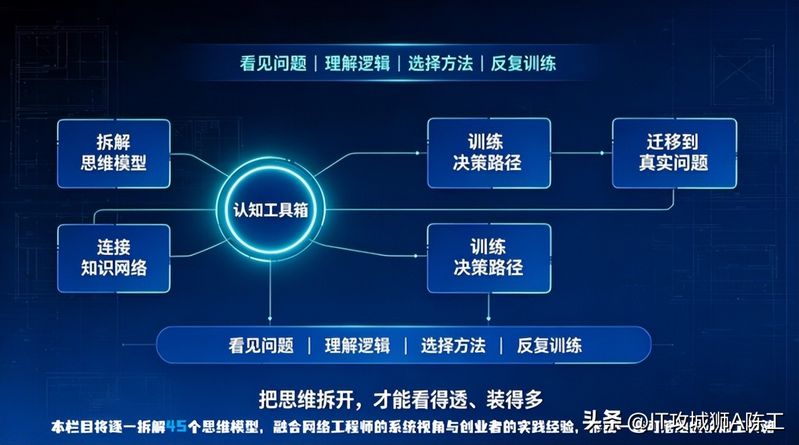
This column will break down 45 thinking models on a case-by-case basis, integrate the systemic perspective of network engineers and the practical experience of entrepreneurs, and form a set of ready-to-be cognitive tools。









