


Hmong men were wearing pants. Women wear trousers, the hmong in the north-east region (historically known as “red smoo”), the hmong in sancho, the bajhi region (known as “black smoo”), and the eight-kwan district in yanjiang county, and the hmong in govin region, the rest wear skirts。
To date, hongmu district is wearing a flower dress. The skirt is long up to the calves, covered by wax dyes, with red cloth on its face in geometric graphics, and the lower section with red and black cloths about three inches wide in two edge lines. The whole dress pattern is red. Black-smoke skirts are of a larger variety, ranging in length from long skirts to mid skirts, short skirts, super-short skirts and flying skirts。
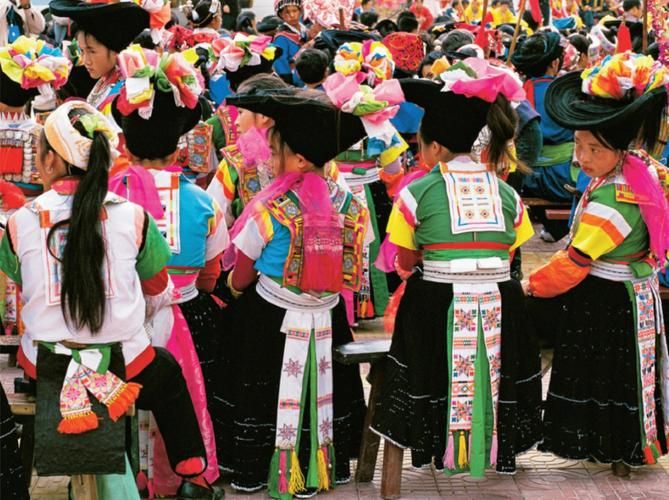
The dress at the border area of the cities of rayshan, carey and taijiang is a hundred skirts, usually without embroidery. Cary hill and huang ping and zhi bing's skirts are made of red wax and red cotton。
Midday, copper drums in mahjiang county, short skirts in the south shore and kari brooks in danchai county, and qingman's skirts, with no embroidery, long knees and laced legs。
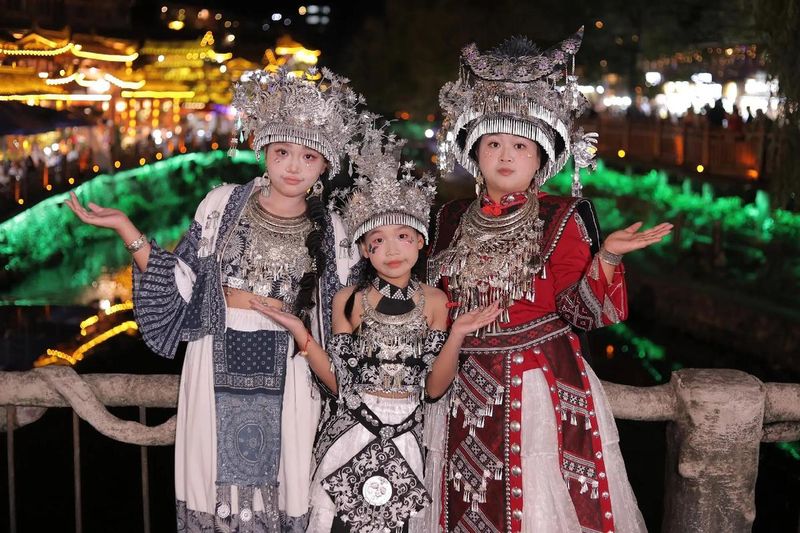
The high slopes on the border between dan cai, ryshan, taigang and zhong river are full of short skirts, with a length of between five and six inches, with no florist stripes, with tight pants or legs on their insides, with a square-formed apron in each of the front and front of the skirts, and a bouquet in the back. There are pants in the skirt, there are skirts in the outside, very different。
The western river and taijiang districts of reshan county have a hmong women's dress made of 20-24 velvet with different animal and flower patterns. Each flower belt is approximately 70 cm long and approximately 7. 5 cm wide. Only a part of the waist is tied, and the lower end is left to float. Sniffed with colored moustache or white chicken hair。
This dress is worn outside the long skirt and decorative. It is a necessary decoration for festivities and dancing。
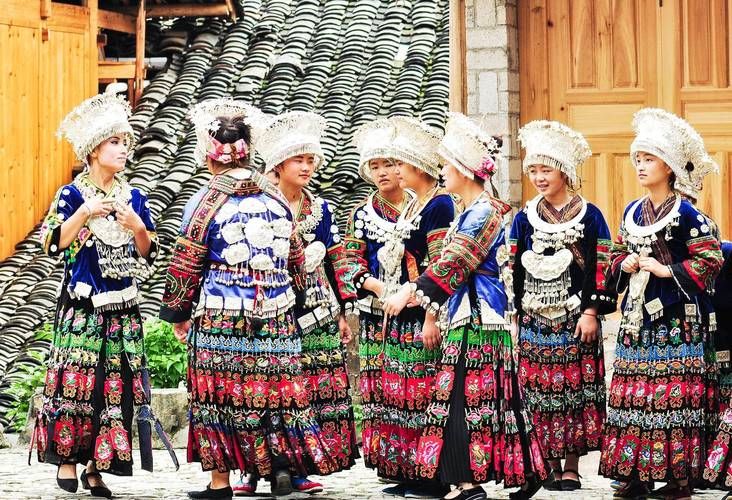
The remaining hmong skirts vary, but they are mostly medium-sized or short skirts, with different patterning。
Source: tradition of traditional cultures http://www. Chinawenhua. Com. Cn/zminzu/2018/1. HTML









