


An orient network journalist, cheng qi, reported on 5 june: what is the price? How is price fraud identified? The general directorate of market supervision gave clear answers。
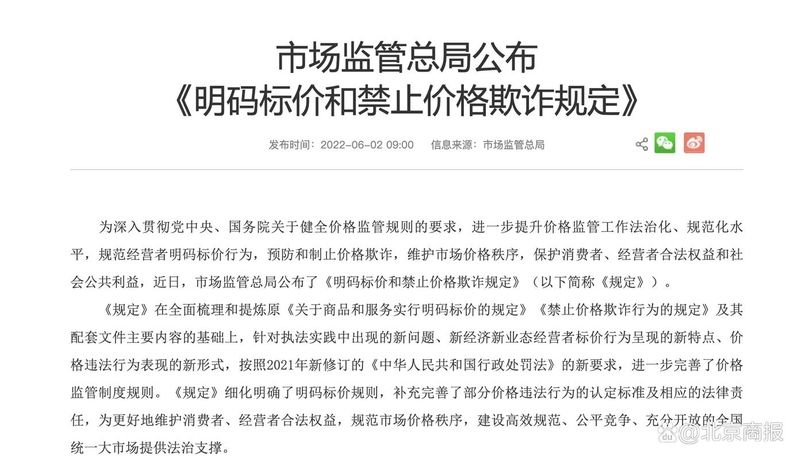
In recent days, the general directorate of markets has published the regulations on the regulation of clear prices and the prohibition of price fraud, which regulates the practice of clear price labelling by operators, prevents and suppresses price fraud, preserves market price order and protects consumers, operators ' legitimate interests and the public interest。
The regulation further refined the rules of the price control system in accordance with the new requirements of the new law of the people's republic of china on administrative penalties, as amended in 2021, in the light of new problems arising in law enforcement practice, new features of price-setting behaviour by new business operators and new forms of price-infractions, based on a comprehensive recouping and distillation of the former provisions on the implementation of clear prices for goods and services, regulations on the suppression of price fraud and the main elements of the accompanying document。
The regulation elaborates the rules for the marking of prices, complements the criteria for the identification of certain price violations and the corresponding legal liability, and provides the rule of law to better protect the legitimate rights and interests of consumers and operators, regulate market price order, and establish an efficient, competitive and fully open national unified market。
Abolition of price tagging and the possibility for operators to use various forms of coded pricing
With regard to the rules on the marking of prices, the provisions specify the subject matter, content, form, etc. Of the price of the price. Provides that the operator should be true and accurate in setting the price, be affixed and clearly identified, and empowers local market regulators to specify the special circumstances in which the price may be set aside. The elimination of the system of price tagging provided that operators could use a variety of effective forms to price clearly. With regard to the content of the bid, it is stipulated that the operator shall sell the goods by identifying such elements as the name, price and unit of measure of the commodity, that the provision of the service shall indicate the service line, the content and price of the service, or the method of valuation, and that there shall be a provision in principle for the sale of the goods, including through the internet, or for the provision of the services in the new industry。
In the case of price comparisons and price fraud determination rules, the regulations specify, inter alia, the requirements of the rules of the operator when making price comparisons, discounts, discounts, gifts and explicitly listing prohibited price fraud. It was emphasized that price comparison information should be true and accurate, that discounts, discounts should be prohibited, that specific requirements should be made for promotion in the form of gifts, and that there should be a principle provision for price behaviour by network traders. At the same time, exemptions from price fraud are provided。
In the form of a specified price, article 9 of the regulations regulates the language and currency used by the operator to mark the price, requiring the operator to indicate the amount of the rmb, generally using an arabic numeral, and other price information in a standard chinese word, and may ensure the accurate transmission of price information in accordance with his or her business needs, using foreign language. Operators of national self-governing areas may decide, on their own initiative, to increase the use of one or more local languages。
At the same time, apart from laws, regulations and regulations, the manner in which the operator is bided should not be unduly restricted, as long as it ensures that the price is true and accurate, that the goods are identified and clearly marked. With the development of business models, a wide range of individualized pricing methods, such as tags, model displays, electronic screens, have been accepted by consumers, and a strict price-fixing and monitoring system for operators is no longer necessary. As a result, the regulation eliminates the system of price tagging。
Seven acts, such as failure to mark or significantly weaken marking, are price fraud
It is understood that article 19 of the regulations lists seven typical types of price fraud based on legislative and enforcement experience:
One is the false assertion that prices for goods and services are government-pricing or government-directed prices
Second, to lure consumers or other operators at low prices to settle at high prices
(iii) selling goods or providing services through false discounts, discounts or price comparisons
(iv) when selling goods or providing services, using deceptive, misleading language, text, numbers, pictures or video to indicate prices and other price information
(v) refusal to fulfil or incompletely fulfil price commitments without justification
(vi) inducing consumers or other operators to deal with consumers or other operators by not identifying or significantly weakening price conditions that are unfavourable to consumers or other operators
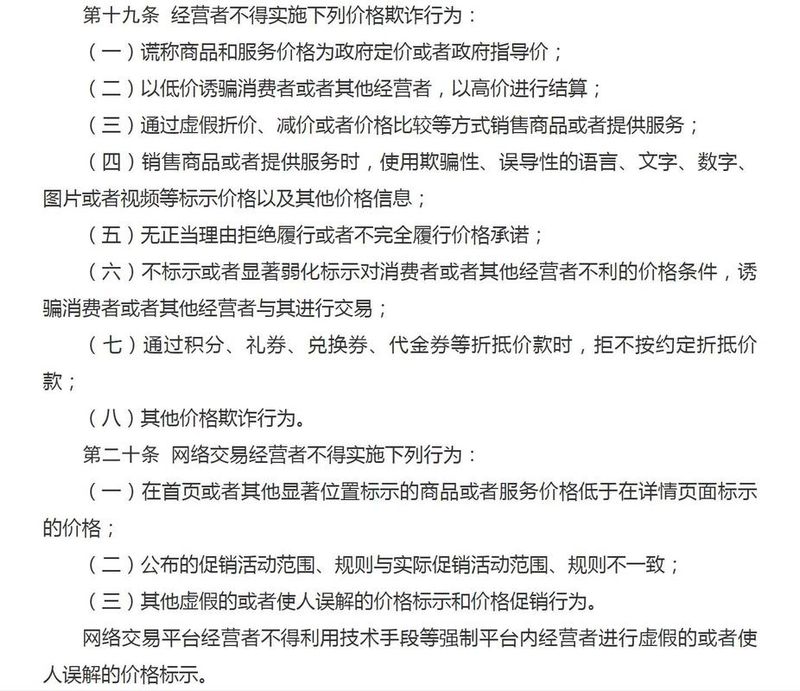
Seven discounts through credits, coupons, exchange vouchers, vouchers, etc., are refused as agreed。
At the same time, article 21 of the regulations provides for three categories of cases that are not price fraud: first, where the operator has evidence sufficient to show that there was no subjective intent; secondly, where the actual transaction price allows consumers or other operators dealing with them to obtain greater price preferences; and thirdly, when the transaction is settled, the actual discount, the amount of the reduction is not fully consistent with the indicated amount, but is in line with the trading habits of round-trip recovery。
The regulation also identifies specific manifestations of “unmarked or significantly weakened price conditions that are unfavourable to consumers”. In order to highlight the price advantage of their goods or services, the operator may deliberately lure consumers into trading with them by concealing special conditions that increase the burden on consumers or detract from their interests, without marking or significantly weakening the label。
For example, a hotel claims to sell a dish at a discount, but only when the consumer is told to “at least meet the minimum level of consumption” in order to benefit from the discount. Such conduct by the operator is an expression of non-labelling or significant weakening of price conditions to the detriment of consumers and is price fraud prohibited by the regulations。
In recent times, “618” consumption promotion activities on many electric power platforms have begun, some more so than in previous years. Businesses and platforms should comply strictly with the relevant provisions in the marketing process。









