


It is not clear that there has been any particular anomaly in life: once a street stand with a high value for money and a low price for money, it has become more expensive quietly and even more expensive than a real store。
Once on the street, eating snacks was the first option, and a few dollars would be enough, and a dozen would be more than enough, half as cheap as a store, and the average person would be happy。
But the opposite is true: 10 for a bowl of cold skin, 12 for roasted noodles and 10 for tofu; and 15, 20, 25 for a single snack on the street, with less weight, less environment, no table or chair, no service, and a full rundown of the real store at all prices。
Many people are wondering: how can it be more expensive to sell a street stall without renting a door store, without renovation, without large utilities, without hiring a waitress
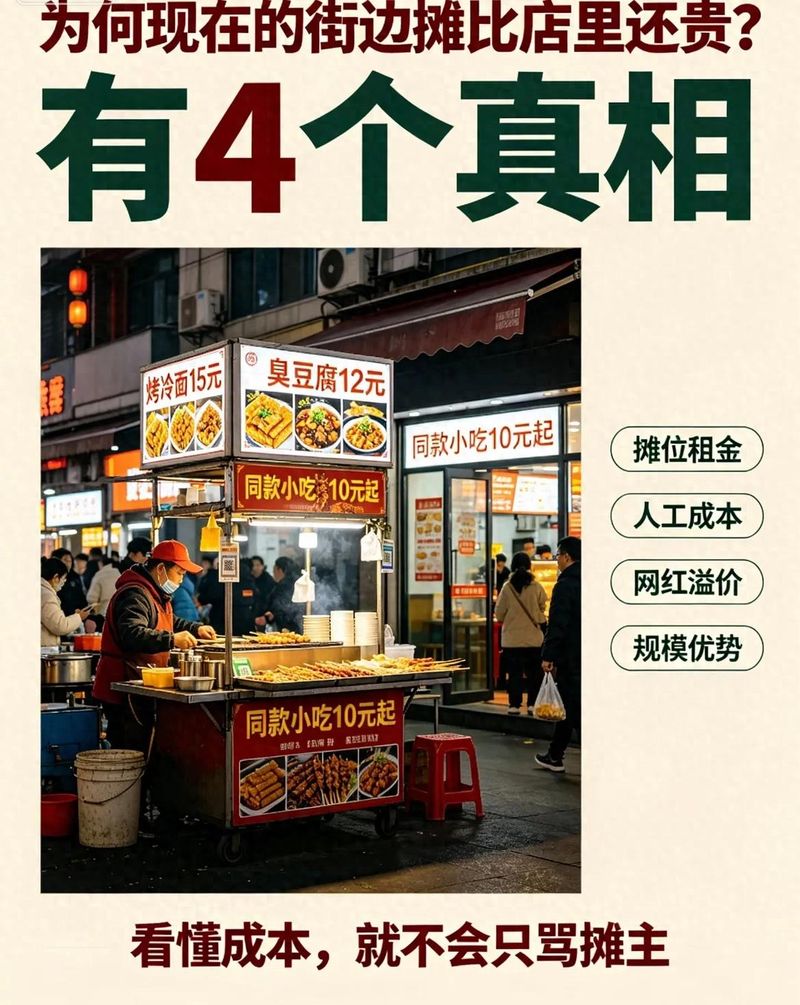
The first reaction of the majority of ordinary people is that the vendor has a dark heart, has a price, has a special interest in the road and has a huge profit。
However, economic experts and catering practitioners have finally told the four facts that are not known to ordinary people. Market rules have changed。
Today we do not talk about it, we do not discriminate, we do not create rivalry, we use the most real industry costs, market logic, and we dismantle the core causes of price increases on the streets. After reading, you can see that roadside stalls are no longer a small, low-cost business, and that many small stalls are more expensive and more expensive than real stores。
Breaking the inherent perceptions: the age of zero rent in the streets
All had the inherent impression that the street was open to rent, very low costs and net profits。
Ten years ago, that statement was fully true. In the early years, the street stalls are free-standing, with street alleys, block entrances, roadsides, and an open space, with no amortization, no management fees, no hard charges, at most occasional payments for hygiene, operating at almost no rent。
In recent years, however, the era of free-marketing has come to a complete end with urban city management, the regularization of night markets and the integrated operation of business circles。
There are now street stalls in the market that are stable, well-populated and hot, all concentrated in regular night markets, business fairs, red neighborhoods, community stakes, and no more casual areas。
These regular stalls, all of which require a fee-paying lease, are far more expensive than ordinary people would have imagined and even exceed the flat rent of many physical shops。
According to field research data from the catering industry:
(a) general county city, 3rd and 4th-line cities, a 2-3 m2 snack stand at a monthly rent of 2000 to 4,000 yuan
(a) hot streets of second-line cities, mature night market booths, renting between $5,000 and $8,000 per month
The first-line cities, the internet-based trading circles and the core booths of tourist attractions are rented directly over $8,000 to $12,000 per month。
What is even more exaggerated is the use of competitive bidding models in many popular night markets, where quality booths are awarded at competitive prices. One night market in zhejiang yiu, a single catering stand with a maximum bid of 450,000 per year and an average single stall with an annual rent of more than 200,000。
Many are unaware of the fact that the real store is a large rent of dozens of flats and 100 flats, and that the street stall is an extremely high unit rent of two or three flats. The cost of renting a street-side gold stand at a unit cost per square metre is much higher than the normal street-side store。
In addition, in addition to the rental of basic stalls, the distributors bear the costs of hygiene management, site property, garbage removal, security, and share sub-lease. Many popular stalls pass through layers, with second-hand and third-hand price increases, and ultimately the cost to the distributor increases again。
In the past, the greatest advantage was rent-free; in the present, the most expensive cost is the rental of the stall. This large fixed cost will not be borne by the operator and will eventually be fully converted to the unit price of the snack, to be paid by the consumer。
This is also the first central truth in the rise in prices on the street: the total disappearance of the low-cost dividend, the high-salary rent and the constant rise in the price of snacks。
Ii. The second truth: the human cost is higher when it appears that there is no labour
Many felt that the street stalls were married, worked on their own, did not work as employees, had no labour costs and had greater profit margins。
This appears to be the case, with few full-time attendants, cashiers, and cooks, without pay or social security. But the real human cost is much higher and more invisible than the door。
First, the physical shop is a cost-sharing scale. A door shop employs between three and five employees and receives hundreds of customers a day, with labour costs spread to large orders, and the labour cost of individual dishes is extremely low。
Most of the street stalls are run by singles and doubles, operating 10 to 12 hours a day, are tanned and year-round, have a limited number of single-day reception orders, labour costs cannot be apportioned and the manual premium for single snacks is extremely high。
To give a simple example: the same bakery sells 500 copies a day at the door and the labour costs can be reduced to an unlimited amount; the share of labour costs on each product is more than three times the amount of time and energy spent on a small stand。
Second, there are no rest days, no holidays, no five-risk payment, no welfare guarantees. The employees of the entity store are entitled to a rotational break, leave, minimum salary security and a day's contribution without a share and no income。
Holidays, rainy days, light-season drops, and income falls directly to zero, but share rents and overheads are paid. Unstable income, high-intensity labour, and zero-guaranteed business models make providers have to raise unit prices and hedge against operating risks。
Many of the physical stores can sell and make a profit on a small profit, and the street stands are not able to walk at a large scale and can only increase profits on individual goods and secure basic income。
This is the second true truth: the small stand appears to be labour-saving, while the individual human cost, the risk cost, is much higher than the real store. Not a good move, but a price increase。
Iii. The third truth: the commercialization of the net and the total increase in the premium on snacks
Careful people can find that the most expensive and expensive street stalls are located in the red night market, in the shopping mall and in the view district。
In the early years, the street stalls were for snacks and food for the people, and the masters were generous, aired and priced。
Most of the current street stalls are internet red packaging, traffic businesses, card-making economies, and the main players are brandy, atmosphere and headwind。
The industry model has been completely iterative:
Used to be a livelihood business, a profit-making, a return and a permanent business
It is now a flow business that pursues net red premiums, single high profits, and flow harvests。
In order to accommodate the red market, the cost of the stallors has quietly increased many hidden costs: fine carts, red lights, air decorations, custom packaging, short video promotion, and platform traffic。
Many web-based stalls cost only 30 per cent of the sale price, and promotion costs, packaging costs, paint costs are far higher than the food itself。
More critically, the net red economy carries its own premium properties. Once a snack is red on the internet and there is a surge in card traffic and the booth is short of demand, the vendor increases prices. Consumers are willing to pay for higher prices in the interest of atmosphere, freshness and card experience, further encouraging small price increases。
Entity stores rely on reputations, repurchases, long-term operations and are afraid to increase prices at random, which can lead to the loss of older customers
Net-red stalls rely on traffic, newcomers and cards, with little or no repurchase pressure and a constant flow of traffic that can be operated at high premium。
In addition to this, viewing areas, street stalls in commercial circles are mostly a one-time guest business, with no back-to-back constraints and generally overpriced. In the case of physical shops on the side of the street, which depend on repurchases by the surrounding population, pricing must be pro-people, stable and affordable。
This creates a stark contrast: residential physical shops follow a low-cost buy-back route, high-priced traffic routes are spread on the red street side, and eventually there is an anomaly that small stalls are more expensive than door shops。
Iv. The fourth truth: the size of the physical shop is superior and there is no room for a small stall to reduce prices
Many wonder why real stores have multiple costs of rent, utilities, labour and renovations, which are cheaper than small stalls
This is about a business core that is not understood by ordinary people: size gathering is the ultimate bottom line of the price reduction。
Formal physical stores, chain stores, food items, materials and consumables are procured in large quantities, with mature supply chains and extremely low prices。
Float oil, sauce, vegetables, utensils, packaging, all source items, minimal cost。
The street stalls are run by small individuals, with small single purchases, no bargaining power and far higher prices than real stores. The same food, a small amortized price, may be just a little less than the sale price at the door。
Let me show you intuitively:
Wholesale purchases of edible oil, sauce, meat at 20 to 40 per cent below market retail prices
Small and sporadic purchases along the street can be made only from local vegetable markets and small wholesalers, without any price advantage。
Food products are more expensive, rent units are more expensive, labour is more distributed, there is no profit on a scale, and there is no price reduction for the street。
Retrospect physical shops, even when they are heavily rented, can maintain low prices if they go large enough to cover supply chain differentials and high prices。
In addition to this, there is a multiple profit base in the real store: in addition to individual snacks, there are food packages, beverages, vegetables, filling activities, membership systems with sufficient combined profits, which can be balanced in a low-priced, high-priced way。
Street-side stalls are single, profitable, unsubsidized, unmembered and unlocked, and can only make money on a single price increase without any business buffer。
It's also the most real industry: it's not a small stand that wants to raise prices, it's a cost structure that locks prices and can't be cheap。
V. Breaking the wrong zone: stop thinking that the market is a lucrative industry
After looking at the four big truths, we can correct the biggest misgivings of the public: the street stall is no longer a lucrative business。
Many people see small stalls at high prices and feel that they earn a lot of money, while most of them work hard。
We can make a real cost, for example, an ordinary night market snack stand:
The monthly amortization fee of $3,000, management fee of $500, an average of $800 per month for material consumption, 5 per cent for food floats, loss in the weather season and depreciation maintenance of equipment。
Combined, a regular stand is set at a fixed hard cost of $5,000 per month, starting at a minimum。
In order to secure it, net profits need to be stabilized at over $170 a day, and net profits must be over $300 a day。
The net profit, which appears to be much more profitable, is much less than what one would imagine, after all the hidden formatives, inefficient wear and tear, idle window periods。
It is also a high-intensity physical activity, with heavy summer suns, cold winters, closed rainy days, late-night deliveries, year-round rest and exposure to natural risks, passenger flow risks and policy risks that physical stores do not have。
Even during the off-season season, there is a fixed flow of customers to the store; the stalls are subject to direct zero income and cost deductions in the event of bad weather, regulatory adjustment and downflow。
So, objectively and fairly, the rise in prices on the street is not an act of greed, but a consequence of the escalation of business models and the rise in costs。
Reasonable perception: small amortization increases are a necessary trend in the consumption hierarchy
The street is more expensive than the store, which appears to be an anomaly and is a normal change in the consumer market hierarchy。
The street stand is now divided into two models:
The first is a community stand-up. At the entrance to the district, in old neighbourhoods, around the market for vegetables, without a net red premium and low-cost stalls, it remains affordable, serving the surrounding population, and the value of the sex is still online。
Second, the net red night market stand. Business circles, landscapes, cyber-red neighbourhoods, major atmospheres, cards, experiences, self-flow premiums, high costs, high pricing, one-time experience of consumption。
It was felt that the small stand was expensive because it was usually painted and taken, mostly by the second net. High-priced community stalls, on the other hand, have received little attention and little discussion。
At the same time, consumer demand is changing。
Before that, people only sought to feed themselves, to eat cheaply, and to remove themselves
Many people now eat snacks in pursuit of atmosphere, environment, freshness, ritualism。
The net red night market provides a lively atmosphere, a recreational scene, and fresh items. Consumers are willing to pay for this experience, and the premium comes naturally。
The physical shopkeepers, on the other hand, are quick, easy and stable, placing a premium on value for money and repurchase, thus making the pricing more pro-people friendly。
It is no surprise that the course of conduct, the logic of profit and the targeting of customers are already completely different。
Vii. Three hot spots on the internet, one-time clarification
Zone one: no taxes on the street, no profits
Truth: the formal night market, the compliance booth, which is fully integrated into the unified administration, is subject to payment for related management fees, compliance services, the size of the night market stall owner is required to report for business, and there is no claim of full zero cost exemption。
Mistake 2: the price of a small amortization is the owner's black heart
The truth: individual stallors do not have the base for random price increases, and large-scale price increases are the result of a combination of industry costs, share rents, supply chains, market environments, and a single stallor is unable to reverse the market。
We're in the middle of nowhere
Truth: communities just needed a small share of the price, with high premiums only for net red, view areas, and commercial traffic, and a large number of street stalls still exist, although there is no topicality。
Viii. Comprehensive summary
Combining all the bottom logic, the street-side price counter-substantial store, the core of which is four truths:
First, the end of the free-marketing era and the high rent of the formal stall have eliminated the cost advantage of the stall
Second, the stand could not be scaled up to share labour, and the cost of a single manual risk far exceeded the cost of the shop
Thirdly, the net-red-flow economy generates premiums, captures consumption instead of just-in-kind consumption, and prices are priced out of the parity system
Fourth, the supply chain of the physical shop has been reduced in size, with no advantage in small-scale and piecemeal procurement and no space for price reductions。
Times have changed, and street stalls are no longer small, low-cost, low-threshold, high-profit businesses。
The so-called “roadside assassin” is not behind the vendor's greed, but a complete re-establishment of industry rules, cost structures and consumption patterns。
We don't have to spit on the market, and we don't have to raise prices with excessive anxiety. Consumption itself is free to choose between community-based shops, people's stands, experience and atmosphere, and the net night market。
Understanding the business logic behind it would make it possible to view price changes rationally, not be misled by appearances, and not be emotionalized。
Topical discussion









