


I. Overview of optical sensors
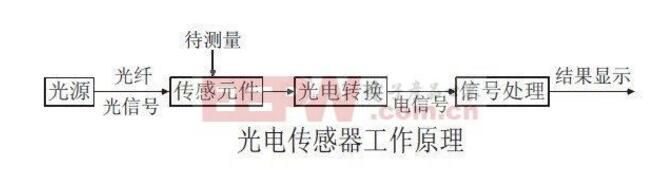
Photoelectric sensors are sensors using photoelectric elements as detection elements. It first converts measured changes into changes in light signals, and then further converts light signals to telecommunications by pv elements. Optical sensors typically consist of three components: light sources, optical circuits and photovoltaic components。
Pv sensors are pvs as sensors for conversion elements. It can be used to detect non-electrophysical amounts, such as light power, light light, radiation temperature, gas composition analysis, etc., that directly cause photochange; and other non-electric amounts, such as parts diameter, surface roughness, reaction, position shift, vibration, velocity, acceleration, and the shape, working status of the object. Pv sensors have characteristics such as non-contact, responsiveness, reliability, etc., and are therefore widely used in industrial automation devices and robots. The emergence of new pvs, particularly the creation of ccd image sensors, has opened a new page for further pv applications。
Ii. Characteristics of optical sensors
1) long detection distance;
2) there are few restrictions on the detection of objects and almost any material can be detected;
3) rapid response;
4) high precision;
5) non-exposable detection without damage to the detector or sensor;
6) the colour of detectable objects;
7) facilitate the repositioning of detected objects。
Iii. Structure of optical sensors
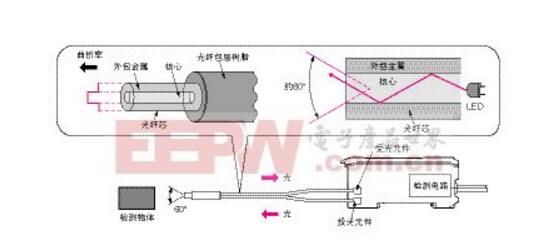
The optical sensors consist mainly of three major components: transmitters, receivers, detection circuits and, in some cases, transmitters and optical fibres. Of these, the transmitter, i. E. The light source (e. G. The light diode, laser diode, infrared diode, etc.), is used to provide light; the receiver consists of three components: the pv diode, pv triode, pv cell, which are used to receive light beams from the transmitter and convert them to telecommunications; and the detection of circuits to detect telecommunications from the receiver, filtering out effective signals and filtering out interference signals。
Iv. Methodology and steps for the regulation of physical insistor switches
The discovery of electricity has given us infinite light and unprecedented power, which directly drives us forward in our lives. The combination of light and electricity also offers us infinite possibilities. Today's novel is about a switch -- an optical sensor -- that we're not saying much. A brief description of how this sensor regulates and the information about it will be presented below。
1. Self-regulating. The pv switch is used first to check whether the switch itself is intact, or not it looks good。
2. When avoiding the shield. When pvs are used, pvs may be inoperable for goods such as coloured goods, less reflective goods, goods with larger space between small items, transparent goods, or in the context of sunlight or halogen exposures, which is due to light***。
3. When a high-level adjustment is made, another pv switch of the pv type above the * plate cannot detect the goods, the direction of the pv switch may be appropriately modified to direct it to the centre of the goods; if not effective, the *ekt shell may adjust the sensing distance, adjust the sensitivity button in the direction of the clockwise and rotate in the direction of the clockwise until a reliable sense is achieved。
4. Directional regulation. When the pv is detected outside the goods or the electric wheel, the counterclockwise adjusts the sensitivity button and rotates in the direction of the counterclockwise until it reaches the point where the sensor cannot be detected, then it is worth noting that the charge* is strictly prohibited。
V. The working principles of optical sensors
Optical sensors achieve their control function by converting light power changes to telecommunications. First, the transmitter is directed at the target and the beam is launched without interruption; second, the receiver receives a beam and converts it to a telecommunications number; finally, detection circuits detect receiver output telecommunications and retain only valid signals。
Application of optical sensors
Pv sensors are highly accurate, responsive, simple in structure and diverse in form, and are therefore widely applied in all aspects of life。
The bar code scan pen distinguishes the bar code information according to the state of reflection. When a scanned pen moves on a bar code, if a black line is encountered, the light of the luminous diode will be absorbed by the black line and the luminous triode will not receive the reflecting light, be highly resistant and be in a state of closure. When encountered with a white interval, the light from the luminous diodes was reflected to the basic poles of the light-sensitive triodes, which produced light currents and guided them. After the entire bar code has been scanned, the light-sensitized triode transforms the bar code into a single electrical pulse signal, which is amplified, integrated and formed into a pulse column, then processed by a computer to complete the identification of barcode information。
Photo-sensitive electrical resistance can be used for light measurement and light control, mainly for light power measurement, most commonly in control of roadlight control and building induction. In the state of circuit connection, the light changes with the relative strength of the light, and the light in the course of the building does not light during the day and at night, also takes advantage of light-sensitive electrical resistance to light. Photo-sensitive electrical resistance is also applied to navigation at sea, where buoys usually use photo-sensitive electrical resistance as a switch on a channel lamp, which becomes smaller at night, connects to the control circuit and turns on the light; and increases in light-sensitive electrical resistance during the day will break the control circuit and turn off the electrical light。
Based on differences in material optical properties, the selection machine is an equipment that automatically separates the alien particles from the particulate material using pv technology and that detects the colour by pv before packaging the product, compares the voltage differential output when the color of the item is different, connects the electromagnetic valves, and blows the difference from compressed air。
Optical sensors can be used to monitor soot pollution. Optical sensors are a small electronic device that detects the light power changes that it receives and achieves control functions by converting changes in light intensity into changes in telecommunications. Because of the non-contact, responsive, reliable performance characteristics of the optical sensor, it is widely used in industrial automation devices and robots, and we can use the characteristics of the optical sensor to detect soot, so that the strength and weakness of the output signal of the optical sensor can reflect changes in the flue density。
Optical sensors may also be applied to laser weapons. Optical sensors are more vulnerable to laser attacks because they are sensitive to infrared radiation, or to visible light, or both. In addition, electronic systems and sensors themselves are highly vulnerable to thermal and electromagnetic noises produced by lasers and are unable to function normally. Laser weapons on the battlefield attack optical sensors in a number of ways, inter alia, by “blinding them” with laser beams of appropriate energy, preventing them from detecting or continuing to track detected targets. Or if the sensor is directing the weapon towards the target, blinding it will render it untargeted. In summary, since sensors play an increasingly important role on the battlefield and are vulnerable to laser attacks, they have become the preferred targets for low-energy laser weapons。
The field of optical sensors is now very broad, but many other subjects and applications await our exploration. For example, the development of micro-optical technology that combines an pv sensor with other microtechnologies, the inclusion of an pv sensor array in the detection of motion objects, etc. It is believed that as science and technology continue to develop, the perception and application of optical sensors will also take a new step forward。









