


The paper attempts to describe in popular terms the basic composition and operating logic of robots. For robotics professionals, reading this paper can be based on how to translate technical language into everyday expression; for non-technicals and robot lovers in the robotics industry, the basics of robotics are generally known。
It should be noted, however, that some of the following are from the author's personal point of view and others may no longer be the most advanced knowledge in the robotic industry. However, their selection for description and dismantling would help to achieve the core purpose of this paper as described above。
Definition of robot
The problem of defining robots is extremely complex. More than anything else, the definition of robots needs to be worded with caution, as it is an extremely fast-growing frontier area of technology, and the definition given today may not be as rigid as it was two months later. In addition, i would like to share with you a bold idea that if something is considered a robot by many children, then it has the potential to be included in the pan-mechanical sphere. The reasons for this scenario will be explained in detail in future writings, only one of which is mentioned here: from an industrial and scientific point of view, robots need normative definitions and theoretical support, but as a cross-border concept that has been mixed since birth with illusions, literature, inventions and science, robots should have open definition space。
Elements and commonalities of robots
The robotic composition is similar to that of most common animals: removable bodies, bodies driving body movements, a system of sensory environments, power sources, and hubs controlling the above structures. In a sense, robots are human-made mechanical organisms that are machines and semi-intellectual bodies that mimic human and animal behaviour. This is due to the fact that human beings are unable to rise above their own perceptions and their own lives, and that all man-made inventions are bound to be influenced by the environment that humans perceive and recognize. This is also largely related to the presence of a large number of genres in artistic creation as images of people or plants and animals。
Biokangaroo robot
Now, let's figure out what robots share。
1. About movement. Some robots can move only on wheels, while others have a large number of removable components, which are generally made of metals or plastics. Similar to human bones, these separate components are connected by joints。
The robot's wheels and axes are connected with some sort of moving device. Some robots use motors and screw tubes as transmission devices; others use hydraulic systems; others use aerodynamic systems (systems driven by compressed gases). Robots can use any of the above-mentioned transmission devices。
2. A robot needs an energy source to drive these transmission devices. Most robots use batteries or fixed power outlets to supply electricity. For hydraulic robots, a pump is required to press the liquid, and aerodynamic robots require gas compressors or compressors。
3. All transmission devices are connected to the circuits by the conductor. The circuit provides direct power to electric motors and screws and manipulates electronic valves to activate hydraulic systems. The valve controls the path by which the ballast fluid flows within the machine. For example, if a robot were to move a hydraulic-driven leg, its controller would open a valve that would flow from a hydraulic pump to a piston in the leg. The hydraulic charge will drive the piston and rotate the leg forward. Typically, robots use pistons that provide two-way thrusts to enable components to move in two directions。
The robot's computer controls all parts connected to the circuit. In order for the robot to move, computers open all the motors and valves that are needed. Most robots can be reprogrammed. If you want to change the behavior of a robot, you just have to write a new program into its computer. Of course, with technological advances, future robots may no longer need to do computer programming over and over again。
Besides, not all robots have sensor systems. Many robots have no visual, hearing, smell or taste. The most common feeling a robot has is a sense of motion, that is, its ability to monitor its own movement. For example, dent-carved wheels are installed at the joints of robots. The luminous diode is configured on one side of the wheel, which sends a beam of light through the chute and is projected on the light sensor located on the other side of the wheel. When a robot moves a particular joint, the wheel with a dent turns. In the process, the groove will block the beam. Optical sensors read beam flash patterns and transmit data to computers. The computer can accurately calculate the distance from which the joint has been rotated using this pattern。
How the robot works
The most common robot is the arm of the machine. A typical arm of a machine consists of seven metal parts, which are connected with six joints. Computers control robots by rotating step-by-step motors linked to each joint (some large machine arms use hydraulic or aerodynamic systems)。
Unlike normal motors, step-by-step motors move precisely in an incremental manner. This allows the arm of the machine to move precisely and keeps repeating the same actions. Robots use motion sensors to ensure that they move in the right amount。
This industrial robot with six joints is very similar to human arms and has the equivalent of shoulders, elbows and wrists. Its “shoulder” is usually installed on a fixed base structure. This type of robot has six degrees of freedom, that is, it can move in six different directions. Compared to this, human arms have seven degrees of freedom。
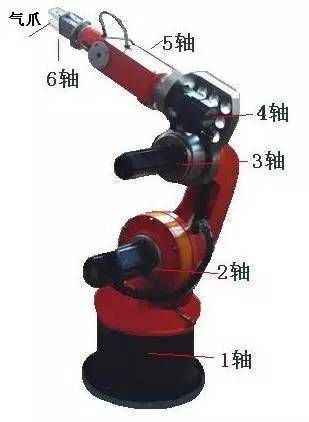
A joint of a six-axis industrial robot
The role of human arms is to move hands to different positions. Similarly, the arm of the machine acts as a moving end implementer. We can install various end-end implementers on the arm of the machine for specific applications. There is a common end-of-pipe implementer capable of capturing and moving different objects, a simplified version of the manual。
Machine hands often have built-in pressure sensors to inform computers about the strength of robots when they hold a particular object. This prevents objects in robotic hands from falling or being crushed. Other end-of-pipe implementers include jet lamps, drills and paint sprayers。
Industrial robots are specifically designed to perform identical jobs over and over again in controlled environments. For example, a robot may be responsible for wringing the lid on the jar that is delivered on the assembly line. To teach robots how to do this, programmers use a hand-held controller to direct the machine arm to complete the whole set of actions. The robot accurately stores the sequence of the actions in the memory and then repeats the actions whenever new cans are transmitted on the assembly line。
Most industrial robots work on car assembly lines and are responsible for the assembly of cars. The robots are much more efficient than humans when they do a great deal of such work, because they are very precise. No matter how many hours they have worked, they are able to drill in the same position and screw with the same strength. Manufacturing robots also play a very important role in the computer industry. Their hands are so precise that they can assemble a microchip。
The manufacturing and programming of mechanical arms is relatively less difficult because they work within a limited area. One of the reasons why service robots are difficult to land in bulk than industrial robots is that they need to move and operate in relatively complex environments。
The first challenge is to provide a viable motor system for robots. If robots just move on flat ground, the wheel or orbit is enough. But if the terrain is complex, it is clear that wheels and orbits are inappropriate, so four or more of these robots remain under constant attention. At the same time, research on leg-based robots also helps researchers to acquire knowledge of natural dynamics, which is a useful practice in biological research。
The robot's legs are usually moved back and forth, driven by hydraulic pressure or aerodynamic pistons. The pistons are connected to different leg parts, like muscles attached to different bones. This is undoubtedly a challenge if all these pistons are to work together in the right way. At the infant stage, the human brain has to find out which muscles need to be constricted at the same time in order not to fall while walking straight. Similarly, robot designers must identify the correct piston combination associated with walking and incorporate this information into robotic computers. Many mobile robots have an built-in equilibrium system (such as a set of gyroscopes), which tells computers when they need to correct robotic actions。
The movement of two feet is per se unstable (in this sense, human beings are by no means perfect creatures), making it extremely difficult to achieve robotics. So the breakthrough of human robots in the last two years has come to the fore. Humans have been studying animals and insects to design more stable robots for travel. Insects have several legs and are super-balanced and adaptable to different terrains。
Some mobile robots are remotely controlled and humans can direct them to specific jobs at certain times. Remote control devices can communicate with robots using connections, radios or infrared signals. As an effective extension of human capabilities, long-range robots are of great value in exploring environments that are fraught with danger or that are inaccessible to humans (e. G. Deep sea or within volcanoes). Some robots are only partially controlled. For example, the operator may direct the robot to a particular location, but not to guide it, but to allow it to find its own path。
Let's go back to some sensors。
Some of the traditional robots, in particular the old ground sweepers, have collision sensors used to detect barriers. When the robot is activated, it's basically going straight. When it touches the barrier, the force of impact works on its collision sensor. Every time a collision occurs, the robot's program instructs it to retreat, then turn to the right and then move on. In this way, robots change their direction whenever they encounter obstacles。
Other robots rely on infrared or ultrasound sensors to detect the barrier. These sensors work in a manner similar to the echo-positioning system of animals: robots send a sound signal (or an infrared light) and detect its reflection. The robot calculates the distance between it and the barrier based on the time that the signal reflects。
Some robots use stereo vision to see the world around them. Two cameras can provide deep perception to robots, while image recognition software enables robots to locate objects and identify objects. Robots can also use microphones and scent sensors to analyse the surrounding environment。
Some robots can only work in the limited environment they know. For example, weeding robots rely on underground markers to determine the extent of grassland. The robots used to clean offices require building maps to move between different locations. And of course, these robots are making progress。
Some robots can analyse and adapt to unfamiliar environments and even to difficult terrain areas. These robots can link specific terrain patterns to specific actions. For example, a rv robot uses its visual sensors to generate maps of the front ground. If the map showed a rough terrain pattern, the robot would know it should go another way. Such systems are very useful for exploratory robots working on other planets。
Other robots use looser structures and introduce randomization. When the robot is stuck, it moves the limbs in all directions until its actions work. It carries out its mission in close collaboration with force sensors and transmission devices, rather than being guided by computer programs. This is similar to some insects trying to bypass the barrier: they appear to be difficult to move quickly when they encounter obstacles, and they continue to try to do so until they pass。
About artificial intelligence
Artificial intelligence is undoubtedly one of the hottest areas in recent years, and writers have always considered robots to be part of artificial intelligence, even though it is controversial in the industry. However, there is now a burgeoning trend towards the convergence of artificial intelligence with robotics, as the larger model developed by the openai-represented technology enterprise advances. In the future, artificial intelligence is the “brain” and “heart”, while robots are powerful entities that follow the “brain” and “heart”。
Although, like the term “robots”, “artificial intelligence” is difficult to define. The ultimate artificial intelligence, for example, is the re-emergence of the human mind process, which has almost the same power as human intelligence. But at the same time, artificial intelligence is much better than humans, and it theoretically learns any knowledge, works instantaneously, and produces valid ideas. In the current reality, artificial intelligence is far from perfect, and the fields of machine visualization, multimodular interaction and so on are broadly defined as artificial intelligence。
The real challenge for artificial intelligence is to understand how natural intelligence works. Whether the path studied is symbolic or simulatory. The brain contains hundreds of billions of neurons, and human thinking and learning is done by connecting different neurons. However, it is difficult to understand how these connections achieve advanced reasoning capabilities, even at a lower level of operation, which is complicated. The neural network of the brain is extremely high, and it's a real black box。
Concluding remarks
Different robots work differently, and new technologies are changing the industry at an unprecedented rate. But no matter how the times change, something of the essence is difficult to change, such as human nature, the basic way of thinking of human beings, the limits of the physical world on creation, etc. This means that uncertainty is still full of certainty, and research on robots should never deviate from these hard-to-change things. But that doesn't mean that we follow the rules, and, as noted at the beginning of this paper, robots have a tremendous outreach space and the difficulty is how we dance in shackles。
In fact, the shackles contain the greatest uncertainty that humankind is moving from the old to the new world. How can robotic tracks, as a front-line technology, develop in such a new and old alternation? It's an exciting subject. In the future, we will have a dedicated exploration of this。
The robotics industry's homemade recording and the robotic practice application are the tri technology think tank's external content platform, which focuses on the broad area of robotics plus intelligent communities。









