The recommended algorithm is no longer new, but the controversy surrounding it never stops. These disputes include the problem of recommended algorithms bringing about title parties, low-quality and even false content, and information cocoons. There are many misperceptions about recommended algorithms, which are supposed to label the content, then assign the user the corresponding attribute, and then, through the data operation, recommend the content of the corresponding label to the user with the corresponding attribute. In fact, with the development of machine learning technology, the referral system for tremors has become almost non-dependent on labelling content or users and, through complex neuronet calculations, directly predicts the probability that each user may interact with each content。
The main contribution of machine learning to recommended algorithms is the establishment of a scoring system, in which the user's behaviour is abstracted into a mathematical map in a mass-calculations and supply environment, and the recommendation to the user of the objective of his high-scoring content。
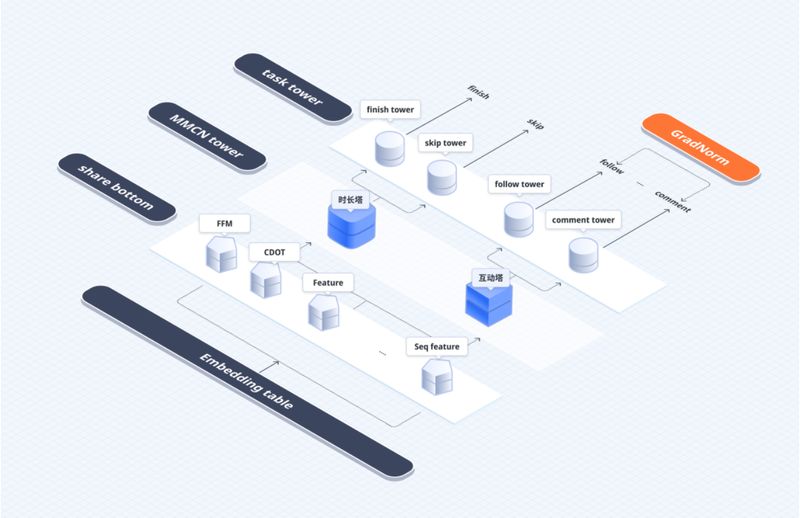
Algorithms are modelled around feedback from users, whether they are impressed, see seconds, write comments, light the author's home page ... And so on, and these interactions will lead to a growing understanding of the algorithm of a user, the "arctic star" indicator of the shivering recommended algorithm, and, ultimately, an increasingly accurate “predict” of the incidence of user behaviour by pushing the most valuable video of feedback to the user. This means that, in this era of high-density digitalization, algorithms can predict the potential interest and behaviour of users efficiently without a deep understanding of the specific type or semantics of the content。
The algorithm behind the tremor
In the past, the recommended algorithm for the short video platform was to label content and users, and then to match each other, and even to produce a great deal of knowledge about how to guide the system to label itself when it is adopted. However, labelling mechanisms are a vestige of the experience of the age of manual editing and are used to imitate algorithms that mimic human confusion. They are only useful in very early recommended algorithms. Once machines have matured their skills, the practice of using hundreds of labels to understand content is completely eliminated。
In recent days, the website of the centre for the safety and trust of the dressing voice has been on-line and has made public the rationale of the recommended system for the dithered sound algorithm, the recommended logic of the algorithm behind user behaviour and the manual management of the platform to identify risks. The core logic of the current recommended dithered algorithm can be simplified to “recommended priority formula”: a comprehensive projection of the probability of user behaviour x weight of behavioural value = video recommended priority。
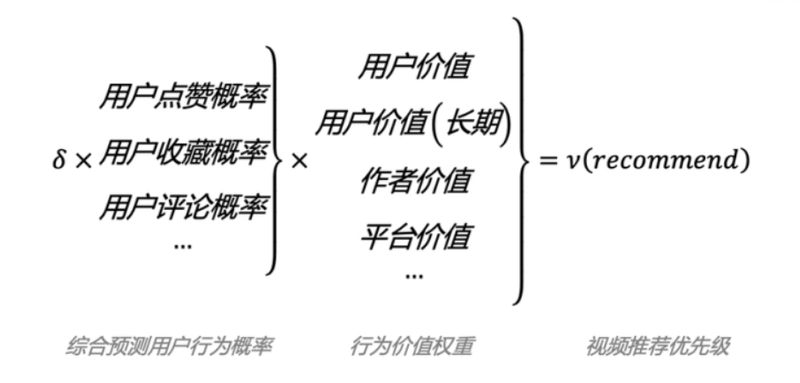
Recommended priority formula
The recommended ultrasound algorithm is an important application scenario for artificial intelligence machine learning techniques and is essentially an efficient information filter. In the practical application of the tremors, all the content published on the platform is evaluated, the higher the flow of content is evaluated, the more rigorous the standards are, and the manual + machine reviews work together closely -- the machine evaluates all the contributions and manually "deep." the creator uploads the content to the machine first: if the content is identified as containing high-risk characteristics, it will be stopped directly; if the high-risk characteristic is not hit but the model is judged to be problematic, it will be sent to manual review, and if the problem is less likely, the basic flow will be obtained to the next stage. Reporting of content, centralized challenges in comment areas, surges in traffic, etc., may trigger re-examination and lead to the discontinuation of further recommendations and distribution of disposals。
The recommended methods based on user behaviour include a variety of technical models, such as synergetic filtering, double tower recall, wide&deep models (both commonly used in recommended systems). Algorithms can find users with similar interests and refer content of interest to others in a completely “ununderstanding of content”。
• the synergetic filtering of recommended algorithms is the most classic of recommended algorithms, and content-based synergetic filtering algorithms analyse and compare user behaviour. For example, user a has seen content x, y, z, user b has seen content x, z, w, and user c has seen content x, z, and v. The algorithm has determined that there is a high similarity between x and z, and that the system recommends other content similar to those that have been viewed or rated according to the user's preferences. The principle is to find users who are of similar interest to you and recommend to you what they are interested in。
• the wide&deep model is one of the main power models of the tweeting recommended algebra and consists of the wide and deep components. The main function of the wide segment is to give the model a strong “memory capability”, which allows the model to learn directly and to use the “coherent frequency” of articles or features in historical data; and the main function of the deep part is to give the model a “penetrating capability” to discover the rare characteristics that are not even present and are relevant to the final label. Cross-domain recommendations for knowledge mapping, efficient distribution and connectivity of enabling information, can address the more obvious head effects of coordinated filtering algorithms。

When the wide&deep model works with synergistic filter algorithms, the platform can both quickly recommend popular content and tap into the potential diversity of user interest, allowing smaller content to become more visible. In terms of recommended algorithms, tremors are similar to most of the content-recommended platforms in the country and abroad, including recall, filtering, sorting, etc., and gradually down from hundreds of millions to tens of thousands, thousands of people, until a few users are able to filter out what can be painted, depending on the algorithm’s ability to “recall”。
How simple is it to understand "recall": how many times does it take to guess which team is the champion if a fan who knows the results is the champion? The way to "recall" is to number 32 teams from 1 to 32, and then ask, "are the champions between 1 and 16?" if you're right, go on and ask, "are the champions between 1 and 8?" if you're wrong, then you know that the champion must be between 9 and 16. That's what mathematical models do, they don't need to know the strength and weakness of the 32 teams, but they can "recall" with the greatest probability of being low and simple。
The recommended algorithms, built on machine and in-depth learning, have enhanced the efficiency of information distribution, referral and delivery of tasks that human beings cannot perform quickly and efficiently. The time between the occurrence of the act and the actual effective feedback is already very short, and this near-immediate mechanism helps to predict user behaviour more accurately. The "minute" feedback update has been achieved。
However, because algorithms attempt to recreate the uncertainty of user selection through complex processes such as data collection, feature engineering, model training, which is essentially a mathematical model operation rather than an understanding of the content itself, they remain limited. It is precisely because of this characteristic that the tremors have tried to heat the depths of knowledge, history, technology and so on, but have not worked well. This alters the normal logic of algorithms and can affect the data cycle, leading to interference with subsequent recommendations for these elements; thereafter, a model to estimate the probability of collections and double viewing is used to shift the tone of voice-to-heart thinking, training in depth content, and to increase the efficiency of distribution of deep content in the platform。
A value model is a value calculation of the interactive behaviour of the user and the weighting of the various types of value through constant adjustments of parameters, representing an understanding of which actions the tremor may be more important. Simply put, considering only the probability of user interaction may create problems, for example, where well-produced medium- and long-quality videos may be at a disadvantage in distribution because of lower rates of completion. Through in-depth analysis and weighing of these factors, the principle of " maximization of value " can provide a strong basis for subsequent recommendations by calculating scores reflecting their potential value for each candidate。
And it is precisely because of the regularity of algorithms that, at the practical level, in recent years, users have enjoyed “reverse domestication” algorithms – unconscionable points of approval of video-types, non-use of platform search logs, and occasional browse clearances – that are designed to create “data noises” more actively to domesticate, balance the algorithms, proactively inform the algorithms of their needs and preferences, and force platform algorithms to upgrade recommended service levels。
The great age of algorithms
The essence of the recommended algorithm is the information filter system, which is related to the environment in which the information explodes. According to idc reports, the global production of data amounts to 159 zb in 2024 and 384 zb in 2028. It should be noted that 1zb is equal to 10 trillion byte, and that, if measured by the size of about 20g of a 4k film of about two hours ' duration, 159zb is equivalent to 7. 95 trillion films, which take about 1. 8 billion years to be broadcast consecutively. This has completely exceeded the volume of information to be addressed in any given era in history。
Despite the fact that the number of new videos added daily to the tremors is as high as 100 million, and hundreds of videos that ordinary users can consume on average every day have died, how to ensure, as far as possible, that in this limited number of videos, they are all user-friendly, and that algorithms require constant mastery. Many people see the algorithm as an information cocoon pusher, but the facts are far from it。
The term information cocoon is derived from the 2006 publication of information utopia by the american professor of law, keith r. Sandstein, which means that if people only focus on and choose content for their own pleasure, the information reach becomes narrower and trapped in self-weaved cocoon houses. In fact, the concept was not presented for algorithms and was not supported by empirical research and quantitative data。
Different web platforms, such as social media, search engines, have actually expanded users'sources of information, and there is no complete segregation between networks of users with different perspectives, giving users a greater diversity of information than users who do not use them. But even the best algorithmic engineers can't get away from the theory and architecture of algorithmic techniques, simply explaining why a video is recommended to these users, not to those users -- when each user becomes a "point" in the data, the user is unable to look at the whole picture and is bound to feel very easily in the black box。
In addition, algorithmic governance has become a common issue for the platform today. The central network office of letters and letters deals with the primary responsibility of the website platform by putting in place a series of policy regulations, building a whole-process regulatory system for algorithm filing, security assessment, monitoring and inspection, enforcement of penalties, and strengthening algorithm governance. Only by improving transparency in the design of algorithms and the interpretability of their operation can algorithms be properly applied to “accountable fields”。