


The reforestation of plant vegetation takes place during the afforestation season, where seedlings are cultivated, and seedlings of various specifications have been formed, with root and tubing, drying and off-site planting, leading to a rapid revegetation of woody communities。
(i) materials and forms
(1) plantation requires the selection of good seedlings。
(2) cultivation is carried out by both bare root and earthball planting. The earthballs are planted, depending on whether or not the packaging is present, and can also be divided into ground-bearing and container-planted seedlings。
(3) afforestation techniques are often used in combination with water protection technologies for topography and drought control。
(ii) functional characteristics of the measure
(1) a grown tree is more resilient to the adverse environment and able to adapt relatively quickly to the environmental conditions of the afforestation site。
(2) the rate of afforestation is high and the restoration of vegetation is stable。
(3) the application of trees is wide in scope and applies almost to all afforestation species。
(4) particularly applicable in the context of drought and severe soil erosion。
(5) landball planting has the advantage of non-harming, non-naked tree roots and high activity rates, especially in containers, maintaining the natural state of the original soil and root systems, following a slow-growing process after planting, and growing fast in juvenile forests, which can significantly increase the rate of forestation even on poorly-located plantations。
(iii) design and construction
(1) cultivation of trees, especially bare trees, in abandoned lands with poor soil, with a moderate expansion of the pits and application of 3-5 cm of organic or base fat on the bottom of the pits for local improvement of the land。
(2) the key to afforestation is to ensure that the tree specifications ensure that the tree roots are stretched (without nesting). The specifications of the caves are determined on the basis of the root system characteristics of the tree (or the size of the earthball) and the situation in sysho. The pits of the flat roots should be increased in diameter and the pits of the direct roots in depth. When digging, the topsoil and subsoil are placed separately as required. The top and bottom of the caves must remain vertical and equal in size. Excavated into a cone or bottom of a pot, otherwise planting in real time would cause the roots to crack, curly or plume, resulting in a non-extension which would affect the life of the trees。
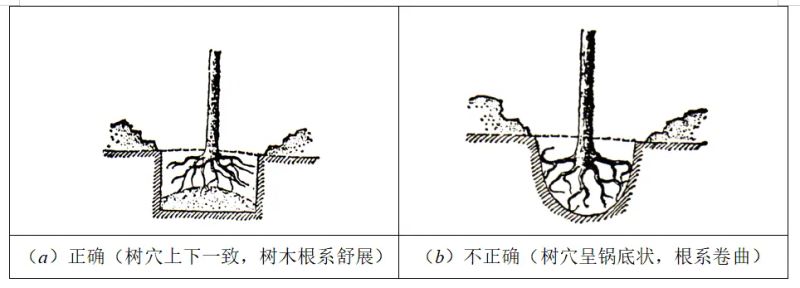
(3) another key aspect of afforestation is the application of the operational requirements of “triple, double, one seedling”, including the process of three burials, two steppings and one lifting of the tree upwards。
(4) the period between the extraction of a naked tree and its planting shall be as short as possible and shall follow it. It is important to keep root wet during transport, with wet grass cover to prevent root wind drying; in addition, the use of root slurries increases the rate of transfer to work by 20 per cent。
(5) when a naked tree is planted, the roots must be kept intact, not too long, with as many sides and roots as possible. The roots can also be moderately trimmed to promote development。
(6) the earthy seedlings take care of the protection of the earthen ball during loading and unloading in order to avoid break-ups, injury to the roots and impact on the functioning of the vessel; and the wood of the packagings take care of the containers and avoid causing the earthen ball to scatter。
(7) larger-specified seedlings should be transported to the planting grounds and moderate trims should be performed to reduce evaporation and increase the rate of tree activity。
(iv) conservation management
(1) water must be watered in a timely manner after construction to ensure that the three perusals of the trees are alive must be met。
(2) the soil structure of the abandoned site is gravel, and artificial water or rainfall runoff causes the soil to seep down a plume, resulting in holes in the original planting pit, within the root range, and should be detected and filled back in time to avoid the death of dehydration。
(3) fertilizers may be duly applied during conservation, depending on plant growth。
(4) in the year in which the trees are planted, in the event of continuous drought and low rainfall, it is necessary to replace the water manually and in a timely manner; in the year of winter, it is necessary to refill the water with cold water and in the spring。
(5) attention to timely prevention and treatment of pests and diseases。
(v) scope of application
(1) abandoned lands of mines, which apply to soil, rock and earth。
(2) to apply to the flat ground and to stable slopes or slope platforms that are not steeper than 1:4。
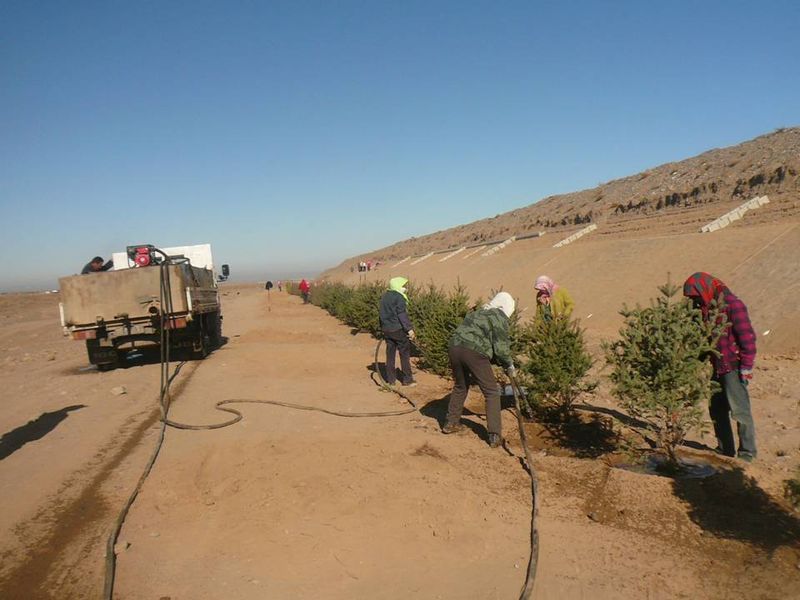
(3) naked roots are mostly planted for the very small seedlings of permafrost and fallow plantations, and earthy saplings are mainly used for larger-scale needle plantations, and packagings are widely used for large-scale forestation of permafrost trees, particularly for revegetation of mines。
(4) plantation revegetation techniques are applicable throughout the country, but artificial water recharge is required in arid and semi-arid areas。
(vi) engineering applications
Revegetation of abandoned land in mines needs to be combined with land improvement and drought-resistant techniques, which can effectively improve the productivity of trees and enhance their greening and stability. In practice, it is generally used in combination with the techniques used to replant the plant。
The following are recommended for revegetation of abandoned areas:
(1) the seedlings of the packaging are capable of avoiding wind-burning and mechanical damage during seedling, transport and planting. The process of seedlings has also been reduced by the fact that roots have their original soil. It has a higher rate of afforestation activity than conventional afforestation methods。
(2) packaging seedlings are better fertile conditions than bare seedlings because of the nutrient-rich soil in the packaging, favouring the growth and development of the seedlings and creating good conditions for the growth of the larvae and early depression of the forest。
(3) packaging seedlings adapted to afforestation in the spring, summer and autumns can accelerate the rate of reforestation。
(4) the cost of forestation in containers, although higher than conventional afforestation, is high in activity, low in depression, fast in forest formation, significant in effectiveness, avoiding defects in conventional reforestation and more efficient in combination。









