Prices are one of the most powerful economic forces in our daily lives and one of the least understood. Price is the most powerful ecoNomic force in our day-to-day lives and one of the least underwood.
— german manager hermann simon
In the old saying, "it's not as good as selling."。
Vendors' “smartness” often stems from their profound understanding of the market。
Today i speak of a product and service pricing method that i will certainly speak about in the course of the “initiative finance practice” project of the financial mba project in chinese and china: sub-pricing。
The price of a product or service in a segment is usually composed of two components: a one-time charge and subsequent charges based on usage. This means that two costs are to be paid for the purchase of commodities, including a fixed (one-time) cost that does not vary with use or consumption and a cost that changes with use or consumption。
This form of pricing strategy is called “two-part pricing/two-part pricing”, two-part pricing, two-part tariffs, and two-part pricing。
Two-part pricing is a price discrimination strategy. In general, price discrimination strategies occur only in partially or entirely monopolistic markets, with the aim of obtaining more profits for enterprises than in a non-discriminatory pricing environment。
There are many examples of two-part pricing. Most commonly, for example, cell phone calls, which sometimes charge fixed monthly rents and a per minute call. For example, playgrounds sometimes charge an entrance fee and additional costs for individual entertainment projects。
Cost = entrance fee + usage * single usage fee
Disney's project was randomly played after payment of the entrance fee, which corresponds to one of the above special cases (one-time usage fee = 0):
Disney cost = entry fee + usage * 0
Service providers such as banks, finance, telecommunications and transport usually use two-part pricing. Part of the pricing is intended to recover fixed costs that are specific to some customers, such as connection costs in telecommunications or line rental costs. The other part is that greater profits can be derived from usage。
Another more common type is membership fees. Many shoppers prefer to charge annual membership fees, such as prime in amazon, costco, sam's member shop. These membership fees help to encourage people to spend more money in a year. After you paid for your membership, every subsequent purchase was made at near-cost prices, which allowed both buyers and sellers to get the best results at the same time。
In the case of membership fees, membership fees paid are not important in future purchases, as they are already sunk costs. In future consumption, one would only consider the price of a single consumption as close to the cost, so that everyone would choose the optimal use for himself。
>. History of two-part pricing
The history of two-part pricing, dating back to the late nineteenth century in the united states, was not fully realized until the beginning of the twentieth century, a concept that gained significant prominence in economic theory in the 1970s and 1980s。
One of the classic success stories in history is the gilley razor。
At the end of the nineteenth century, the united states had dozens of patents related to safety razors, of which gilley was one. The use of this safety razor is not easy to shave, but saves time and money to go to a barbershop。
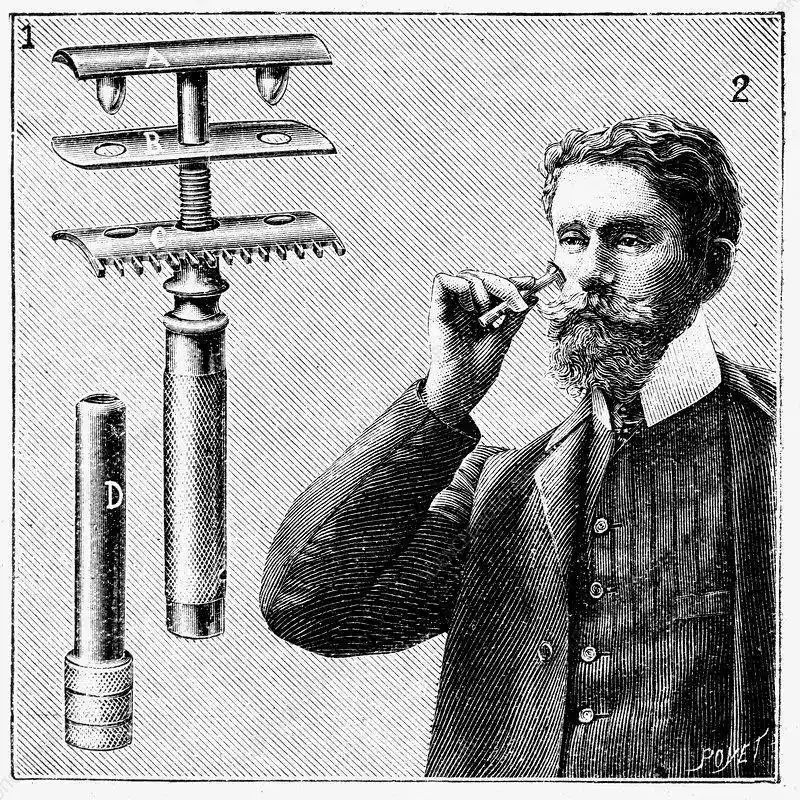
However, such commodities, which appear to be economically convenient and marketable, are difficult to sell because they are too expensive. It would cost 10 cents to go to the barber shop, while the cheapest safety razor would cost $5, equivalent to a week's salary for a senior mechanic, compared to a significant cost。
In such circumstances, the gilead safety razor is not available. Gilley's razors are no better than other razors, and their cost is not low, and the reason for the heat is its pricing strategy。
In order to sell the razor at the lowest possible price, the gilley sticker set the retail price for the razor slasher at 55 cents and the wholesale price at 25 cents, which is less than one fifth of its production cost。
At the same time, the razor blades are sold at a price of 5 cents, supplementing the loss of the razor with the profit of the blades, because the blades cost less than 1 cents and the razors can only use their patented blades。
Based on the six to seven times per blade, less than a cent is spent on each shave and only one tenth of what is spent on a barber shop. This pricing brings the cost of each shave very close to the cost of the blade. Gilley subsidizes the loss of razor blades through the profits of razor blades. Successful use of segment pricing strategies to gain access to markets。
>. Two-part pricing requirements
In order for two-part pricing to be logically viable in the market, a number of conditions must be met。
The first condition is that access to products or services must be controlled. In other words, it must be possible not to purchase the product without paying access fees. Because without access controls, a consumer can buy a bunch of products and sell them to customers who do not pay the original access fees. Thus, one of the necessary conditions for the feasibility of pricing two parts is that the resale market for the product does not exist。
The second condition that needs to be met for two-part pricing to be sustainable is that producers using this strategy have a certain market power. Two segments of pricing are clearly not feasible in fully competitive markets (i. E. Where sellers do not have pricing rights), where producers are price recipients and therefore do not have innovative flexibility in pricing strategies. In monopolistic markets, the monopolist is able to adopt a two-part pricing strategy because it is the sole seller of the product。
That is, it is possible to maintain two-part pricing in markets that are not fully competitive, especially if competitors use similar pricing strategies。
>. Basic model for two-part pricing
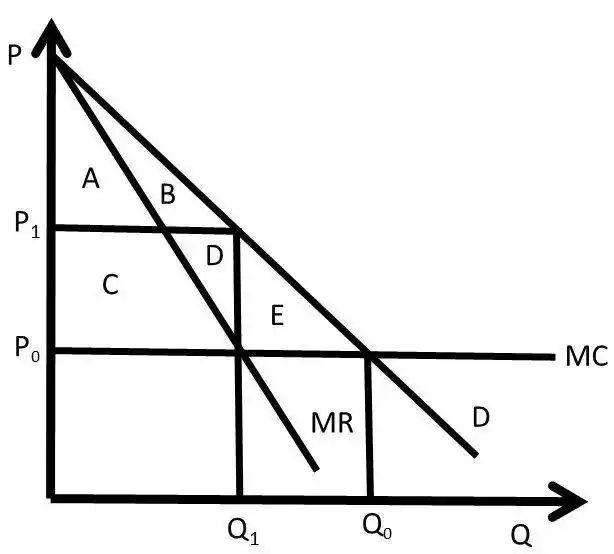
Assuming that the above figure represents the needs of a consumer, in a competitive equilibrium (lower marked 0), the price is mc, yield is q0, the producer surplus (ps) and the consumer surplus (cs) are given in the following formulas (a, b, c, d, e)。
Ps0 = 0
Cs0=+abcde
The price charged by the company is equal to the constant marginal cost (p=mc) and there are no remaining producers. The consumer surplus is the total area between the demand curve (the willingness to pay) and the price line (the price to pay), which is the sum of the area abcce。
A company that maximizes profits (subscript 1) will maximize profits by producing q1 units of goods and charging p1. The remaining producers and consumers are:
Ps1=+cd
Cs1=+ab
In such a case, the price paid by the consumer transferred the profits from area c and area d to the producer, but there was still a surplus of profits from area ab. Producers wishing to obtain more consumer surplus can design a two-part pricing strategy to transfer more consumer surplus to producer surplus。
Because of cs>0, consumers are willing to pay higher prices than priced, and businesses can earn more consumer surplus. At this point, enterprises may charge a fixed threshold fee (t), which consumers will be willing to pay as long as the cost is less than the remaining consumer at the price-fixing level (cs1=ab)。
>. How two-part pricing affects profits
When producers have the capacity to control their pricing structures, they implement two-part pricing in profitable circumstances. More specifically, when two-part pricing is more profitable than other pricing options, two-part pricing is most likely。
In most cases, two-part pricing would be more profitable than conventional monopolistic pricing, as it would allow producers to sell more quantities of products and obtain more consumer surpluses than conventional monopolistic pricing。
In general, unit prices for commodities would be lower in two segments than in traditional monopolistic pricing, which would encourage consumers to consume more individual goods. At the same time, profits from unit prices would be lower than profits under monopolistic pricing, so the threshold would need to be set at a sufficiently high level, at least to cover the gap, and at a sufficiently low level to allow consumers to remain willing to participate in the market。
Of course, in addition to the pricing strategies described above, a more complex two-part pricing model can be developed to determine the optimal fixed cost and unit price in a world with different consumers or consumer groups. In these cases, producers have two main options。
First, producers may choose to sell their products only to the group of customers with the highest willingness to pay, setting fixed costs at the remaining consumer level of that group (effectively excluding other consumers from the market), and setting per unit price at marginal costs。
Alternatively, it would be more profitable to set fixed costs at the remaining consumer level (and thus keep all consumer groups on the market) in the lowest paying customer group, and then set prices above marginal costs。
Sub-pricing is a very basic pricing model in economics, but i often see that many traders do not know how to price with scientific methods, but rather do complex marketing promotions that mislead consumers with less sophisticated models such as vouchers。
In fact, it is not difficult to find a good pricing model that increases profits if these simple things are understood in depth。
Irwin and joan jacobs, university of qinghua