


A classic investment book that let wall street handlers spend 12 consecutive years without losing money, now the PDF collection is free of charge in an it cat. A lot of people went through itTechnical analysisThe curriculum was still at a loss, and the problem was often not that of lack of information, but rather that the chain of reasoning was broken and the conclusions were naturally crooked。
A handler for 12 years without losing money. Bottom gas
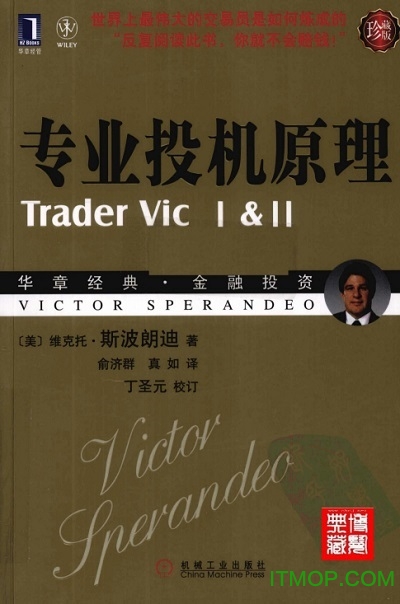
Victor sporandi is the master of american professional securities and has been a fund manager for 25 years at rand management. From 1978 to 1989, he invested in wall street for 12 consecutive years, without any loss of one year, and was called "the terminator of wall street" in the baron book magazine, while the inner circle called him "the player vic"。
The wall street journal and the baron book have long tracked him as a financial focus. One wonders what he's won for 12 years, and sporundi's answer is simple: rather than relying on insider information, he turns the three tools of technical analysis, statistical methods and economic fundamentals into a line, drawing conclusions with a strict chain of reasoning, and then deciding on the direction and position of the bet。
Focusing on principles is more important than what you know
In the book, sporandi has repeatedly stressed that it's not about how much you know, but about whether what you know is real and relevant. Each shareholder looks at the same k-line map, the same GDP report, and the same central bank interest-rate resolution, but, unlike the reasoning process, the final conclusion is completely different, as is the profit-making deficit。
He called it "the principle of focused thinking" and used the alligator principle as an example: if you see a prey, you reach out, but if you don't, you can't go after him because you're open. Chapter 2 of the book is devoted to this concept, and the central meaning is not to lose, but to retain the principal and the basic discipline that entitles you to remain on the table。
From gambling to the full learning framework of dow's theory
The book consists of 31 chapters in two volumes. In the first section of the previous volume, an analogy was made with the book of gamblers, which compares the calculation of the ratio of shares to casinos, to help you understand that the market is not purely random and that there are statistical patterns behind it. Chapters 4 to 7 focused on the theory of dunes, the precision of trends and the advantages and disadvantages of technical analysis, which were part of the ground-based approach, and suggested that the chapter-by-chapter approach should be completed。
The fourth part of the next volume deals with the relationship between volatility and the growth of the gnp, the fifth part deals with the right-to-choice trade, chapter 31 deals with the character of the trader, which brings the subject to the moral level of wealth, reminds readers of how to spend money and how to maintain a balanced mind. The whole book has a strong sense of restraint。
Emotional discipline is more difficult than technical techniques
Chapter 13, entitled spock syndrome, is about the ongoing war between reason and emotion. Sporandi's point is straightforward: the vast majority of the diaspora loses money not because they can't read the graphics, but because they can't hold it, and they can't catch it. Chapters 14 to 17 are devoted to breaking the "false self-esteem" and are psychological traps that cost the lives of the dead。
His operational recommendations were particularly specific: the reasons for each transaction were written before the opening of the warehouse and the execution records were checked against the warehouse. If three successive transactions deviated from the plan, they were forced to stop for a week and cooled emotions. The methodology looks simple, but those who can really insist on implementation are likely to be less than 5 per cent of market participants。
Selective trading and practical skills to be eliminated on the day
Chapter 29 refers to the right of option as a "trading tool of the three-digit rate", which means controlling the position, and a single transaction can theoretically double or even triple, provided that the damage is strictly stopped. Chapter 30 deals with the professional method of elimination on the same day, requiring traders to clear themselves before closing, not to leave their night space, and to avoid the uncontrollable risks of jumping off the air the following day。
These chapters are high thresholds for ordinary bulkers, but the core idea can be borrowed: to limit the maximum loss with the right to options and to train discipline with the rhythm of the day off. It is also mentioned that the option strategy is suitable for use at the stage of greater volatility, such as before and after the fed's deliberations, and that the sense of direction is more important than the choice。
How do you read it
YesProfessional speculation theoryAfter the publication, the titles "the best business book of the year" "the ten great professional book of finance" and "100 most influential books" were published, and the paper version was available on a variety of channels, but the early cost of the cut-off was fired to hundreds of dollars, which was not very friendly to ordinary readers。
If you want to read the whole story at zero cost, go to the it cat-cat site and search for the "professional speculation principles", the PDF collection can be downloaded directly and the phone and computer can be opened. The order of reading is different: first, first, then basic analysis, then technical analysis and right of choice, and the sequences double the cost of understanding, equal to half the white reading。
The last time you lost money, did you look in the wrong direction or did you get it right? If you've been through this "right and no" experience, you're welcome to tell your story in the comment area, order a collection and share it with your friends who are also struggling。









