


At the actual detection site, the coating thickness instrument often uses both magnetic induction and vortex thickness methods, both of which permit the reading of thickness on the surface of the probe, but the coating and paint thickness on the steel plate requires magnetic induction, while the paint on the aluminium plate is generally measured by vortex. Why do coating thickness measurements vary from material to material? What's the difference between magnetic sensors and vortex thickness
I. What is the difference between a magnetic sense and a vortex thickness
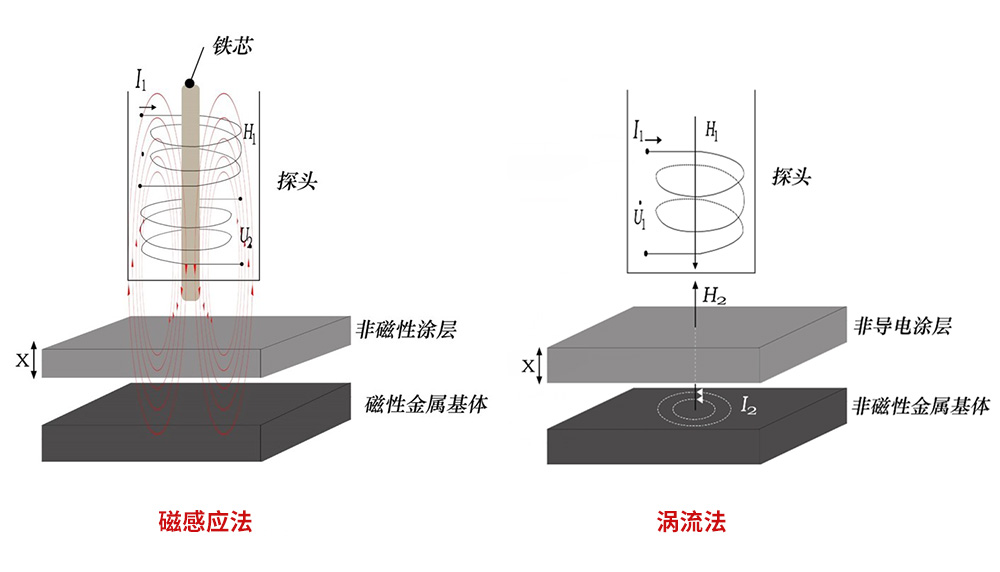
1. Magnetic induction working principles: measuring coating thickness through magnetic field variations
The inside of the probes is usually a steel core and a coil, which creates a magnetic field when it is electrocuted and forms a magnetic route when it approaches the metallic metal matrix. When there is a non-magnetic cover between the matrix and the probe, magnetic resistance is increased and magnetic flux is reduced. The larger the non-magnetic cover, the greater the magnetic resistance, the thickness of the coating is calculated on the basis of measured changes in magnetic signals。
The magnetic induction method is therefore suitable for non-magnetic coating tests on magnetic base materials such as steel, using an example from the field of coating paint thickness measurements on steel plate surfaces。
2. Turboflow working principles: measurement of coating thickness using internal metal induction currents
High frequency (hf) exchange of electricity into the inside of the probe, resulting in an intersection magnetic field. Probes, near the aluminium, copper, and other conductive metal matrices, detect vortex flow inside the metal matrix, which produces a reverse magnetic field to change the circle resistance and influence the electromagnetic response to the probe. The thickness of the coating alters the distance between the coil and the metal matrix, thereby altering resistance, and the instrument calculates the thickness of the coating based on changes in the electromagnetic response。
3. What is the difference between magnetic sense and vortex thickness
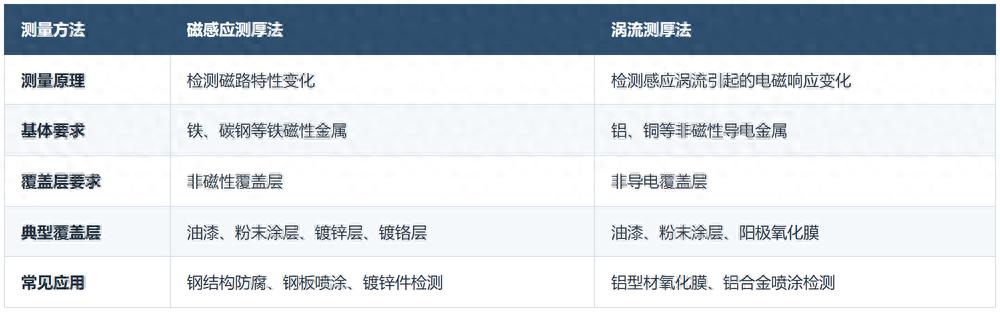
Gb/t 4956-2025, non-magnetic cover cover on magnetic bases overlay measurement magneticity law and gb/t 4957-2025 non-conductive cover covering cover on non-magnetic conductive bases metals non-conductive covering covering cover measurement angular spectrum sensitive flows law, provides for the detection of magneticity and vortex thickness methods and scope of application。
Restrictions on the use of magnetic sensors and vortex thickness
Magnetic induction and vortex thickness are both non-destructive detection methods, but do not mean that all coating thickness can be measured in both ways。
The coatings on the non-metal matrix could not be detected, with an example from the field of paint coatings on plastics; magnetic coatings on magnetic metal matrices such as iron plating nickel could not be measured; and conductive coatings on non-magnetic metal matrices such as aluminium alloyed copper could not be detected with conventional amplitude sensitive vortex coating thickness meters。
Detectable coatings such as iron plating, steel plate paints, aluminium alloy oxidation membrane, etc., also need to take into account differences in the magnetic conductivity of different steels and differences in the conductivity of different aluminium and copper alloys. If pre-test calibration is performed using a zero plate of low-carbon steel to measure the thickness of the paint coating of the structural steel surface, the data obtained may well be inaccurate. The coating thickness instrument product description or test technical specifications will typically require clearance of unpainted works by the colonel, who is in no position to do so and recommends zeroing of the same or similar materials as the basis of the work being measured。
Magnetic sensors or vortex coatings require, for example, base materials thickness and curvature radius. Different requirements for probes, tests should select suitable probe measurements, and other detection methods such as gold phase are considered if the base is too thin or too small。
Iii. Is there a coating thickness instrument that supports both magnetic sensing and vortex
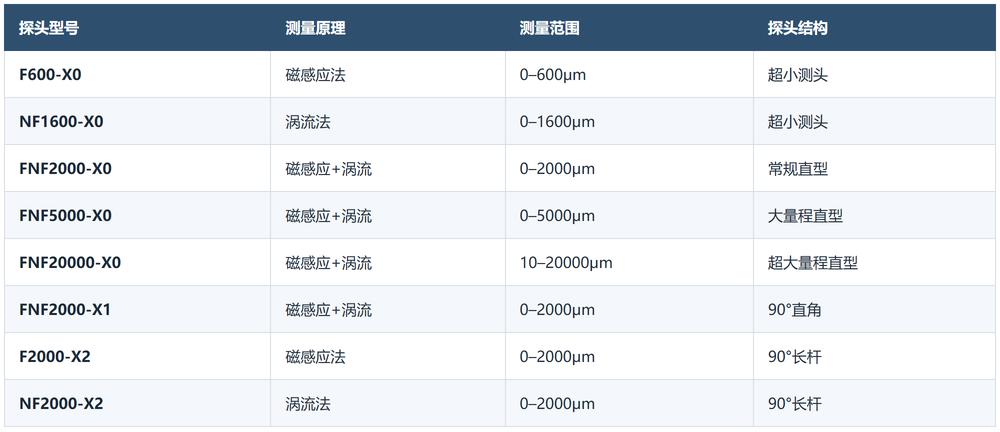
There are many coating thickness meters that support both detection methods and are able to identify whether the measuring matrix is an iron-magnetic metal or a non-iron-magnetic, and automatically choose to use magnetic induction or vortex thickness. A field example is the ls227 coating thickness machine with eight probes:
2 f iron-based probes: magnetic induction principles, detection of non-magnetic coverings on the iron-magnetic matrix。
2 section nf non-iron-based probes: vortex principles, detection of non-conductive coverings on non-magnetic conductive metal matrices。
4 fnf double-base probe: magnetic induction and vortex principles, applicable to different base materials such as iron and aluminium。
Practical test case: test of the thickness of zinc coated steel tubes and aluminum alloy anode oxide
Experimental purpose: verify that different materials use different measurement principles
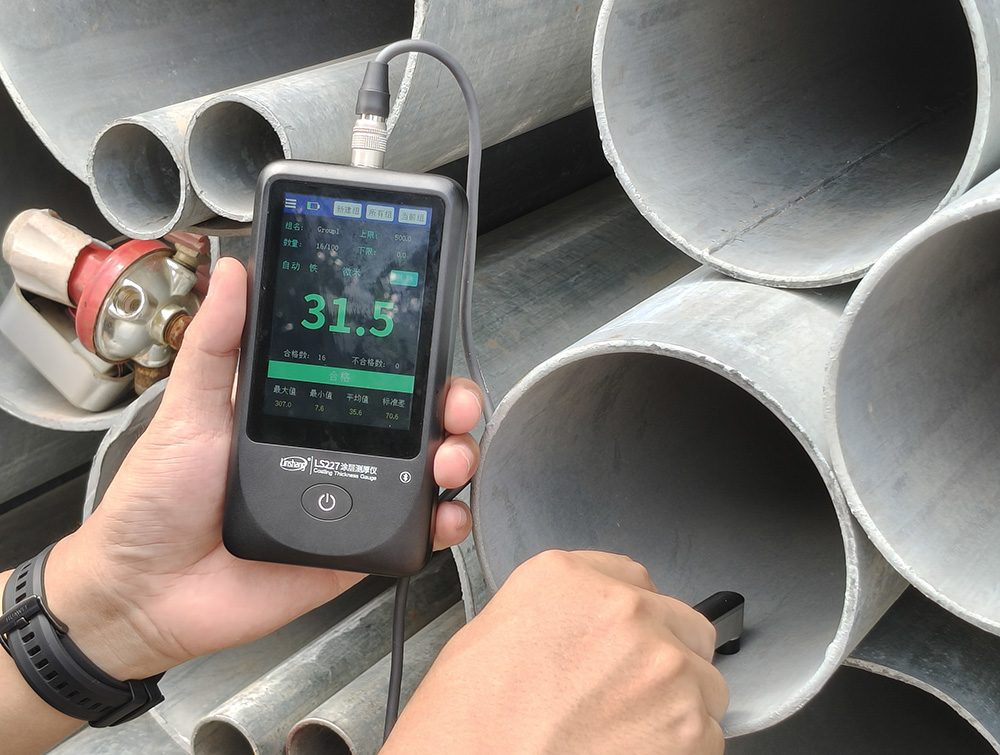
Use of instruments: ls227 coated thickness gauge with fnf2000-x1 probe
Work to be measured: zinc plating steel tubes, aluminum aluminum alumina tubes
Test steps:
To connect the instrument's mainframe to the probe, enter the settings interface to select the matrix material "iron", "non-iron", "iron/iron" and "iron " , at which point the instrument is tested using magnetic sensors。
The probe is pressed to the zinc plating tube point, and the instrument screen displays data such as “31. 6 micrometres” of iron。
On the aluminum aluminum aluminum aluminum aluminum with a probe, the instrument displays "+inf" and cannot identify the matrix material。
When setting the interface to switch the matrix material to "non-iron", the instrument uses vortex principles and presses the probe on the aluminum aluminum aluminum aluminum alumina tubes, the instrument displays "non-iron" "23. 4 um"。
In setting the interface, the matrix material is changed to "iron/non-iron" when the instrument follows the dual principles of magnetic induction and electro-vortex. A further measurement of zinc plating tubes shows "automatic iron" with "31. 5 micrometres" and "automatic non-iron" with "23. 6 micrometres"。
Experimental results: steel and aluminium alloys use different principles to detect coating thickness, and coating thickness instruments automatically recognize matrix materials and detect coating thickness in magnetic induction and vortex double-principle models。
Different matrices, such as gold, can consider dual-base probes, and a multi-prospective coating thickness gauge can also be used to model the probes according to different detection applications such as coating thickness and space size measurements. The smaller the preparation, the less the return to work — the most intuitive experience of all these years。









