


The wooden doors were coated, and it was not a board that was not looking well, but the thickness of the coatings on the same doors. The large plane is bright and the edges are thin; the sample is working well, and bulk production is followed by detour, cracking, orange peels or rinsing fluctuations. Such problems, if seen only physically, can easily be dragged to the packaging, installation or even after sale. The role of the wood coating thickness instrument in the field is to change the word "experimental" to "detected, read, documented."Process controlI don't know。
The varnishing of wood surfaces, base paints, paints, uv coatings, tide-proof coatings, and spray paints of metal surfaces are not the same. The wood is varnished, and the edges of the density plate and the end of the wood are more readily absorbed; the position of overweight sand may be thinly coated; and the shape line, slots, door-sets are not easily evenly sprayed. As a result, when the door is painted, the thickness of the coating cannot be measured only in the middle of the door, but also in the position where the mass risk is easily present。
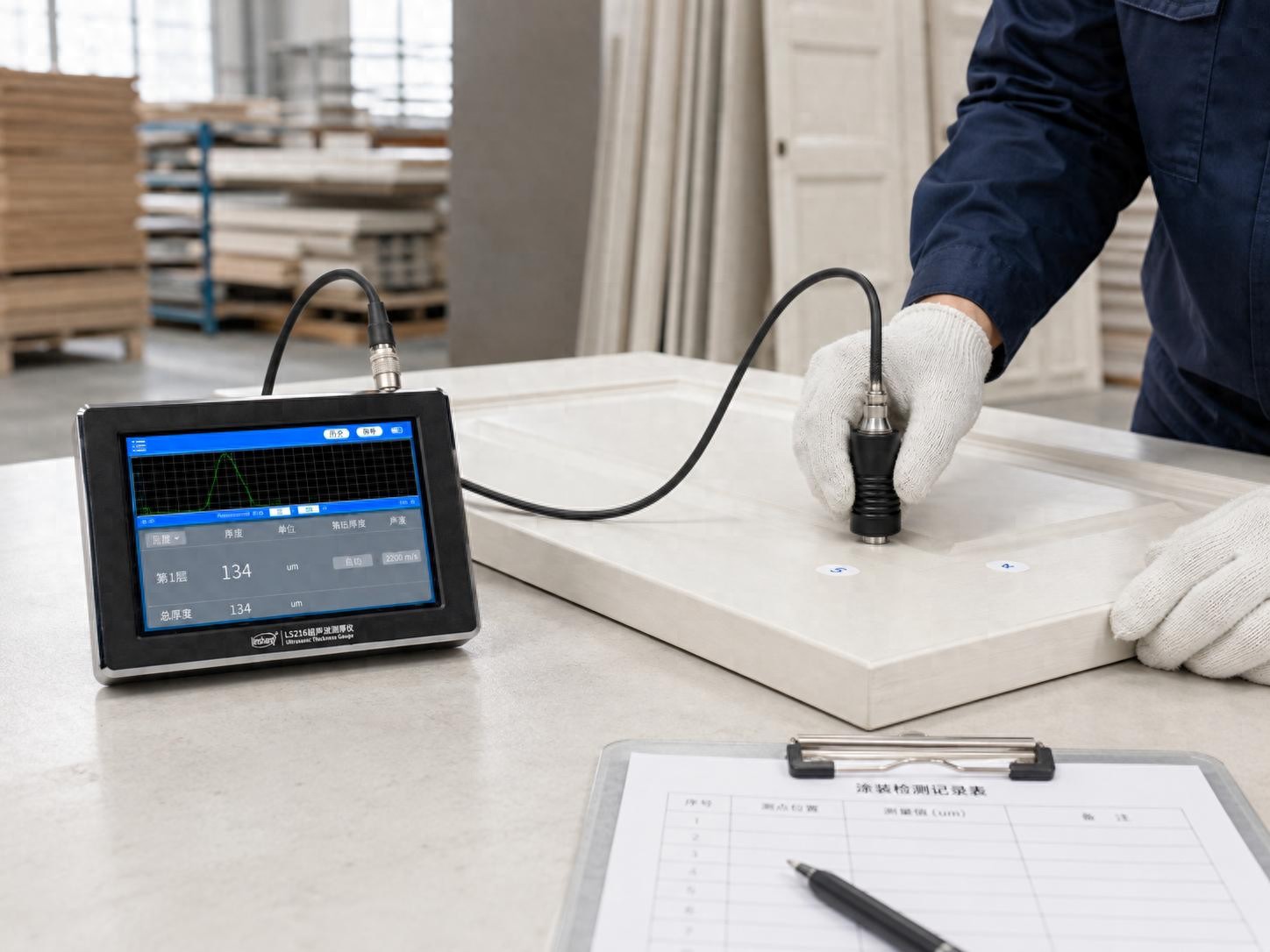
Why do you need to test the thickness of the wooden door coating
The thickness of the coating is directly related to the mass of the wooden doors. A thin coating may affect cover, glacial abundance, damp resistance and margin protection; it may lead to slow drying, high stress between layers, cracking or higher costs. In particular, the combination process of bottom-to-face paints can also expose matrix textures if the bottom is underfilled; if multiple coatings are overheated, later contraction and reinforcement also require attention。
On the production line, the wood coating thickness instrument is not necessarily used to determine whether each door is ultimately eligible, but is well suited for process inspection. For example, changing batch paints, adjusting spray guns, changing transmission speeds, changing sand-light parameters, and maintaining uv lamps, sample thickness can be extracted to see if the coating status is clearly drifted. This test is more proactive than waiting for the finished product to look unusual before returning to work。
Test link
A place of concern
Field purpose
♪ under the dust ♪
Large plane, side, corner
Determines whether the remaining coatings are stable after bottom filling and sand light
After the paint was painted
Central to the door, by the door, by the line
See if the coatings are evenly distributed and avoid local bias thin
Uv solidified
High light, grinding face, edge position
Review of thickness and batch consistency of coatings after solidification
Check before packing
On the back, on the side, on the side
It's easy to trace
The basic idea of hypersonic coating
Timber is not a magnetic base and many common metal coating methods are not applicable. The ultrasound coating thickness machine sends ultrasound through the probe, and the acoustics enter the coating and are reflected in the interface, and the instrument calculates the thickness based on the time of transmission and the sound speed. The principle sounds simple, but when actually tested, sound velocity settings, surface cleanness, coupling agents, and probe pressure affect the outcome。
Therefore, when wood coatings are used by personnel on the ground, it is not recommended to learn only “by weight”. A truly useful operating process should include pre-test preparation, parameter setting, repeated measurements, unusual review and data recording. The following follows a more common process of wooden door coating。
Operation step 1: set the sound speed first
Acoustic speed can be understood as the speed at which ultrasound is transmitted within a material. Wood-gate coatings may contain base paints, paints, paints or uv layers, with different acoustic speeds for different systems. There are three more conservative methods: selection of acoustic speeds based on the material; reverse acoustic speeds measured using the known thickness template; and manual input after acoustic speed given by a process or quality review document。
If an enterprise has a fixed coating system, it is recommended that acoustic parameters be established using a similar process template. For example, under the same base paint with the same face paint, under the same solidification, a reference sample is made and the acoustic speed is measured with the known thickness. The data will be more comparable when the same batch is subsequently measured. If a paint formulation, coating structure or solidification condition is changed, the acoustic speed should be re-established and the old parameters should not be applied for long periods。
Operational step two: clean materials surface
Surface contamination in wooden door-painting workshops is common. Dust, polished powder, oil stains, handprints, residual packaging membranes, and patches of incomplete drying all affect spot contact. The measurements shall be preceded by the cleaning of the spot and the avoidance of visible currents, bubbles, damage and pits. If an anomaly area is to be measured, it should also be clearly stated in the record that it cannot be compared with normal surface readings。
For the high-light wooden door, the cleaning should be light, avoiding scratches; for the open paint and the visible surface of the woodline, cleaning does not mean that the texture is “cleaned”, but rather removes the stains that affect the combination. Crude texture itself can cause reading fluctuations, which need to be judged by multipoint measurements and repeat readings。
Operational step iii: painting coupons
Ultrasounds enter the coating from the probe and require a coupling agent to remove air gaps. There are two extremes at the scene: too few coupling agents, too little air between the probe and the surface, and a back wave of instability; too many coupling agents, which are easy to slip, change at the pressure angle, and readable. The correct approach is to paint a thin and even layer at the point, allowing for steady contact。
When combined agents are used, care is taken to influence the surface of the finished product. For wooden doors to be packed, the measurements shall be based on the business process to wipe clean points to avoid residual effects on the appearance or subsequent membrane. If the customer is demanding a high level of surface cleanliness, the mixture should first be certified in a non-visible location without creating traces。
Operational step four: measure by pressure probe
The probe shall, as far as possible, press vertically on the surface of the spot, and the pressure shall be stable, and not pull side by side. The large flats of the doors are easier to measure, with lines, arcs, grooves, seals depending on the size of the spot. If the point is too narrow or the curvature is too high and readings are unstable, it is not appropriate to impose conclusions。
If the number of consecutive readings varies significantly, the sound speed, coupling agent and surface state should be checked first, before considering whether the position is not suitable for ultrasound measurements. On-site personnel are required to develop a practice of double-checking: at least multiple points are taken from the same area, and the abnormal values are reviewed in a neighbouring location and, if necessary, the head of the examination is asked to confirm whether the batch was recorded。
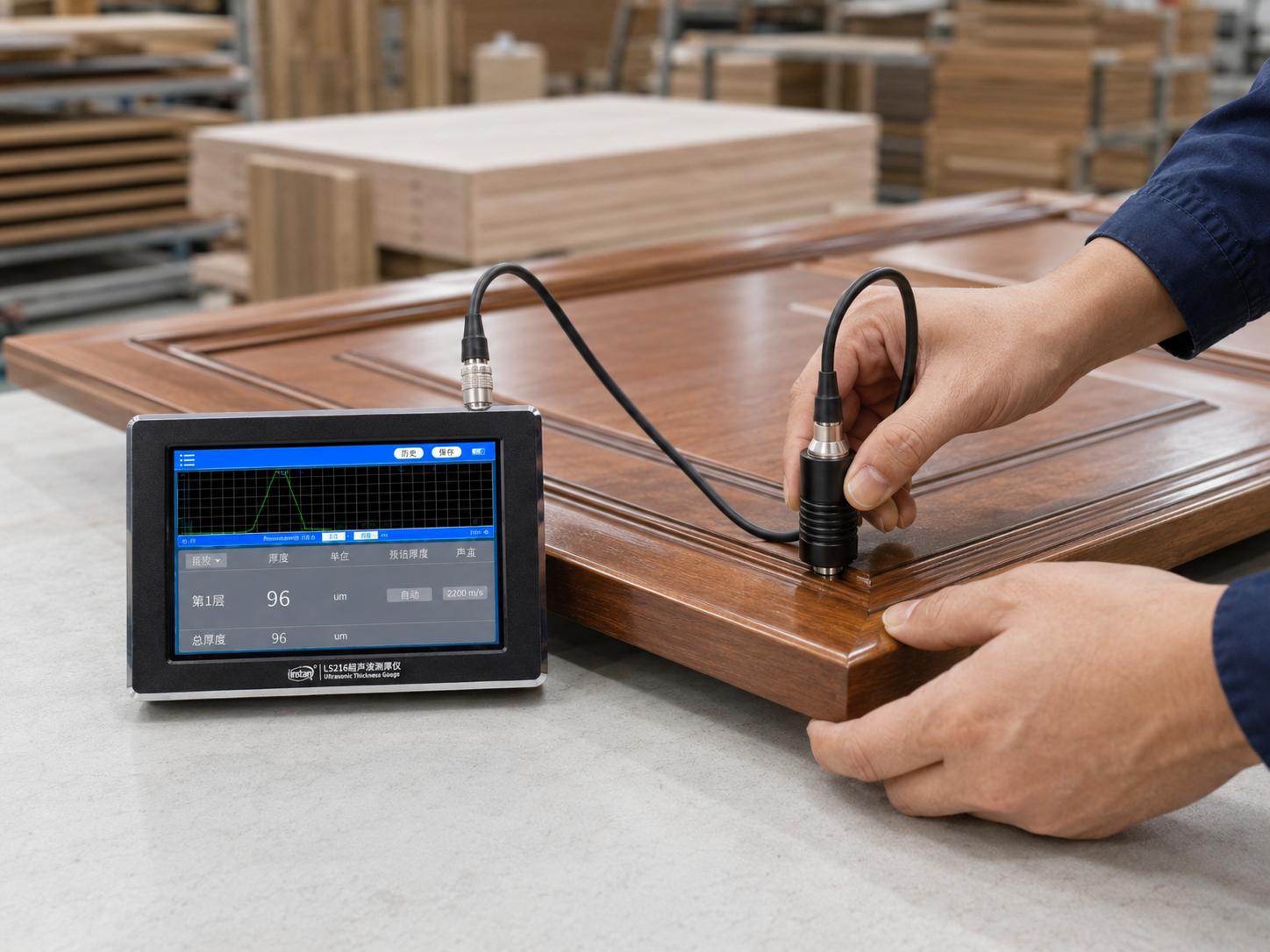
Operational step five: result reading and retention
Reading is not the end of the process. More important is the way in which wooden coating is carried out. It is recommended that records be established by door type, batch, paint lot number, spray date, location of the site and detector. Averages, maximum values, minimum values and abnormalities can be recorded for each region. This would allow for a review of the state of paint at the time, rather than relying solely on experience, once the retrofit or client action arose at a later stage。
In some of the on-site reviews of furniture and carpentry enterprises, portable ultrasound coating thickness monitors are deployed as process detection tools. In the case of the ls216 ultrasound thickness instrument on the forest, such instruments are more suitable for use in material review, production inspection, product sampling and quality traceability. Where third-party testing reports or contested decisions are involved, they should still be judged in combination with existing standards, sampling rules and measurement status。
What do you mean
First, when coatings are not fully solidified, readings are not recommended as formal batch conclusions. Second, if woodlines are deep, open holes are visible or the surface is rough, the spot shall be increased and the surface state shall be indicated. Third, the position of the corner, trough and curve can only be measured when the contact conditions of the probe are met. Fourth, the speed of sound should be reconfirmed when the coating structure changes. Fifthly, the instrument should be confirmed in the form of an enterprise measurement management requirement after a long period of service。
The wood coating thickness instrument is not a tool to replace process experience, but rather to make it possible to record and review it. The earlier the wood-gate paint thickness was checked, the lower the cost of refurbishment; the more complete the data records, the clearer the quality. This is of more practical value for bulk coating production lines than simply seeking a single reading。









