



You can subscribe to hac online by clicking on it
I. Definition, area of application, classification and rationale for air conditioning
Definition of air conditioners: air conditioners full of room air conditioners, a processed air equipment that directly provides the room or other closed area to regulate temperature and humidity in the room
2. Name of ac: kfr(d)50lw/t (d bp j xf)
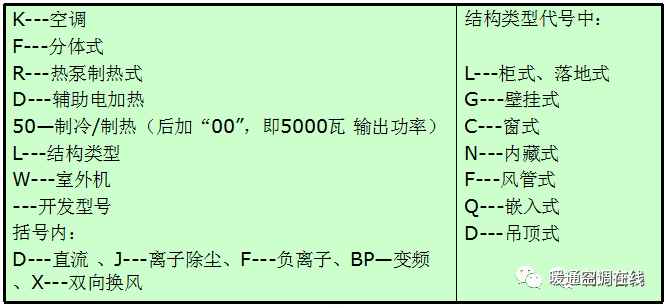
Note: general air-conditioning voltage is 220 v, but 3 of them are 220 v and 380 v, 220 v are commercial for household model 380 v and 5 and 10 are common machines " s" (all of them typically have the word "s" in air-conditioning models)
3. Applicable area for air conditioning
1. 0: 2300 w-2500 w applicable area 11-17 m2
1. 25: 2600 w-2800 w applicable area 18-23 m2
1. 5; 3000 w-3600 w, applicable area 18-25 m2
2. 0: 4000 w-5200 w applicable area 30-35 m2
2. 5 horses: 5800 w-6200 w applicable area 35-45 m2
3. 0: 6500 w-7200 w applicable area 40-50 m2
5. 0 horses: approximately 60 m2 of area applicable to: 12,000 w
10: 240,000 w for approximately 80-100 m2。
Formula: room area (m2) x output power/m2 (120-150w) = room actually applies refrigeration output power。
4. Electricity consumption of air conditioners
1. 0 veers: 880 w-950 w
1. 25 pieces: 950 w-1300 w
1. 5; approximately 1300 w
2. 0: 1800 w
3. 0 horses: 2800 w
5. 0: around 5000 w
Ten. Around 10,000 w。
5. Air-conditioning environments
Single cold 18°c ~ 43°c; cold heat - 5°c - 43°c。
6. Classification of air conditioning
Air conditioners are generally classified as stand-alone (box) air conditioners, hanging air conditioners, suspension air conditioners, central air conditioners and vehicle air conditioners。
Stand-by generally applies to the living room because it is far away. Households are more suitable for hanging, and window-based air conditioning is generally suitable for bedrooms, since the general bedroom area is small and window-based air conditioning is largely replaced by mounted air conditioning. The suspension air conditioners and the central air conditioners are generally used in multiple rooms such as hotels. Car-based air conditioning is generally used in the vehicle, which provides some convenience for drivers and passengers。
7. Distinction between wac and rac
The high power of the variant air conditioner is activated, rapidly reaching the established temperature, maintaining low power and balancing room temperature, thus allowing for rapid cooling, power savings and low room temperature fluctuations。
The stationary-frequency air conditioner operates at fixed power and maintains indoor temperature through frequent switches, which slows thermal cooling, shocks the household electricity grid and fluctuations in room temperature。
8. Distinction between direct-flow and communication-frequency air conditioning
The direct-frequency air conditioner changes the electric voltage of the compressor, thereby changing the working speed of the compressor to the working voltage of 150v ~260v。
Interchange-frequency air conditioners change the power frequency of the compressor, thereby changing the working speed of the compressor and the power frequency of 10hz ~150hz。
Refrigeration cycle component
A closed system consisting of compressors, throttle catheters, evaporationers, condensers and electromagnetic transformation valves, one-way valves, limitors, filters, dryers, silencers, etc., in which refrigerants are injected。
10. Air cycle segment
Composed of trans-winders, centrifuges, axle winders, wind filters and wind escape fences。
Electrical control component
Composed of computer control boards, temperature monitors, switch controllers, power relays, starters, overload relays, frost-freezing relays, heat-sensitive electrical resistance, and capacitors, compressors heaters, etc。
12. Shell component
Composed of indoor and outdoor carcasses。
13. Air-conditioning fans
It can be divided into axle-flow fans, centrifugal fans and transient fans. Axle current fans are used for outdoor machines, which generate gas by using the power generated by high-speed rotation of the leaves, thus allowing for the exchange of indoor gas. A continuous fan is used for indoor hangers, and when the fan operates, the air flow flows vertically from one side of the wind wheel to the wind wheel and then from the other。
14. Air-conditioning performance factor and energy efficiency that's right
The national standards set the test conditions for nominal cooling: an indoor dry ball temperature of 27 degrees and a wet ball temperature of 19. 5 degrees; an outdoor dry ball temperature of 35 degrees and a wet ball temperature of 24 degrees。
The national standards set the test conditions for nominal heat preparation at 20 degrees for indoor dry balls and 15 degrees for wet balls, 7 degrees for outdoor dry balls and 6 degrees for wet balls。
(the country also provides that the actual cooling/calorization of air conditioners is allowed to be 8 per cent lower than the nominal value
Performance factor for air conditioners (eer)
It refers to the ratio of cooling to total power consumed when the air conditioner is operating:
Err = actual cooling / actual consumption total power (w / w) = branded refrigeration / branded input power (w / w)
The physical significance of the performance factor is the amount of cooling that can be produced per 1w energy consumption, so the less energy is produced by air conditioners with high performance factors。
15. Energy efficiency ratio of air conditioners (cop)
It refers to the ratio of heat to total power consumed when the air conditioner heats:
Cop = total actual calorie / actual consumption (w / w) = branded heat / branded input power (w / w)
The physical significance of the energy efficiency ratio is the amount of heat that can be generated per 1w energy consumption, so energy-efficient air conditioners produce equivalent heat less electricity。
Selection, installation and routine maintenance of air conditioners
Application of air-conditioning voltage: the range of voltage of fixed-speed air-conditioning is: 198-242 v; the range of voltage of variable-frequency air-conditioning is: 187-242 v, and at the same time, it can be activated at ultra-low pressure under 150 v。
Simple detection of breakdowns in air conditioners: checking the power supply and the voltage range is normal; checking the remote control battery for electrical power; setting parameters for normality; interference with the remote control signal by electromagnetic interference near the inner machine。
Refrigeration of air conditioners is determined to be 2. 7 metres high for layers, 2. 4 metres high for ceilings and 1. 8 metres * 1. 8 m for windows, with heat insulation and a standard room of good seal, with a cooling capacity of 130 w per square metre area, but limited to the impact of cities, directions, floors, etc., can be estimated by the general customer at 160 w/m2。
The selection requirements for air conditioners outlets are 10-16 for the general wall hanger and 2p or less, 25-30 for the two p or more, and require a reliable approach, closer to the air conditioner plug, which must be equipped with a special fixed slot and must not be reconnected to other appliances。
The requirements of acs for power lines: the entry line shall not be less than 10 square millimetres. Air conditioners should have dedicated branch lines with a capacity at least 1. 5 times greater than the maximum current of air conditioners. (until 2p shall be selected for single-share copper lines of 2. 5-4 mm and above 2p shall be selected for single-share copper lines of 6 mm。









