


I. What is the rationale for the density scale test
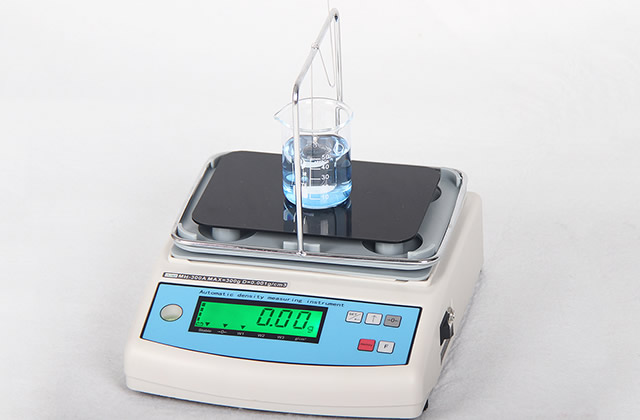
Density scales are a special scale for measuring the density of objects, which can be shown directly on screen. What is the rationale for density scales
The density of an object = the weight/volume of the object, and the density scales are also tested and calculated using the akimid principle that an object immersed in geostationary fluids (gases or liquids) is subject to a floating force equal to the volume of fluid weight that the object excreted, vertically up and through the shape heart of the discharge, i. E. F float = g liquid discharge = m liquid discharge g = g/gv queuing。
The essence of density scales is to measure the mass of solids in air and in liquids (e. G. Water, ethanol, or measured liquids) and then to calculate the density, which is calculated using a known density liquid as an auxiliary liquid, which can be measured by the mass of solids to be measured in air (a) and in auxiliary liquids (b)。
Ii. Density scales formula
The use of density scales to measure density follows the akimid principle, with some formula:
A solid immersed in liquids will be subject to buoyancy, the value of which is equal to the weight of the volume of solid excavated liquids, and the density scales will allow the solids to have the same amount in air as in water
== sync, corrected by elderman == @elder man
Or if the volume of the impregnated solid is known, the density of the liquid is determined by the following pattern:
Ρ(f1) = g/v。
Here: old = solid density, old (f1) = liquid density, w(a) = solid weight in air, w (f) = solid weight in liquid, g = floating power of immersed liquid, v = volume of liquid。









