


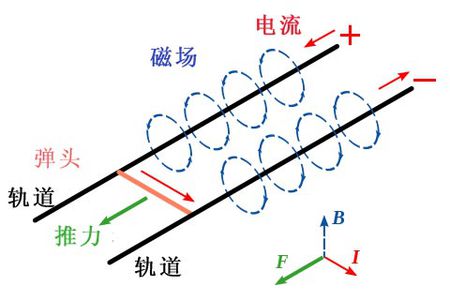
One of the main features of the magnetic field is its power to act as a carrier conductor, called electromagnetic. The function of the carrier in the magnetic field is proportional to the current in the conductor, the length of the conductor in the magnetic field, the magnetic intensity and the sine of the angle between the conductor and the direction of the magnetic field. When the conductor is vertically in the direction of the magnetic field, the conductor is the most powerful. When the conductor is parallel to the direction of the magnetic field, the conductor is inert。
Magnetic cannonsHe's an important member of the artillery family. The electromagnetic gun is a new type of hypervelocity launcher, also known as an electromagnetic launcher, that relies entirely on electromagnetic projectiles. It is on the basis of this fundamental physical principle that the electromagnetic gun is designed and developed to accelerate the projectile using the electromagnetic force (usually called lolenzli) received in the magnetic field by the motor charge or by the fluid conductor. Depending on the method of work, the electromagnetic cannons are divided into two types of conductor and wire cannons。
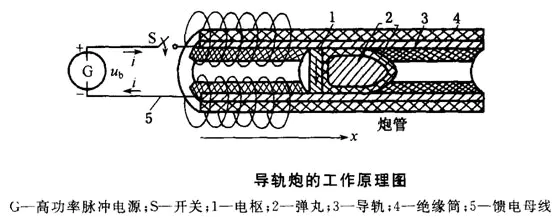
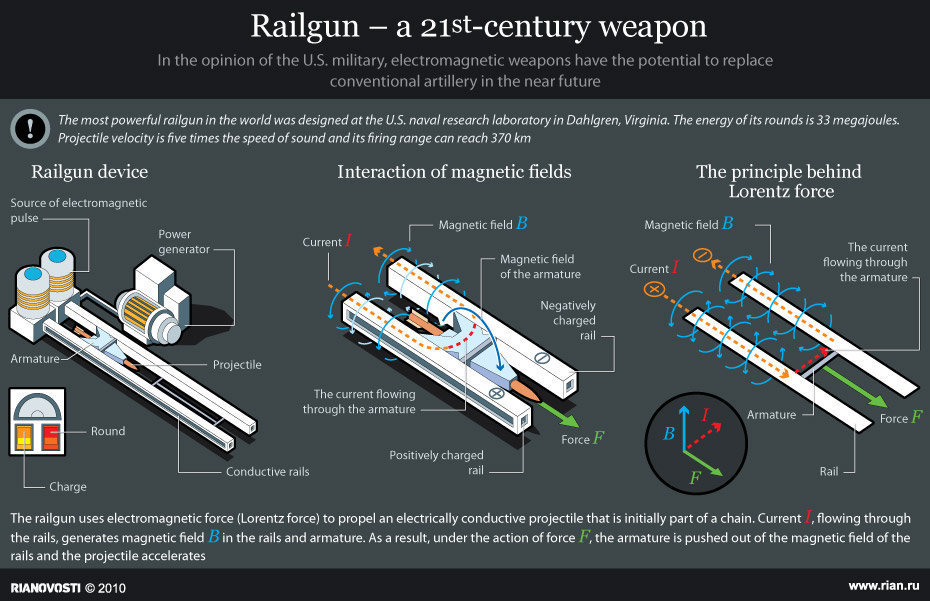
The guidance cannon consists of a parallel track and a mobile power hub (balls) caught between them, as well as switches and power sources. Following the switch, when a large electrical current flows from one track to another through the power hub at the bottom of the shell, a strong magnetic field is formed between the two tracks, which interacts with currents at the currents of the current power hub, generating a strong electromagnetic power (lorenz) that promotes the discharge of the current power hub (balls) from the trajectory, which, under current engineering conditions, can theoretically begin at a rate of 600 m/s ~8000 m/s。
The greater the magnetic field strength and current, the greater the electromagnetic power. The length of the circuit is determined by the size of the projectile, it will not change significantly and the main influence will be on currents and magnetic fields. For example, to accelerate a shell of 1 kg mass to 5,000 m/s, 2. 5 x 10⁶ n is required if the acceleration is assumed to be constant at 0. 002 seconds. If the electro-epide (i. E., the size of the projectile) on the projectile is 0. 05 m and the magnetic field is 20 t (which is the maximum value that can be achieved by superconductive wires), the required current strength is 2. 5 x 10⁶ a. The kinetic energy obtained by the projectile is 12. 5 x 10⁶ j and the time to convert storage to kinetic energy is several milliseconds, i. E. The acceleration time of 0. 002s above, with a power of 6. 25 x 109 w. In this calculation, it is assumed that there will be no depletion of the entire process and 100 per cent efficiency. In fact, energy losses are significant, only to provide a quantitative concept of the energy required。
The guidance gun under study may take a variety of forms, such as a single, chained, conjunctivated and multilayered, and may select multiple dimensions of the cannon, such as squares, circles or ellipses, according to the course. The main types of power hubs are solid metal, plasma and hybrid. Energy for pulse power is currently provided mainly by capacitors, high performance batteries, various unipolar generators, pulse transformers, compensatory pulse generators (i. E., mandatory generators) and explosive generators, and superconductive energy storage systems to be used in the future. The advantages and disadvantages of these different pulse-power energy sources are difficult to assert at this stage。
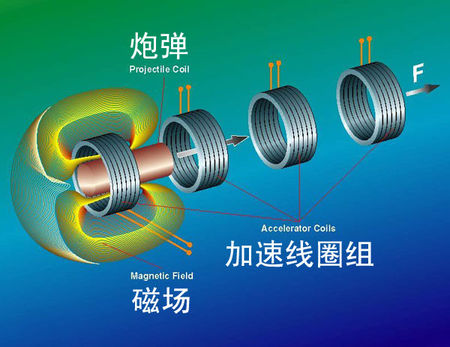
The wire guns consist mainly of sensor-coated fixed and actionable wires, as well as energy storage, switches, etc. Many of the same-calibre same-axis fixed-wire rings are equivalent to the body of the gun and can move the wire equivalent to a bulletball (in fact, a wire is embedded on the bulletball). When a strong current is transmitted to the first wire of the barrel, a magnetic field is formed, the coil sensor on the projectile produces an electric current, the magnetic field from the fixed coil interacts with the sensory current on the moving coil (lorenzian), which accelerates the aerodynamic coil; when the shell reaches the second coil, it supplies the second coil and advances the projectile, and then accelerates it to a very high rate through the third and fourth coil ... Until the last coil. The thrust of the accelerator projectile (lorentzli) is higher than the current strength in the fixed wire and the current strength in the projectile ring and the degree of intersensation of the fixed and actionable wire。
The structure of the wire cannon is homogenous, flat, smooth contact, magnetic accelerator, etc. There is also a reconnected artillery consisting of multiple upper and lower rectangular cones. The emitters accelerated their movement in the middle of the line. Relaying guns are considered to be the structural form of future advanced space-based electromagnetic guns, but only some preliminary theoretical and experimental studies have been carried out on them. It was said that the reason for the name was the reconnection of the cannon was the reconnection of the magnetic field at each level of the wire to the power grid。
The electromagnetic cannons are mainly guided and coiled in principle, but are structurally mixed. The threat analysis of modern battlefields has shown that new weapon systems must increase the range and effectiveness of firing. However, the performance of the artillery used in the attacks over the last 100 years has reached its limit due to the limitations of gunpowder gas heat parameters. The use of electromagnetic propulsive methods, for example, could well exceed the performance limits of conventional artillery, so that the research on electromagnetic artillery technology for more than a decade has been given special attention and has made remarkable progress worldwide。









