


This is a comprehensive presentationArtificial intelligence(ai) the rationale, including its definitions, components and how to build and operate the ai system over time. The article elaborates on the ai workflow from data collection, pre-processing, model selection, training, testing assessment, optimization and deployment to ongoing learning, with the aim of helping readers to better understand ai technology and its applications and hopefully to help you。
Ai is an evolving technology designed to imitate human intelligence. It helps computers learn how to reason, learn and solve problems like human brains。
The implementation of artificial intelligence technologies in industries ranging from health care to finance has a meaningful positive impact on our lives. Artificial intelligence has the potential for progress in areas such as auto-driving cars and personal assistants, which can drive scientific breakthroughs, enhance medical scanning capabilities and achieve accurate facial recognition。
As artificial intelligence research accelerates and artificial intelligence applications play an increasing role in business and personal life, it is more important than ever to understand how artificial intelligence works and how it is used。
This paper provides a comprehensive overview of artificial intelligence, including its components, and the progressive presentation of its working principles. What is artificial intelligence
Artificial intelligence is an area of computer science that attempts to simulate human thinking. You provide the information in the data source to an artificial intelligence system to process it and create a trained model using input data as a reference。
The more data there is, the better the artificial intelligence system can learn。
However, not all artificial intelligence systems require large data sources. You can use different techniques to train models with smaller data sets, for example, enhanced learning (one of them)Machine learningTechnology, let's move on。
After you have finished, you can ask the ai to estimate and act on the knowledge you have learned. However, the extent and accuracy of artificial intelligence responses depend largely on the quality and algorithm of training data。
You can use ai solutions in many ways, including:
Chat robot. Artificial intelligent robots are trained using operational data to talk to humans and answer questions in real time in human languages. Virtual assistant. The artificial intelligence tools amazon alexa, apple siri and google assistant help consumers in their daily lives. Generating artificial intelligence. The creation of artificial intelligence tools (e. G. Chatgpt for openai), image tools (e. G. Midjourney) and voice tools (e. G. Eleven labs) can generate different forms of media based on input. Voice recognition. The voice recognition tool determines who speaks and what they say on the basis of audio input. Search engine. The search tool improves the information-gathering process by creating better user experience and producing results in real time。
Machine learning: the basis of artificial intelligence
Mechanical learning (ml) is the foundation of artificial intelligence system learning. The data you provide for machine learning tools help artificial intelligence to create data sets to learn how to make decisions and forecasts without programming to perform specific tasks。
However, while machine learning allows artificial intelligence systems to learn from data, they still need programming and algorithms to process data and generate meaningful insights。
Machine learning works for a large amount of data for tools. You can then process the data to create mathematical models that can be used to handle artificial intelligence tasks. In essence, it allows artificial intelligence applications to perform tasks like humans。
Image classification is a good example. Suppose you want to train artificial intelligence to recognize cats。
You can provide cat images to the machine learning system and mark them as cats. The system then learns from what you provide and identifies any pictures of the cat you provide after the training。
Neural network: construction module for artificial intelligence
Neural networks are machine learning algorithms that provide tools for processing information based on artificial intelligence models. They consist of connected nodes (or artificial neurons)。
These nodes are adapted to information about access to the nervous network. This allows the nervous network to discover relationships and patterns in the data。
The nodes are divided into layers, each of which has its own function:
Enter a layer to receive data. Hide layer processing data. The output layer produces results。
In-depth learningIt is a neural network with multiple hides, so it can learn more complex relationships in data. Data scientists can then optimize these layers using different formats (text, audio, video and image) to improve accuracy, but they need more training to work. Data: artificial intelligence fuel
Data are “fuels” for artificial intelligence systems. An artificial intelligence would not have any function without a large number of data sets to train artificial intelligence models。
Good artificial intelligence training data have several features, including:
Full information, all missing and accurate with ai system functionality, no incorrect data up-to-date and no outdated information
You use multiple types of data to train artificial intelligence systems, divided into three categories: structured, unstructured, and semi-structured。
Structured data have predefined formats. Think about dates, addresses, credit card numbers, digital series and other standard input methods. A standard format is used for each data entered into the ais。
Destructured data lack any specific information. Enter unstructured text, images, videos and images to allow ai to find the pattern in the data. Artificial intelligence can handle information using natural language processing (nlp), computer visualization and other methods。
If there is no predefined model, you can use semi-structured data. This data is in file formats such as json, xml and csv. This path will bring you the benefits of unstructured data sources and the ability to easily store training data。
Algorithm: problem solver of artificial intelligence
Algebra is the backbone of artificial intelligence. They are mathematical programs that tell artificial intelligence how to learn, improve decision-making and solve problems. Algorithm translates the raw data into the insights you can use every day。
The popular algorithms used in ai programs include:
Linear regression. Projections are based on the mathematical relationship between input and output. Decision tree. Model decisions based on data attributes. K-average grouping. Creation of data clusters and identification of centres for each cluster based on input identification mode。
These algorithms work by getting the data you entered and entering it into the algorithm. The more high-quality data you provide, the easier the algorithms are to find the mode and turn it into a viable idea
How artificial intelligence works
Since you know what artificial intelligence is, you might want to know how to use it in practice. This section will guide you in the process of building an artificial intelligence system。
Artificial intelligence process: testing and evaluation of an optional training model for pre-processing data acquisitionModel optimizationDeployment of continuous learning
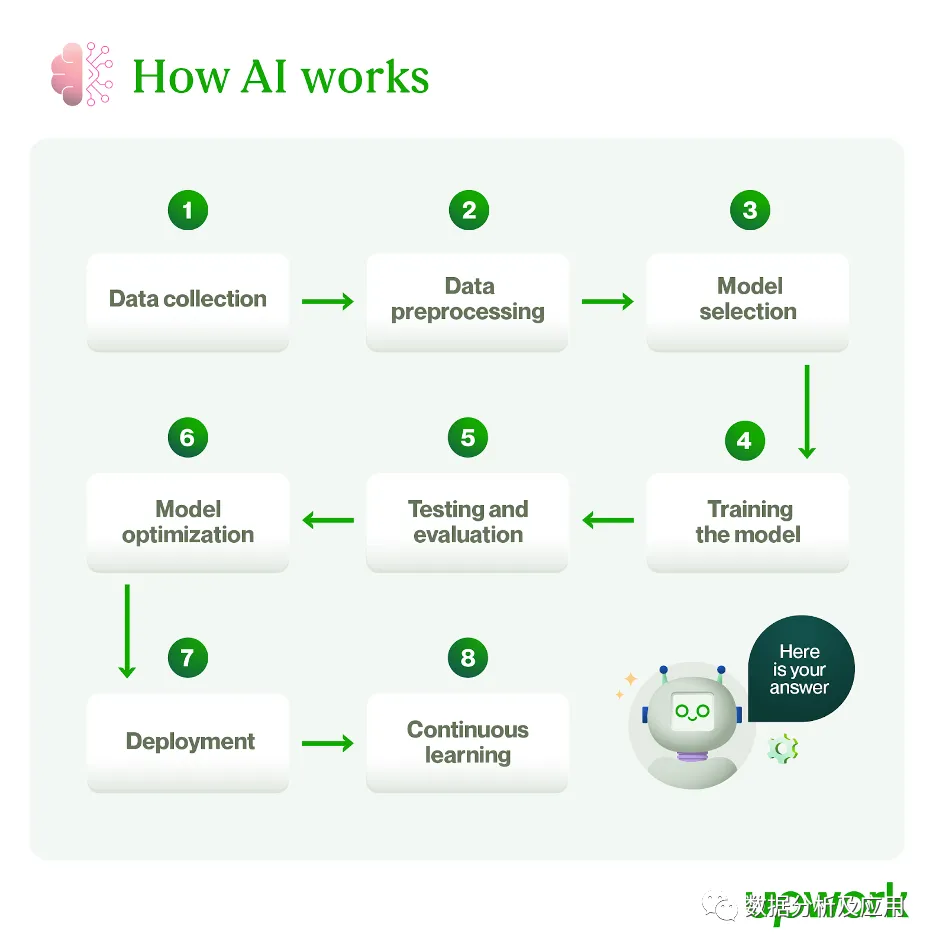
Data collection
Data collection is one of the most critical components of developing artificial intelligence systems. This is the process of collecting large amounts of data to train artificial intelligence systems。
Your training data can be in any format: text, number, image, video or audio. The format of the data depends on whether you use structured or unstructured data sets。
Let's take a look at social media posts and look at brand emotions. A large number of data sets are collected from social media and the emotions of these posts are classified. Are they positive, negative or neutral
The results are placed in the csv document for training purposes. After you have finished, you can determine how your brand feels online。
2. Data preprocessing
You should not only enter the data found. An artificial intelligence system requires accurate, up-to-date and relevant information to achieve optimal results. There is no guarantee that this will happen without pre-processing data, especially when you have a large amount of data。
Noise removal (also known as data smoothing) is an important process. This means finding and deleting any data that undermines the learning process and repairing any format of structured data。
An example is the artificial intelligence model that is being trained in financial analysis. View your training data (e. G. Stock prices and interest rates) to find any incorrect format. Include or delete the dollar symbol to ensure that decimals are in the right place and to remove any other anomaly。
3. Model selection
Model selection is a step in the process of artificial intelligence development in which you can select an artificial intelligence model that is best suited to the current problem. Many artificial intelligence models are available, including machine learning algorithms, deep neural networks or hybrid models using various technologies。
In addition to different types of artificial intelligence algorithms, several types of machine can be used to learn:
Supervision of learning. Learning and acquiring knowledge relies on manually marked data。
No supervisory learning. Knowledge is acquired through untagged data and learning models。
Enhanced learning. Learning from mistakes and acquiring knowledge relies on interactions between artificial intelligence and the environment。
Depth learning models can convert data from multiple layers. It suits more complex mandates。
The model you have chosen will depend on several factors, including:
The amount of data you have waiting for training your total resources your data type your total budget
4. Training models
When you preprocess data and select models, you enter the training phase。
At this stage, you will divide the data into two groups: a training set and a validation set. The training set is the data set that you use to train the model。
The model you choose will start reading your data sets, using mathematical and computational models to view data patterns and create output models to help them make future projections。
The time required depends on the amount of training data you have and the size of the model you plan to train. The more layers, the longer it takes, the more resources are used。
5. Testing and evaluation
You should not just expect the ai model to be productive after training. Depending on the quality of the data set and the performance of your pre-treatment work, the final model may not give good results。
This is where you create separate validation data sets. Your authentication dataset contains the expected output after input and placement in the ai application。
When verifying the ai model, you need to measure it several times. Accuracy (percentage of correct projections), accuracy (percentage of actual positive projections) and recall rate (percentage of cases correctly identified) are the most common。
Problems may arise in the following situations:
Data poor. Inaccurate data means your model cannot produce good results。
Outstanding. The ai model is too simple to capture data patterns。
Prejudice. These data tend to be one direction and the trend is the same as that of human prejudice。
Modelling optimization
Model optimization is the process of improving the performance of the ai model. This may mean fine-tuning or modifying model parameters and using regularization techniques。
The fine-tuning means optimizing the parameters of the model. You can change the weight of the nervous network or the ai algorithm used to adjust the model。
Adjusting the structure of the model means adding and deleting layers to the neural network in order to change the connection between layers and to better capture the complexity of data。
Corrective technologies help to prevent over-synthesis, which is very useful when models perform well on trained data (rather than on missing data). Rectification makes artificial intelligence more accessible and provides more accurate results。
7. Deployment
Deployment is the final stage in the completion of the ai model training and optimized model development life cycle. This is the process of integrating models into existing systems or constructing new computer programs to use models。
Assuming, for example, that you have a new artificial intelligence model that you want to use for financial forecasting. You have a product business and want to know about future sales。
You will link the model to the current computer system to obtain sales data, finance and other relevant information. In return, the model produces a report estimating the sales and revenues you can expect in the future。
8. Continuous learning
Artificial intelligence models are not one-off training. You must continue to see the exact output regularly on the basis of the new information training model。
You can do this in several ways. First is to fine-tune your basic model. You can generate the base model based on initial training data and fine-tune the model based on new data. This provides updated data for your artificial intelligence model to make more accurate predictions。
Another way of updating artificial intelligence models is through enhanced learning of human feedback (rlhf). Through this process, you will monitor the feedback from the artificial intelligence system and rate it. The system would then understand what it had done wrong and use that feedback to provide better results in the future. General
As you can see, training an artificial intelligence system takes several steps。
Data collection. Collects relevant data for your use and transmits it to the training program to inform artificial intelligence. Data preprocessing. Check the data sets to remove the wrong data, fix the format and ensure that the information is kept up to date. Model selection. Select the ai model that best suits your needs. Model training. Provides your training data to the ai model for training. Model tests. Use the test data set to ensure that your model produces accurate results. Model optimization. Models are modified to improve results and performance. Deployment. Integration of new artificial intelligence models with the current system。
Continuous learning. Keep updating your artificial intelligence model based on new information to maintain its relevance and produce good results。
However, this is only an illustrative process. Not all artificial intelligence systems are identical, so you may need to change the process to meet your unique needs。
The diagram is from unsplash, based on the cc0 protocol。









