


Lithium batteries (fillable) require maintenance by their own characteristics. Since the lithium cell itself has materials that dictate that it cannot be overcharged, overlayed, overflowed, short-circuited and overheated, lithium components of lithium batteries are always presented with a fine maintenance panel and a current safety device. The lithium horseman showed you the lithium shield
Typical lithium batteries protect circuits
Because of the chemical properties of lithium batteries, their internal electrical and chemically converted chemically positive reaction during normal use, but under certain conditions, such as overcharge, discharge and run-off would lead to a chemical side reaction within the battery, which would seriously affect the cell's performance and service life and could generate large quantities of gases that would cause a rapid increase in the internal pressure of the battery to explode, resulting in safety, all lithium batteries would need a protected circuit for effective monitoring of battery charge, discharge and, under certain conditions, for closing off the charge and discharge circuits to prevent damage to the battery
The figure below is a typical lithium battery to protect circuit principles。
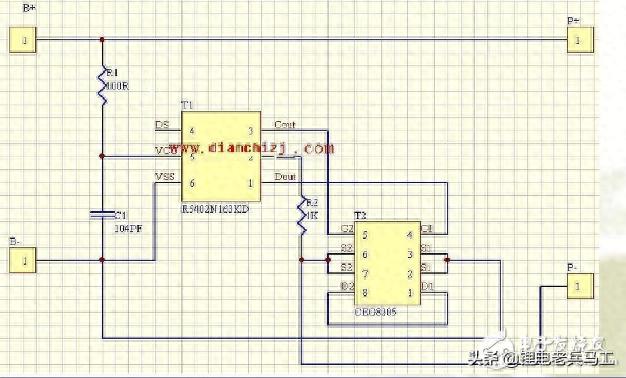
As shown in the figure above, the protected circuit consists of two mosfet (v1, v2) and one control ic (n1) plus a number of resistance elements. Control of ic to monitor battery voltage and circuit currents and control of the two mosfet grids, which act as switches in circuits, control the steering and closing of charge circuits and discharge circuits, respectively, and c3 as the time-extension, which has charge protection, discharge protection, pass protection and short circuit protectionRationaleThe analysis is as follows:
1. Normal status
The “co” and “do” feet of n1 in the normal state of the circuit both export high voltage, both mosfet are in a state of conductivity, and batteries are free to charge and discharge, and because the mosfet guidance resistance is small, usually less than 30 millimetres, their conductive resistance has little effect on the performance of the circuit. The current consumed to protect circuits in this state is μa level, usually less than 7 μa。
2. Overcharge protection
Lithium ion cells require a constant current/consistent pressure charge at the beginning of the charge, which rises to 4. 2 v (with a constant pressure of 4. 1 v, depending on the normal material), to a constant charge until the current becomes smaller. When batteries are charged, the chemical side reaction of the battery will increase when the battery voltage is charged to more than 4. 3 v, causing damage to the battery or safety problems, if the charger circuit is out of control and the battery continues to be consistently charged after the battery voltage exceeds 4. 2 v. In batteries with protected circuits, when the control ic detects a battery voltage of 4. 28 v (which is determined by the control ic, with different ic values), its “co” foot will be converted from high voltage to zero voltage, and v2 will be converted from conductor to shut-off, thus cutting off recharge circuits and preventing chargers from recharging batteries, which will function as recharge protection. At this point, due to the presence of the v2 self-contained bipolar tube vd2, batteries can discharge the external load through the diode. There is also a delay between the control of ic detection of battery voltage exceeding 4. 28v and the transmission of a break v2 signal, the duration of which is determined by c3 and is usually set at about one second to avoid error of judgement due to interference。
3. Short-circuit protection
In the case of the battery during the load discharge, if the circuit flow is so large as to cause u>0. 9v (the value is determined by the control ic, with different ic values), the control ic determines that the “do” foot will quickly be converted from high voltage to zero voltage and v1 is converted from conductor to shut down, thus cutting off the discharge circuit and providing short circuit protection. Short-circuit protection is extremely short-lived, usually less than 7 microseconds. Its working principles are similar to those of electrical current protection, except that it is judged differently and that protection is extended over time. In addition to controlling ic, an important element of the circuit is mosfet, which acts as a switch in the circuit, because it is directly connected to the battery and the external load, its conductive resistance has an impact on the battery's performance, its conductive resistance is small when the selected mosfet is better, its contents are small, its carrying capacity is strong, and it consumes less electricity at discharge。
4. Overflow protection
Due to the chemical properties of lithium ion batteries, battery manufacturers have specified that their discharge currents should not exceed a maximum of 2c (c = battery capacity/hour) and that when batteries exceed 2c discharges, they will cause permanent damage or safety. In the course of carrying normal discharges, the discharges generate a voltage at both ends of the two mosfet cascaded, due to mosfet's conductive resistance, the voltage value u=i*rds*2, the rds is a single mosfet conductor, controls the “v-” foot on the ic to detect the voltage value and, if the load causes abnormality, increases the circuit flow, when the circuit flow is large to u> 0. 1 v (which is determined by control of ic, with different ic values), its “do” foot will be converted from high to zero, and v1 is turned off by the conductor, thus cutting off the discharge circuit, making the circuit zero and protecting the flow. There is also a time delay between the control of ic detection of electrical currents and the transmission of a break v1 signal, the length of which is determined by c3, usually around 13 ms, in order to avoid error of judgement due to interference. It is known during the above control process that the magnitude of its peroxide detection value depends not only on the control value of the control value of the control value of the ic, but also on the conductive resistance of the mosfet, which, when the mosfet conductive resistance is greater, the less it is protected by the same controls。
5. Overpower protection
During the external load discharge, the battery will have its voltage gradually reduced as the discharge process takes place, and when the battery voltage is reduced to 2. 5 v, its capacity will be fully discharged, and permanent damage to the battery will result if the battery is allowed to continue with the load discharge. During battery discharge, when the control ic detects that the battery's voltage is less than 2. 3 v (this value is determined by the control ic, with different ic values), its “do” foot will be converted from high voltage to zero voltage and v1 will be converted from conductor to shut-off, thus cutting off the discharge circuit and preventing the battery from reloading the load and providing over-deposit protection. At this point, because of the presence of the v1 self-contained bipolar vd1, chargers can charge batteries through the diode. Since battery voltage can no longer be reduced in an over-discharge protected state, the consumption of electrical currents required to protect circuits is minimal, at which point control of the ic will enter a low-capacity state and the entire protected circuit will consume less than 0. 1 μa. There is also a time delay between the control of the ic detection of battery voltage below 2. 3v and the transmission of the v1 signal, the duration of which is determined by c3 and is usually set at around 100 ms to avoid error of judgement due to interference。
It is known during the above control process that the magnitude of its peroxide detection value depends not only on the control value of the control value of the control value of the ic, but also on the conductive resistance of the mosfet, which, when the mosfet conductive resistance is greater, the less it is protected by the same controls。
5. Short-circuit protection
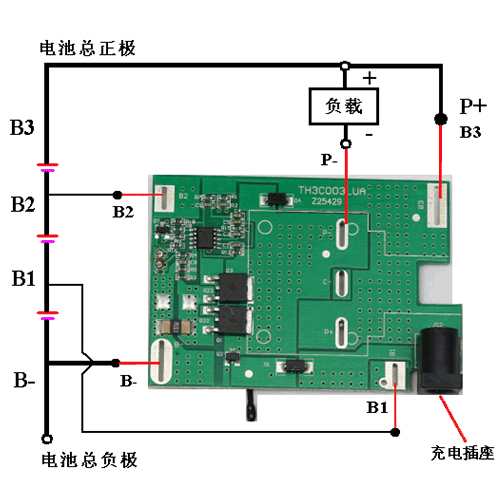
During the discharge of the battery on load, if the circuit is so large as to cause u>0. 9v (the value is determined by the controlling ic, with different ic values), the control of ic determines that the “do” foot will be rapidly converted from high to zero voltage and the t2 conductor to shut down, thus cutting off the discharge circuit and providing short circuit protection. Short-circuit protection is extremely short-lived, usually less than 7 microseconds. Its working principles are similar to those of electrical current protection, except that it is judged differently and that protection is extended over time。
All lithium batteries need a protected circuit for effective monitoring of battery recharge, discharge and, under certain conditions, off-charging and discharge circuits to prevent damage to batteries









