


(read time: 4 minutes and 30 seconds)
“senseiThe lechartley doctrineI'm so full of shit -- "change a condition of balance, and balance moves in a direction that weakens this change" -- can you do it right or wrong?"
"the pressure increases, and the balance moves in the direction of the reduction of the volume of the gas, and i will. But why do pressure sometimes increase and balance not move? Sometimes the conversion rate is lower?"
"give me a temperature-transformation curve that makes me judge whether the reaction is heat or heat, and i reverse it every time..."
If you're in."Chemical balanceIt's not like it's gonna happen. This chapter, it's like a trainee who can't cross the rules and drive. – the principle is not so bad, but as soon as we get to the intersection, we don't know where we're going — and today is the moment you get the wheel。
I'm going to tell you the central truth: you don't understand chemical balance, not because you can't remember the lechette doctrine, but because you've always understood it as a “legal text”, not as a “market rule”。Balance moveThe essence of this is not something that can be summed up by the word "reduced change." it is a multi-player, dynamically adjusted, profitable trading market。
With the following set of “chemical balanced market trading models”, you can, like a sophisticated market analyst, start with any change in conditions, accurately predict the ripple effect of “price” (concentration), “transformation” (transformation rate), “profit” (production rate), and turn all balance issues into “normally evolving” sub-issues。
It's..
I. The mind-blind zone: you see balance as "still," which is a "dynamic trade."
The plight of the vast majority of our fellow students stems from a fundamental misunderstanding: they believe that balance is “as many as one”。
This is a big mistake
The essence of the chemical balance is not the “equal amount” of the substance on either side, but the “trading speed” of the reaction and the reverse reaction. In other words, this is a dynamic market in which a large number of transactions occur every minute - the person on the left is becoming the person on the right (generator) and the person on the right is becoming the person on the left, except that the speed of entry and exit is offset, so the total number (concentration) does not seem to change。
The revolutionary perception that you have to build is that balanced movement is the process of re-pricing markets after “policy intervention”。
Here's the "chemical balance market trading panorama" which is your only pass from the "theory reader" to the "market analyst":
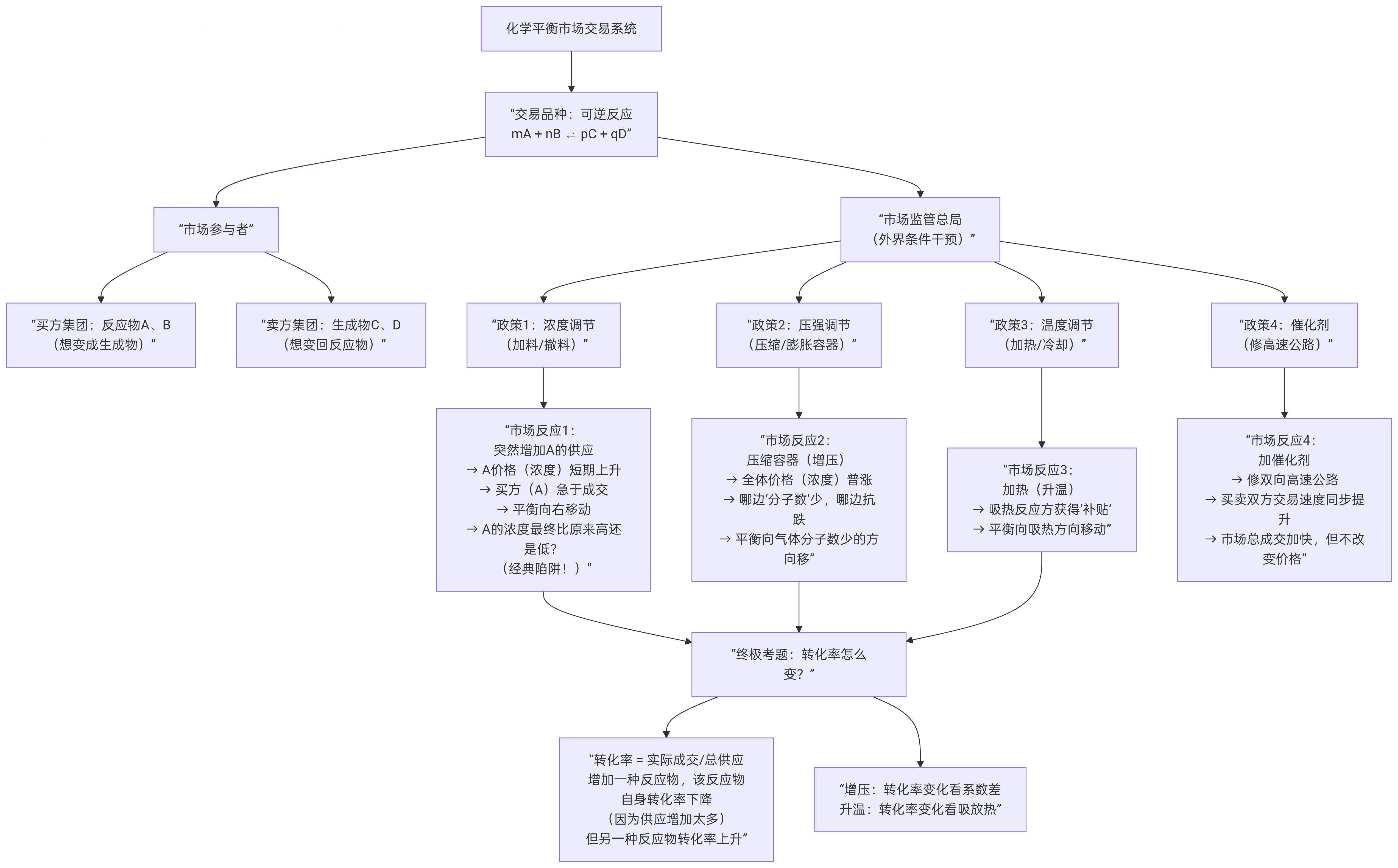
Remember the hard rules of this market:
• balancing the direction of movement is the direction of protests by “vulnerable parties”. Which direction can “reduce” the impact of outside intervention, and the balance shifts to the other side。
• changes in conversion rates do not amount to balancing movement direction. This is the worst place! The balance is moving right, and the rate of transformation of the reactor is not always higher -- depending on which reactor is added。
It's..
Operational analysis: breaking the three classic “trade traps” with “market models”
Now, let's go to the market analysis room, using this system, to decipher the balancing traps that most trouble students。
Trap one: increase the concentration of a reaction - why does its own conversion rate fall
[scene]: reaction n 2 + 3h 2 \\rightleftharpoons 2nh 3, balanced under certain conditions. Now increase the concentration of n 2. Q: how does the n 2 conversion rate change? How does the conversion rate for h 2 change
"the reaction of ordinary students."
"the balance moves right, so the conversion rate for n 2 and h 2 should rise!"
It's the classic "no. Always perception trap" of chemical balance。
Market transaction model decoded
Market scenario: original n 2 and h 2 are traded at a ratio of 3:1. Now suddenly there's a lot of new n 2s。
2. Short-term effects: n 2 bulges in supply. In order to consume these new n 2, the market will consume some h 2 – balance to the right。
3. Calculation of conversion rate:
The conversion rate for h 2 = the contracted h 2 / the initial h 2. The initial volume of h 2 has not changed, but the sum of h 2 has increased (because of matching the newly arrived n 2) → h 2 conversion rate has increased。
N 2 conversion rate = contracted n 2/ initial n 2. The initial n 2 significant increase (due to the addition of material) but the negotiated n 2 has also increased, but the increase has not kept pace with the increase in the initial n 2 conversion rate。
4. Deciphering conclusion: increase in one reaction, which has its own rate of conversion but increases in the rate of conversion of other reactions。
That conclusion, you're gonna have to push it a hundred times. Once you understand it with "the surge in market supply", you will never forget it。
It's..
Trap ii: change of pressure - when is the balance not moving
[scene]: reaction h 2 + i 2 \\rightliftharpoons 2hi, compression container increases pressure. Q: which direction is the balance moving
"the reaction of ordinary students."
"the pressure increases and the balance moves in the direction of gas volume reduction. 1+1 = 2 volume to the left, 2 volume to the right, same size, so the balance is not moving.”
But the point is, why is the balance not moving when the size is equal
Market transaction model decoded
Compressed packagings: the equivalent of reducing market space by half and doubling the “price” (score pressure) of all gases in an instant。
Market responses: which side can “absorption” such price shocks? If the number of molecules on both sides is equal and the price increases on both sides of the compression are the same, no one can take advantage of the balance。
3. If the number of molecules varies from one side to the other: e. G. N 2 + 3h 2 \\rightleftharpoons 2nh 3, 4 volume to the left and 2 volume to the right. When compressed, the price shock on the left (4th volume) is greater (due to the number of molecules and the frequency of collisions), so the left is more inclined to “leave” the high-pressure state of balance in the direction of a small number of molecules (right) in order to “reduce” the increased impact。
Translation of the conclusion: the essence of balanced movement is that market participants have different resilience to “policy shocks”. Whoever is better able to carry it, can take advantage of the new balance。
It's..
Trap iii: temperature change - how do you judge heat from the curve
[scene]: give a curve of different pressures, conversion rates with temperature. P 1
"the reaction of ordinary students."
"the conversion rate rises with the temperature ... The temperature rises in favour of the conversion, so the reaction is heating?"
But if there's two curves, or a temperature-time map, a lot of people faint。
Market transaction model decoded
1. Warming = heating the market. Anyone who needs heat receives a “subsidy”。
2. If the conversion rate increases with temperature: the heat rises to make the positive reaction more active。
If the conversion rate decreases with heat: it means that the heat rises to make the reverse reaction more active → positive reaction to heat (because the reverse reaction requires heat)。
4. Crossing of curves: at the same temperature, the higher the pressure, the higher the transformation rate, indicates that the positive reaction is the direction in which the volume of the gas is reduced. This judgement has nothing to do with heating. It is two dimensions of independence。
Decomposition: the slope of the temperature-transformation rate curve directly tells you whether the positive reaction is heat inhaling (positive slope) or heating (negative slope). It's a "white points" line。
It's..
Your "market analyst" 7-day training programme
Reconstruct your notebook: in the “chemical balance” section, draw a “market-trading panorama”, drawing out the reaction, the product and the buyer and the seller, with arrows indicating how concentration, pressure, temperature changes affect the course of the transaction. Here's your analysis outline。
Conducting “exploration” oral training: looking for 10 balanced moving questions, without looking at the answers, and only practicing the oral process in “market language”: “increased supply a – short-term fall in a prices – is eager to deal with the increase in supply of balanced right movement a too much, so that the conversion rate a is reduced, but the conversion rate b is rising.”
Death “conversion rate trap”: specialized practice on the topic “increased concentration of a reaction, change in conversion rate of each substance”. For every single thing, you have to write on the draft:
• whose volume has increased
• where does the balance move
• increased substances, initial quantities, barter amounts, but not as much as initial amounts
• another reaction, no change in initial amount, barter ↑ conversion rate ·
Production of “three dimensions” speed sheets: a table of the effects of the four conditions of concentration, pressure, temperature and catalyst, on the three dimensions of “balanced movement direction”, “change in conversion rate” and “change in rate”. This is your market policy handbook。
Practice “looking and speaking”: collection of balanced image topics (c-t, v-t, conversion rate-t/p). Each chart does not look at the options and explains itself using a market model: “this turning point indicates that the market suddenly adds catalysts/heated/pressed ...”
It's..
Last thought revolution
Chemical balance is the closest chapter in high school chemistry to “economics”. It uses the logic of chemical reactions to shape the supply-demand relationship, price volatility and how policy interventions affect the final balance of a market。
Those students who lost time and again in this chapter are not stupid。
You're just missing this system of analysis that translates lechette into "market law."。
Today's article is a short version of your national richness。
Let's do the balance next time. Ask yourself: is it now more than demand, or is it not? Is it taxes (pressure) or subsidies (heating)? Is it the issue of coupons (plus catalysts) or direct payments (plus reactions)
Think clearly, the answer is in the market。
Read this, find a balance you made wrong last week. Don't recalculate, write a sentence in the comment area: in this case, the addition of equals the addition of to the market side (supply/demand), resulting in a balance moving towards , an increase in conversion rates and a decrease in conversion rates. Write it down and you'll graduate from the back









