


Overview of the solid-state transformer quail industry
Solid-state transformer, sstElectricity and electronicsPower electroNic transformer, pet, a new electrical energy conversion device based on electrical electronics conversion techniques and high-frequency electromagnetic sensing principles. Its core functions include voltage conversion, electrical isolation and electrical quality control through semiconductor devices (e. G. Igbt, mosfet, sic/gan, etc.) to replace the steel core and copper circuit structure of traditional transformers。
The core difference between solid-state transformers and traditional transformers lies in their working principles and their intellectualization. Traditional transformers are based on the principle of electromagnetic induction, with a single and uncontrollable function of voltage conversion and electrical isolation under the working frequency, while solid transformers use electrical and electronic conversion techniques and high-frequency conversions, not only to significantly reduce their volume weight but also to be a highly controlled smart power hub. In addition to its basic functions, it integrates a variety of functions, such as failure compensation, harmonization, traffic flow conversion and tidal flow control, proactively upgrading the quality of electricity, and building flexible and efficient smart grids and adaptationNew energyAccess provides critical support。
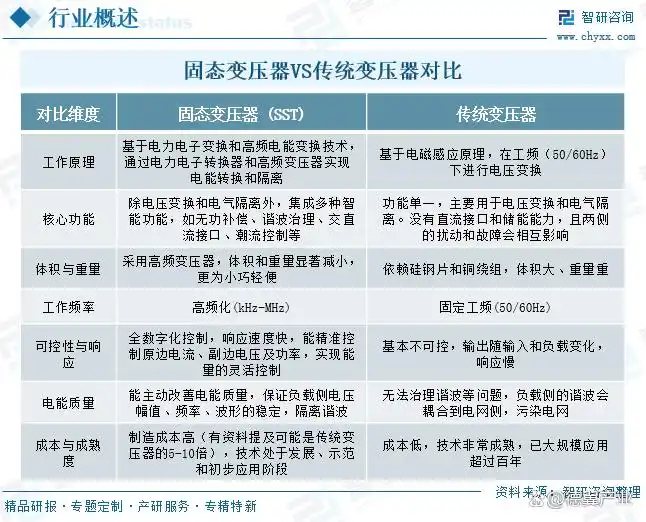
Solid-state transformers (ssts) can be divided into three categories depending on the form of electrical energy conversion and the application scenario: the exchange of solid-state transformers (ac-ssts) through the ac/dc-dc/ac level-iii transformation to achieve the exchange of voltage transformations and isolations applicable to traditional exchange scenarios such as smart grids, industrial distributions, etc.; the direct-flow solid transformers (dc-ssts) using dc/dc conversions to support direct-flow voltage regulation and multi-end management, mainly for direct-flow power supply, electric vehicle overcharging stations, etc., in data centres; and the combined high-efficiency, flexible and intelligent upgrading of energy systems in the mesh (hybrid-sst) to allow for flexible interconnection and energy management of the trans-flow networks。
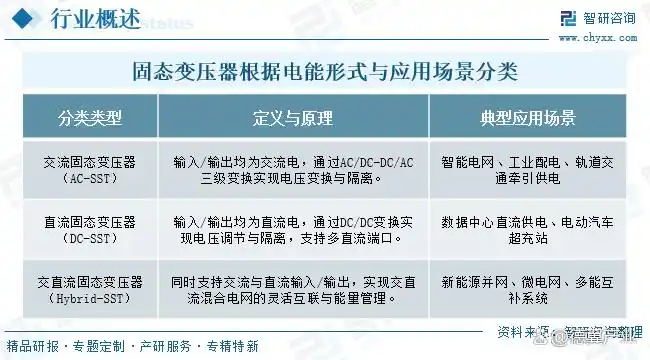
There are three main technical routes for the current 800v direct-flow power supply system: the traditional industrial frequency transformer route, which transforms the 10 kv exchange first-voltage voltage to 800 v straight currents through multi-stage conversion, is technologically mature but less energy efficient; the shift transformer route, which optimizes the quality of electrical power, requires multi-phase conversion and complex systems; and the solid-state transformer (sst) route, which, thanks to its electrical and electronic advantage, directly achieves an efficient conversion of 10 kv to 800 v straights, not only significantly reduces the energy conversion links, improves the efficiency of the system, and is more characterized by small size, light weight and support for modular deployment. As technology continues to advance and scale up, the sst route has demonstrated significant advantages in system efficiency, deployment flexibility and full life-cycle costs, has become the best solution for 800 v direct power supply in the data centre and is expected to be the preferred power supply structure for the next generation of artificial intelligence data centres (aidc)。
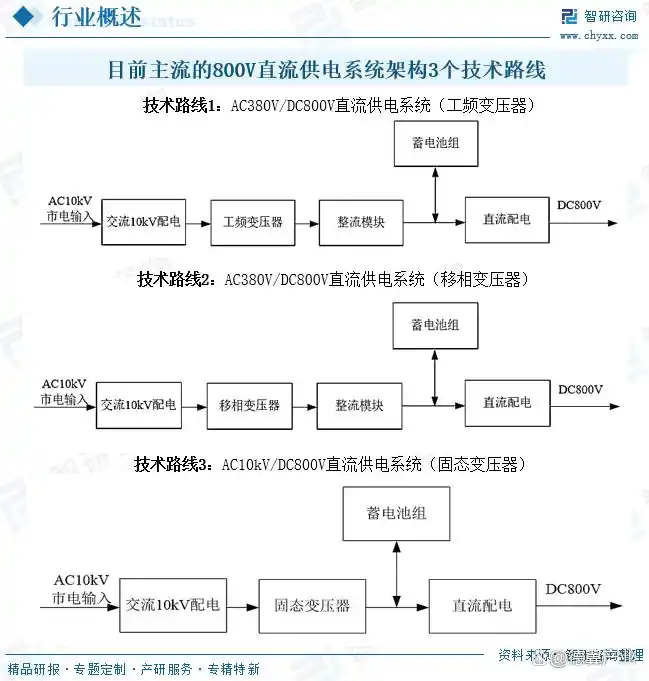
China's solid-state transformer industryIndustrial chain
The chinese solid-state transformers (sst) industry has developed a structured vertical industrial chain structure. Upstream, domestic enterprises such as skyline (sic), nitrogen (gan) and non-crystaltic, nanocrystal soft magnetic materials are at the centre of the ban, high technical barriers, concentration of industrial value added, and domestic enterprises such as tsengkoda and starrian are accelerating the process of domesticization and gradually mitigating supply chain risks at key points; the integration and modularization of mid-stream focus assembly machines, and the continued catch-up of international manufacturers with gold disk technology, quadrilateral shares and the capacity for cost control and technological transformation, industrial resources are gathering further to mature areas such as long-term triangles, bead triangles, and market concentration is increasing; downstream applications are being driven by smart grids, new energy grids and high-density data centres, and the emerging areas of on-orbit transport, ship power and so on, are being driven by policies such as the east-west count project and the construction of new electricity systems. The overall industrial chain is deepening steadily towards upstream material autonomy and diversification of downstream applications。
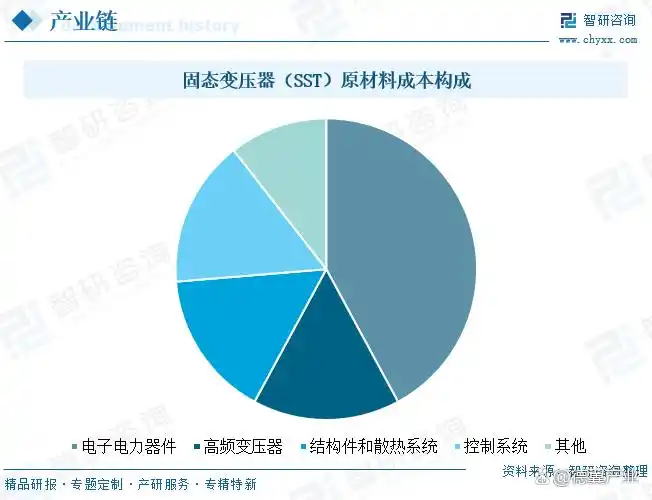
Solid-state transformers (sst) account for the highest share of electrical and electronic appliances (approximately 40 per cent), mainly because of the high price of portable semiconductor materials such as carbide silicon, nitrogen oxides and high resistance requirements for further lifting costs; high-frequency transformers account for about 15 per cent, with increased expenditure on high-performance iron core materials such as iron oxygen, non-crystal alloy and precision manufacturing processes; structural components and heat dissipation systems (15 per cent) and control systems (15 per cent) involve key components such as radiators, cabinets, liquid chillers and control circuits, respectively; the remaining 10 per cent are miscellaneous components such as auxiliary power sources. Overall, sst costs are highly concentrated in upstream cores and materials, and performance optimization and cost control remain challenges。
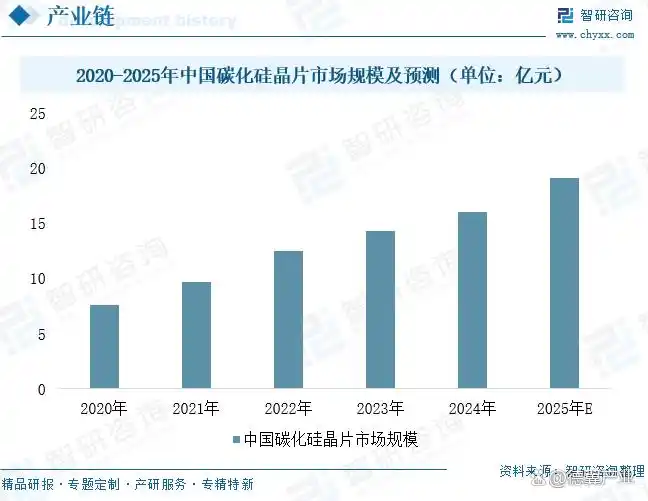
In terms of upstream core raw materials, the silicon carbide (sic) industry is in a critical phase of technological breakthroughs and scale-up applications and has become the core material supporting solid transformer (sst) performance upgrading. Thanks to the sustained pull of high-species downstream applications such as new energy vehicles, photovoltaic energy and smart power grids, our carbon-silic industry has grown rapidly, technological maturity has increased and industrial chain synergy has been enhanced. In 2024, china's market for carbide silicon chips reached about 1. 6 billion yuan, and is expected to grow to 1. 91 billion yuan in 2025, with an annual growth rate of nearly 20 per cent, showing strong growth potential. As industry technologies continue to leapfrog and the process of industrialization continues, our carbon silicon industry is gradually building an autonomous and manageable supply chain system that provides a solid basis for cost optimization and performance enhancement in the solid transformer sector。
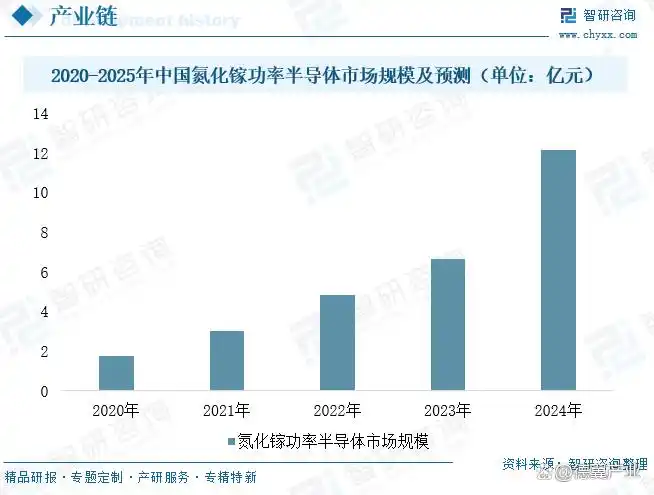
The gan industry has demonstrated its unique value in the medium- and low-pressure sst applications by virtue of its high-frequency efficiency performance advantage. In recent years, domestic firms have accelerated their focus on the silicon-based gan technology route, and the flagship company, represented by san xian-ray electricity, has built up its mass-capable capacity; at the same time, international manufacturers, such as the enhanced gan hemt device launched by british flying ling, have effectively addressed industrial pain points that are vulnerable to interference with low-powered voltage by means of integrated grid polar drives, with their work covering a range of 40v to 700v and flexiblely matching sst requirements at different power levels. While the industry still faces challenges such as high costs, inadequate containment standardization and long-term reliability validation, it is moving towards scale and standardization with the diffusion and process optimization of 300 mm crystal round production technologies. According to statistics, in 2024, our demand for nitrogenized argon had reached 695 million semiconductors and the market size was 1,216 million yuan. In the future, higher performance and more cost-effective medium- and low-pressure solutions will be provided to the solid transformer industry as the nitrogen industry continuously optimizes the crystal area utilization and manufacturing process。
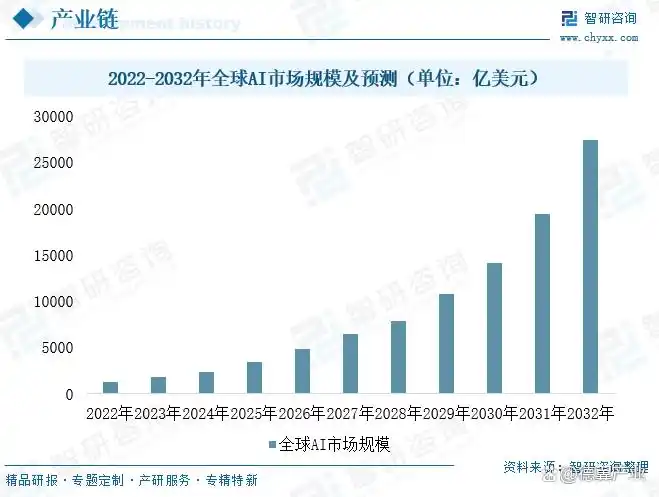
The market for demand downstream of the solid-state transformer (sst) is characterized by high and diversified growth, and its core drivers are closely linked to global energy transformation and digital construction. Currently, aidc has become the most well-required and well-represented application scenario (approximately 40 per cent), and the explosive growth in computing density is demanding the efficiency, power density and flexibility of the electricity system, while sst is becoming the ideal solution for the next generation of data centres with the advantages of high power density, efficient direct-flow conversion and land-use conservation. The global ai industry has entered a new phase of scale commercialization with the continuing breakthrough of large model technologies represented by gene ai. At the gtc 2025 conference in weida, t tata revealed that the global ai market had reached $234 billion in 2024 and was expected to surpass $2. 75 trillion by 2032, with a compound annual growth rate of 36. 8 per cent. This continuously high-growth ai market provides strong and definite growth momentum for the application of solid-state transformers to scenarios such as data centres and margin calculations。
Related report: report on the market marketing and industry prospects in china's solid transformer industry, published by the advisory institute of intellectual studies
Analysis of current developments in china's solid-state transformer industry
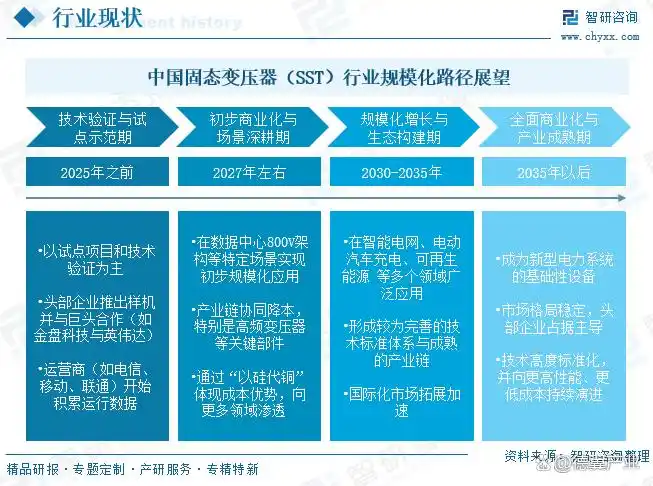
At present, the solid-state transformer (sst) has not been industrialized on a large scale, and its main constraints are concentrated on the high price and capacity of high-frequency magnetic materials and the high technical barriers to the design of high-frequency capping structures and control systems. The sst industry in china is at a critical stage in its transition from technology validation to commercial scale, and its overall operation is characterized by “pilot ahead, standards to be built, costs to be met”. At the application testing level, client decision-making faces three core obstacles: the lack of national standard guidance in the data centre area, which makes technical selection and programme decision-making more difficult; the lack of adequate data support for sst long-term reliability, which affects users ' confidence in product stability; and the technical bottlenecks in the middle-side dimension, which limit the ease of transport by relying on thermal injection mechanism in the traditional data centre, which is difficult to achieve in a 10-kv pressure scenario. In terms of scale paths, the industry has developed clear plans: the data centre 800v architecture is expected to be scaled up by 2027, provided that the reliability verification and load testing of the device is completed; operators such as telecommunications, mobile, connectivity, etc. Are actively pursuing pilot projects to accumulate operational data to support subsequent roll-out。
A clear trend has emerged at the downstream application end, with the introduction of sst as the core power supply programme for the next generation of data centres, mLarge internet enterprises, such as eta, google and microsoft, have also joined suppliers to develop a self-built data centre programme based on dc800v power supply. In terms of industrial cooperation, eton and century-to-seven developed the sst energy router, delta launched the liquid cooling and sst integration programme, and west electric has completed the delivery of sst to the “east and west” ndc node. Despite the broad outlook, costs remain a key constraint for sst expansion in other areas. The industry is working to boost downfalls by optimizing core components such as high-frequency transformers, and sst is expected to accelerate the landing of more applications, with its natural advantage of “silicate copper”, once the cost bottlenecks are broken。
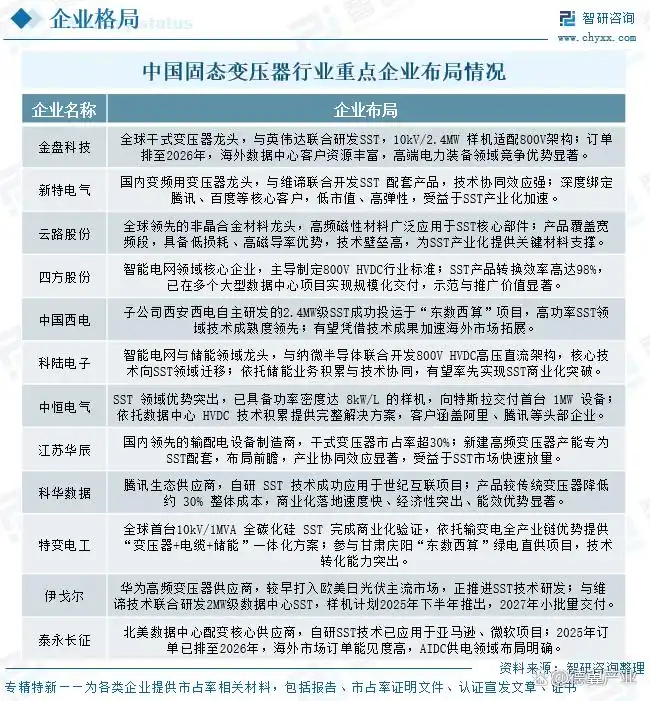
Distribution of enterprises in china's solid-state transformer industry
Technical barriers to solid transformers are high and, despite technological exploration by domestic and foreign firms, the degree of industrialization is still limited. In terms of the domestic enterprise landscape, a multi-dimensional ecosystem of “state-led, private-sector innovation, complementary synergies” has been created, with a steady increase in the head effect and an acceleration of the process of national production substitution. Among state-owned enterprises, china's western power company, with its 2. 4 mw-class sst scale application, accounts for more than 60 per cent of the country's high-end market; the specialized electrician has launched the first global all-carbon silicon sst based on the advantages of the entire industrial chain, and has landed in the yuan xinang district, the east and the west. On the private sector, the golden disk technology and young weidar jointly developed the sst for the 800v architecture, the order for which had been released until 2026; the commercialization breakthrough of enterprises such as science and technology, science and technology, science and technology, or data centre technology accumulation; and the high operational elasticity of the new electrics and tei yong march through deep-seated header technology enterprises. At the same time, upstream material and support systems are being improved, with cloud road shares, antaire technology, etc. Providing core magnetic material to enterprises, and placard photomagne as an exclusive supplier of nano-semiconductors, deeply involved in the construction of the 800v architecture. The whole enterprise is working in tandem with upstream and downstream to accelerate the industry from technology validation to commercial scale。
Analysis of trends in china's solid-state transformer industry
China's solid-state transformer industry is entering a critical stage in its transition from technology validation to commercialization. In the future, industry will continue to make breakthroughs around upstream core material domestication and technology synergies, contributing to cost reduction and performance improvement through modularization design and high-frequency capping optimization; applications will gradually expand from core areas such as current data centres, smart power grids, to diverse markets such as electric cars, industrial variability, orbital traffic, to create clear paths from pilot demonstration to scale; and industry will be shaped more into an eco-system “national-led major engineering, civil-owned technological innovation, upstream-downstream development”, with high-quality scale development that will support the construction of new electrical systems and digital infrastructure, facilitated by a combination of improved standards, mature heat management technologies and autonomous control over supply chains. Specific trends are as follows:
Technology-driven industrial chain synergetic breakthroughs to build the foundation for scale development
In the future, china's solid-state transformer industry will be highly dependent on the material's own performance breakthroughs and technological innovation. The industry is currently working to address technical bottlenecks such as low heat coefficients for traditional paraffin-based materials, inadequate long-term cycling stability and the vulnerability of solid-liquid phase to leakage. The focus of research and development will be on the construction of complex phase transformation systems, such as the introduction of high-conductor heat fillings such as graphite, carbon nanopipes to form a three-dimensional heat conductor network, which will significantly increase the efficiency of heat management; the development of microcapacitation and metamorphosis materials, which will be packaged physically or chemically into polymer skeletons, achieve macro-conformity, fundamentally overcome leakage and enhance material stability. At the same time, the development of new products from the bio-based, hypocool and wide-temperature series will also broaden the environmental adaptation of materials。
2. Applications diversified from demonstration pilot to commercial scale
The application ecology of solid-state transformers will extend beyond a single domain and will be characterized by diversification and deep integration. Initially, the aidc centre, which values its high power density and high-efficiency direct-flow conversion capacity to respond to a calculator explosion, and the smart-grid, which uses its flexible regulatory function to support a high percentage of new energy access and combined power distribution. In the future, as technical reliability is validated and cost optimized, the market will quickly penetrate more potential areas such as electric vehicle overcharge networks, industrial variability, orbital traffic and ship power propulsion, creating clear paths from pilot demonstration to scale-down。
3. Industrial patterns are reshaped in competition and cooperation, and autonomously linked to globalization
In the face of broad market prospects, domestic solid transformer industrial patterns will accelerate the reshaping of a diversified ecosystem of “state-led, private-sector innovation, synergy”. Market competition is no longer limited to the product itself, but has evolved into an integrated competition between technology, capital, supply chains and the channels of globalization. Firms with core technology, scale capacity and stringent certification through front-line customers (e. G., new zealand, amazon, microsoft, etc.) are expected to emerge and expand their market share. At the same time, with the support of the “two carbon” objective and national policies, the autonomous control of the industrial chain will be a top priority, facilitating the process of domestication of key materials and components. While strengthening competitiveness through horizontal integration and vertical layout, local firms actively use their strengths to compete globally and open up international markets。









