


I've been in the stock market for years, and i've always liked to collect methods of warfare。
You can learn from whatever form you see on the internet and take a few thick notes。
What breakthroughs, backsteps, forks, departures, a whole bunch of signals。
When you get to the plate, the signals clash with each other, the more you look at them, the more you don't get them。
It looks good in shape. It goes bad as soon as we enter。
Sometimes it's hard to wait until there's a chance to tell whether it's true or not。
I've been thinking about it for years。
It's not about technology, it's about whether it's edible or stable。
Ten years later, i focused on two sets of classic patterns: 123 inverted rules, andCode 2bI don't know。
Most of the commotion signals, i'm actively filtering, focusing on these two structures。
To be clear, this is just the observation that i have made for a long time。
There is a line of deception in the k-line pattern, and the movement is disrupted by news, a large disc environment and no 100% effective signal。
Risk tips: this paper is a learning-sharing exercise for personal investment experience only, for information purposes only, and does not represent the basis for investment, and all investment decisions are based on rational and independent judgement and risk-sharing。
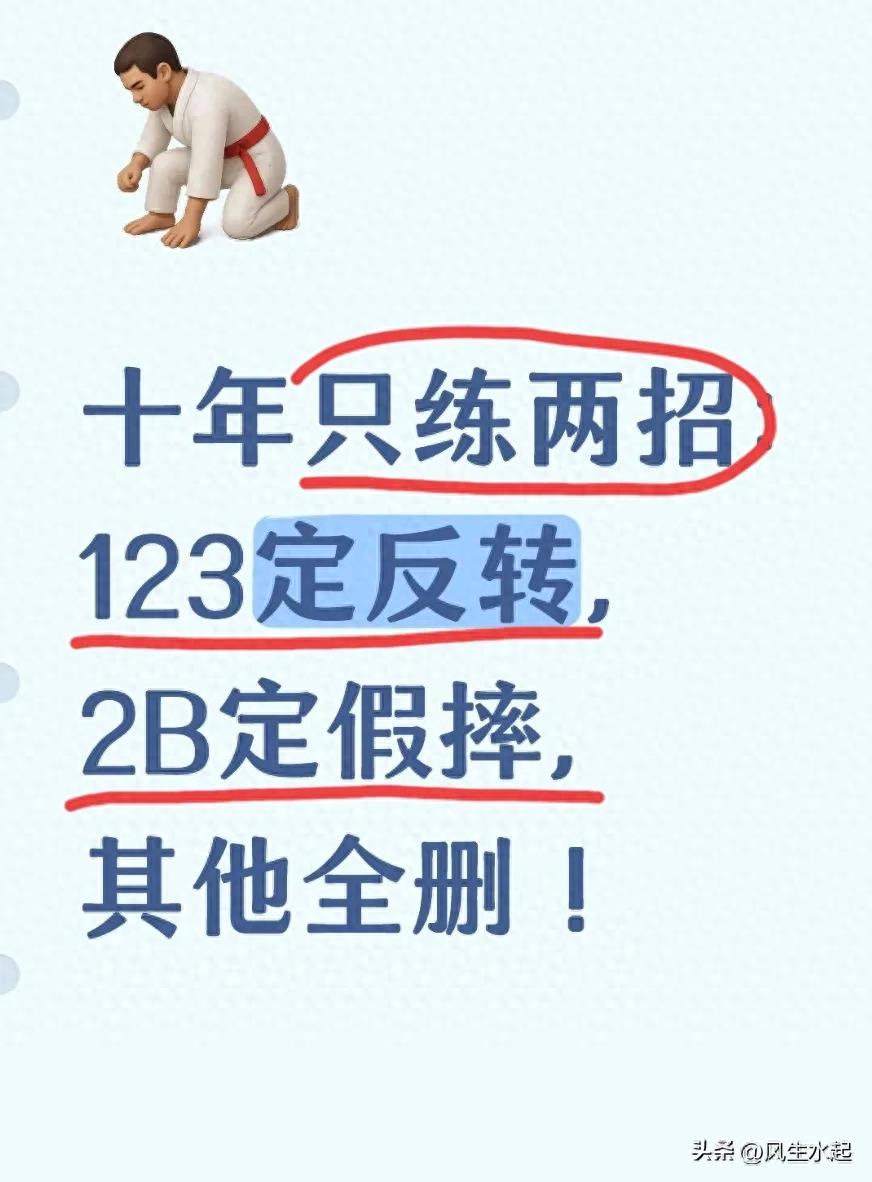
I. Many scattered diseases: inverted and rebounded, stomped on false falls
A lot of people are losing money on the same issue。
The short rebound was seen as a reversal of the trend and the normal retrogression as a runaway。
When it falls, a ray pulls up, and it feels like the bottom comes up, and it rushes into the bottom。
The result is a short-term rebound, followed by low innovation, which is covered directly。
There is another situation。
The trend is moving well, with a brief fall and support and immediate panic。
A few days after the cut, the stock price was pulled back and a false fall was discovered。
In both cases, i stepped on it a million times earlier。
It is only later that it becomes clear that the distinction between true and false cannot be made by looking at a single k-line, depending on the structure。
Law 123, which is specifically designed to identify structures where trends may be reversed。
The 2b code, which is used to identify false breakthroughs and fractures in the vicinity of support positions。
Together, the two tools address the two most common challenges。
But remember, form is only a probabilistic reference, not a status bond。
Ii. 123 rules: institutional instrument for the investigation of trends
Law 123 is the classic trend observation framework with three conditions to be confirmed in order。
Condition 1: old trends broken
In the case of a downward trend, the first step is not to be low。
The price is no longer at a new low, as it was lower than it was。
If there is an upward trend, there is no more innovation。
It's the first signal。
Condition 2: rebound (fallback) to break critical access points
The fall-and-up scene: the last drop in the height of the rebound station。
This high point is the rebound point in the fall。
The rise and fall: fall back and break the low point of the recent round。
This is the signal that multiple forces begin to decay。
Condition 3: step back no longer past the lower point (high point)
The fall turned many times: after breaking the turning point, there was a back-step and no back-step。
After all three conditions, the inverse structure of 123。
I've counted 240 movements in the flash drive。
The probability of completing the 123-step structure in its entirety and following the trend pattern is approximately 55 per cent。
If only the first two are satisfied and the third is not observed, the probability of a reversal failure rises to 68 per cent。
There is a focus here: the time cycle is critical。
Dayline level 123 structure with reference value above 60 minutes short cycle。
Short-term multiple signals can be much more frequent。
A lot of people are rushing to do it, and the conditions are not yet complete。
Just to see how low innovation is, it just bounces in, and it's easy to fall back。
The core of the 123rd code is not prejudiced reversal。
It is to wait for the reverse structure to come to the ground before observing opportunities and not to guess in advance。
The details of the 123rd law
The downward trend is not to be confused。
The first step is to stop the fall and the low is to bounce back to the high point of the rebound and to step back to the low point。
The upward trend is intended to be emptied in the same order。
Let's move on from the high to the low point of falling and falling。
As long as the middle step is broken, the reverse structure will fail。
In the aftermath of a breakthrough, for example, retrogression and low innovation indicate a downward trend。
Don't force the flirting pattern。
Some of the trends are standard, and others simply fail to follow the 123 structure, so give up。
Iii. 2b: specially designed to identify false falls, false breakthroughs
One hundred and twenty-three, and two bs, which often appear together。
Law 2b, which is essentially a test for false actions of support or pressure。
First of all, when you fall, you fall, and that's what you say。
Prices have fallen short of the lower points ahead, creating a climate of panic。
Many people see support for falling, fearing that it will continue to fall and that it will stop the damage。
After falling, however, there was no continuous down and the support line was quickly pulled back up。
That's a typical 2b fake fall。
In turn, the fake breakthrough in the rise is 2b。
Prices quickly passed the top, attracting upswings of capital and then quickly fell back below the heights。
Watching a breakthrough is actually tempting。
2b judgement points:
First, a short price blow through critical support/pressure
(b) second, closing or re-entering two consecutive lines of k
Third, the turnover is often the indentation when it falls, and the drop when it pulls back。
I'm counting 160 times 2b structure:
Indentation leave falls, followed by recovery of support, with a probability of continuing the trend of approximately 63 per cent。
It's not a fake fall, it's a real fall。
This is where many people get confused。
It's either a fall or a 2b fall。
It's 2b when you fall; it's going down, it's going on。
2b's easiest to step on
The first pit: when you see a fall, you default on a false fall and carry more than a loss。
After learning 2b, a lot of people had the illusion that it was a dishwasher。
The more you get, the more you lose。
The second pit: the cycle is too small, with frequent scratches of 2b。
The 5-minute, 15-minute mini-cycle 2b signal is not stable and it has a particularly high level of noise。
Priority is given to observing the solar-line level, with a higher tolerance for errors。
Third pit: ignore the large disc and plate environment。
When large plates continue to weaken, the probability of double-killing after a false fall increases significantly。
When the environment is poor, even standard 2b lowers expectations。
Iv. Two sets of patterns are used in combination
Taking 123 or 2b alone is limited and better combined。
123, responsible for looking at the larger structure and judging whether there is a chance to reverse the trend。
It is appropriate to observe structural changes at the bottom, at the top, and capture trends。
2b, for real and false breakthroughs, real and false。
In the process of formation of the 123 structures, 2b false falls often occur。
Take a common order of fall:
At the end of the decline, there was a 2b fall and a panic wheel
It was then no longer low-intensity and slowly moved out of the 123。
In other words, 2b is often the last dishwashing before the reverse。
But not every reverse, there's a 2b。
Some of the movements stopped in a direct and moderate manner, moving steadily, 123 without false falls。
So don't create a fixed mind: there's always a false fall before turning back。
When you see it, if you don't, wait for the 123 to go。
Two sets of forms are observation tools, not sales signals。
Structures appear to represent only access to the observation pool, which does not mean immediate access。
Five, four high-frequency error zones in the field
Mistake one: mechanical appliance, hard-line 123, 2b for each line
Most of the movement in the market is a disorderly shock and does not follow a standard pattern。
In the concussion, 123 and 2b failed repeatedly and hit back and forth。
The shock market better reduce operations and not force the search。
Mistake 2: make the signal necessary, forget the wind
Even if it's a very standard 123 inverted and 2b fall, it'll fail。
Scattered messages, plates and space can break into structures。
In any form, you have to think ahead of time to get out of here and not die。
Miss three: i can't tell the main. Small cycle signals overwhelm the cycle
Dayline is a downward trend, with 60 minutes to move out of a 123-percent multistructure。
This is a low-intensity sign with high risk and minimal involvement。
Large cycles set the course and small cycles look for details, which cannot be reversed。
Error four: neglect can match, only k-line shape
It's also a 2b fall, with a very different meaning for indentation and drop。
Indents are broken, pressure is low, and the risk is higher; discharges are broken, funds flee, and risks are higher。
Quantities are auxiliary authentication, not lost。
Vi. My day direct observation process
After all these years, i've set a sequence that's not easy to miss。
The first step is to look at the big cycle and determine whether it is rising, falling or shaking。
In this downward trend, priority is given to waiting for a stop-down structure of 123。
Step two, mark key high and low points, draw support, pressure positions。
Without clear heights, there is no basis for judgement of 123 and 2b。
Step three, look at the key points of the price test and see if there's a 2b fall。
In case of short breakback, quick recovery, focus tags, continuous tracking capacity。
The fourth step is to wait for a gradual confirmation of the 123 structures, one by one of the three conditions。
One less condition is not to treat it as a reverse。
Step five, when the structure is fully satisfied, is placed in a self-selected tracking, waiting for the opportunity to step back。
If you don't catch up, you'll be able to keep an eye on it until the price returns to the support area。
Step six, ongoing review of the tracking process。
Once structures have been destroyed, such as again low innovation, moving directly out of the observation pool without illusions。
The core of the package is to wait for structural confirmation, not advance judgement。
Concealing is a major source of losses for the dispersed households。
All thoughts are guessed before the form comes out。
Vii. Ten years of business awareness: the law of war is not expensive
The first time i learned technology, i always thought the more i learned, the better。
Indicators are stacked one by one, in more than a dozen forms, and at the end, they are fragmented。
Then it became clear that the nature of technology analysis was a probabilistic game。
There is no method of warfare that eats everything。
123 helps us see if the trend will change. 2b helps us identify the real dishwasher。
They're good enough for most bands。
The rest, give it to the wind, give it to the patience。
If it is structurally appropriate and environmentally appropriate, look twice; if it is not structurally correct or environmentally sound, stop looking。
An empty warehouse is not a waste of time. It is a disorderly way of avoiding high risks。
At the heart of the transaction is not to capture every wave rise, but to make less risky wrong deals。
Technology just helps us raise a little chance of winning。
Long-term stability, respect for the market and management of silos are always at the forefront。
Do you normally watch the disk, prefer the 123rd rule, or do you often experience a double-b fall









