


Electronic scalesThe core working logic is the conversion of the gravity or geometric dimensions of the object into a telecommunications number that can be identified by the circuit, then the conversion of the number and the processing of algorithms leading to the results of the measurements in digital form. Whether it is a simple weighing or the simultaneous completion of multi-parameter measurements such as height, height, bmi, the bottom of which follows the “physical mass telecommunications number” conversion chain. Understanding this chain helps to judge why an electronic scale displays different precisions, response speeds and functional boundaries in different scenarios。
The principle is that the weight of the electron scales usually depends on resistance variantsSensorsI don't know. When the payload acts on the scales, the retrofits attached to the elastic body are shaped, with minor changes in their resistance values, which are converted to voltage signals through the whistlestone bridge. The voltage signal is amplified, filtered, converted from a modulus converter to a numerical amount, and is converted by microprocessor to a mass in accordance with the nominal factor. The fraction values and accuracy levels are precisely the description of the resolution capacity and error range of this conversion process. In the case of a fraction value of 0. 1 cm, it reflects the minimum display unit of the length measurement channel, not the weight channel; the minimum and maximum scales of the weight channel define the range of the valid term. The quantitative error of 0. 1 per cent is expressed as a relative error, meaning that the deviation between the measurement results and the real value is contained in the effective range. Digital displays determine the form of reading, and three levels of accuracy correspond to the hierarchical understanding of different error limits in industry。

When electronic scales require simultaneous height, height and bmi measurements, their technical differences are mainly reflected in structural design and signal synergy. Height measurements usually use ultrasound or infrared ranging modules, which calculate distance by the time or phase difference between the launch and the receipt; a high-seas measurement requires additional baseline recognition or mechanical positioning structures to ensure the accuracy of the starting point of the measurement in the position. Bmi is not a direct measure but is calculated by the built-in algorithm of height and weight data. This means that the difficulty of multi-parameter electronic scales lies not in the precision of a single sensor, but in time-series alignment, benchmarking and data-link logic between measurement channels. When the power supply is 220v, the equipment is usually directed to fixed sites, which is more stable than battery power, but also requires conditions for the use of the environment. Self-heavy 20kg and specification dimensions reflect the design orientation of the equipment's structural rigidity and placement stability, and greater self-heavy helps to reduce interference with sensor readings by the vibration of the scales。
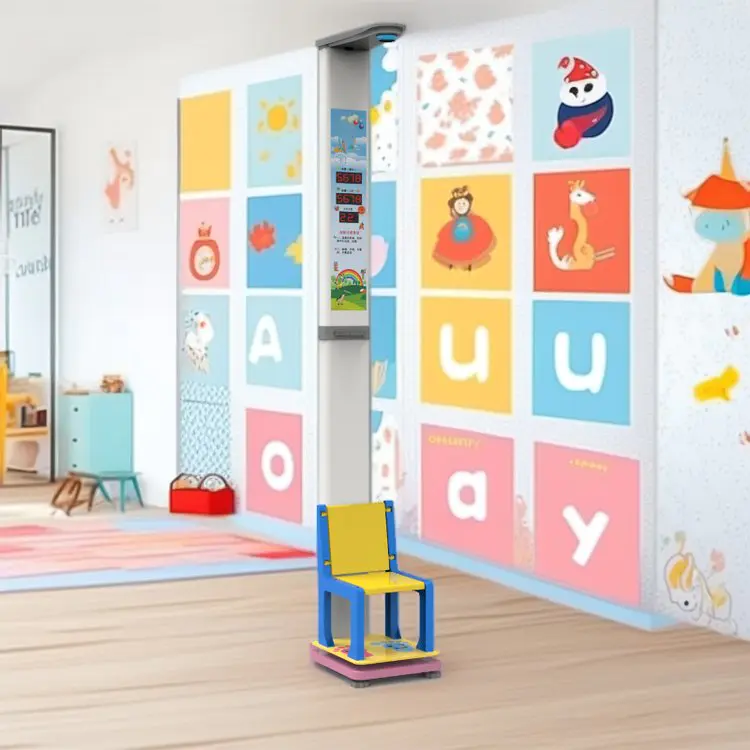
In practiceApply sceneThere are significant differences in the focus points for electronic scales among different users. The equipment used to measure the height of a child's body weight bmi sits, usually at a medical examination facility, in a school health room or in a paediatric clinic, is more focused on the normative aspects of measuring positions, the consistency of the seating benchmark and the consistency of the multi-parameter output than on mere weight speed. Designed to cover a range of 1kg to 200kg, covering the body mass range from young children to adolescents, the minimum scale of 1g retains the ability to recognize changes in the low payload. For users who need to process customization, adjustments to the size of the structure, presentation or functional combination are often made to fit specific measurement processes or spatial conditions. This type of equipment, which is usually seen within the industry as a “measurement work” rather than a stand-alone scale, is valued at integrating height, weight, height and bmi into a measurement exercise to reduce position and record errors resulting from repeated operations. Understanding this point helps to distinguish between the two dimensions of “heavy precision” and “measuring process efficiency” in selection or use。









