


When you're studying electromagnetic relays, many of your classmates see a map of the circuit: it's both ends of the circuit, and it's linked in reverseDiodeI don't know。
A number of students have taken the wrong conclusion: the diodes are used to protect the circuits. But how does it protect the circuits? Most of the students were unable to say the whole story. Instead of understanding the logic behind it, the subject matter has changed slightly and can easily fall into the trap of the issuer。
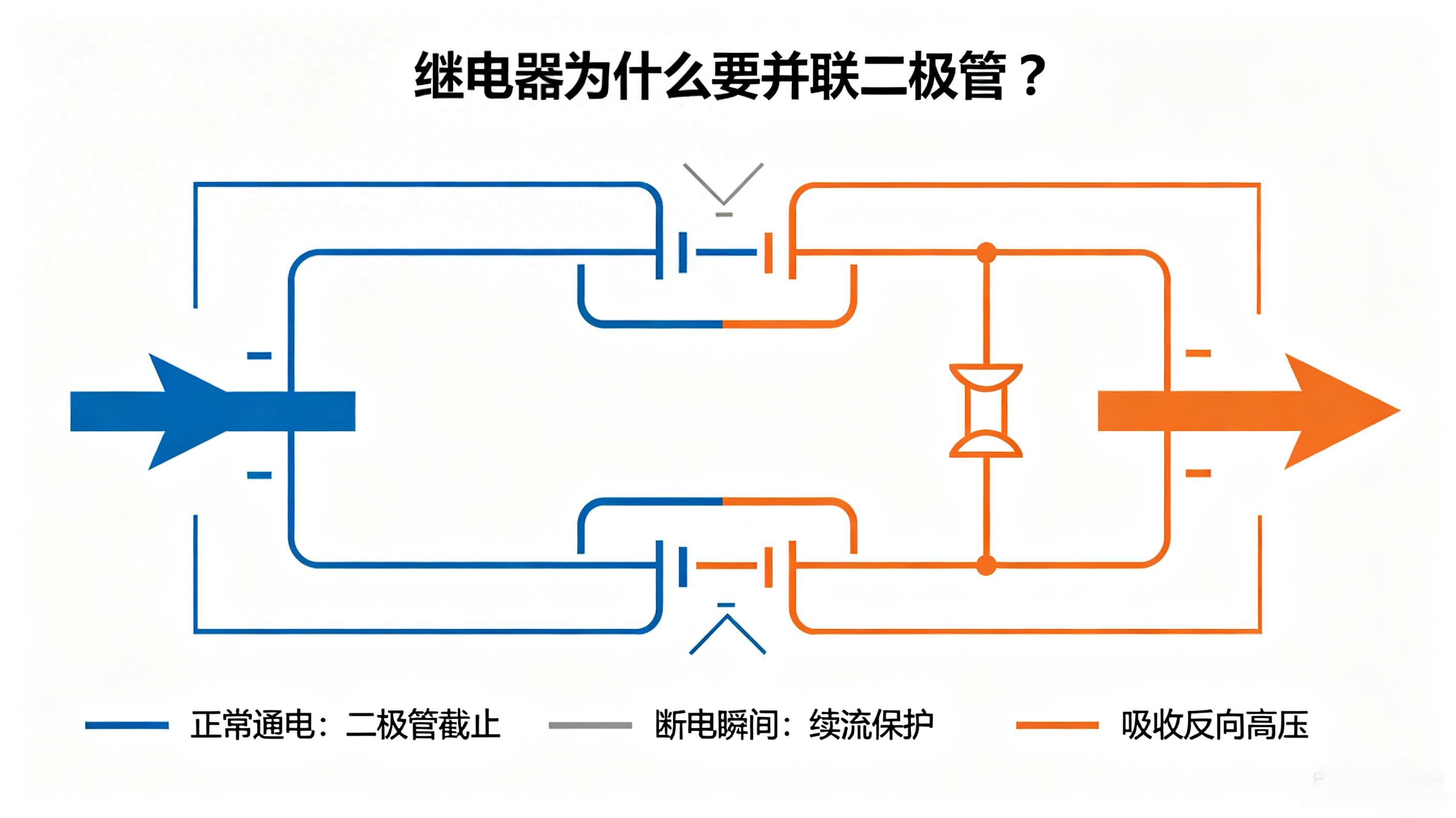
To understand the circuit, we need to remember one feature: the wire inside the relay is essentially an electrical sense。
When the circuit is wired, currents pass around, creating magnetic fields that store large amounts of magnetic field energy. At this time, relay inhaling completes switch control and the entire circuit works smoothly。
When the control switch was disconnected, the power supply to the loop was cut off instantaneously. As a matter of common sense, electrical currents disappear and magnetic fields disappear. But there's one important aspect of the perception: it's a barrier to current change. The current suddenly turns to zero, and the coil immediately produces a very high reactionary electric motion。
This instant high voltage far exceeds the normal working voltage of the circuit, and if there is no energy-emitting circuit, the high-pressure peak will be applied directly to both ends of the elements, such as switches, chips, etc., and will easily pierce a metaphysical device, causing permanent damage to the circuit. This is also the biggest problem of relay circuits。
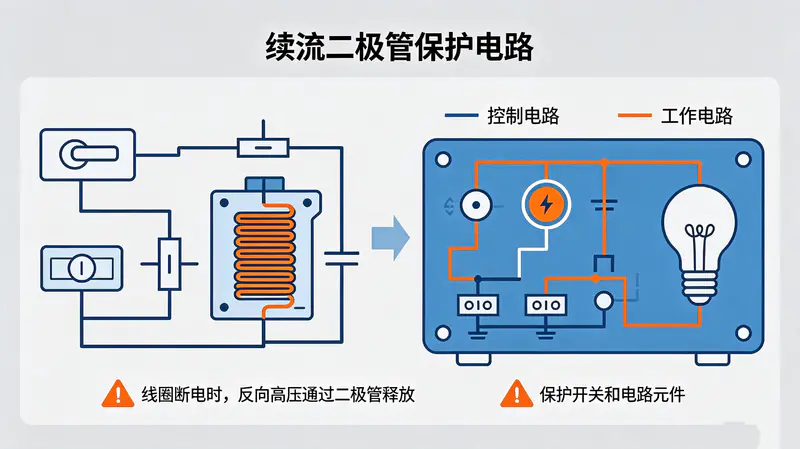
And this combined diode, called a continuous diode, is designed to solve this problem。
Here's a very critical point of error: diodes are not working all the time。
When relays are properly inhaled, the diodes are subject to reverse voltage, are in a state of cut-off, are equivalent to a break-off, do not divert the current from the loop, and do not interfere at all with the normal work of relays。
Only in the moment when the switch is off and the wire is out, the inverse high pressure generated by the wire is precisely the correct guidance for the diode. At this point, the diodes create a release loop for the magnetic field energy stored in the coil, which forms a closed loop, and the sensor electric current slowly consumes magnetic field energy along the circuit. The instant high-pressure peaks are directly eliminated, and circuit elements are protected。
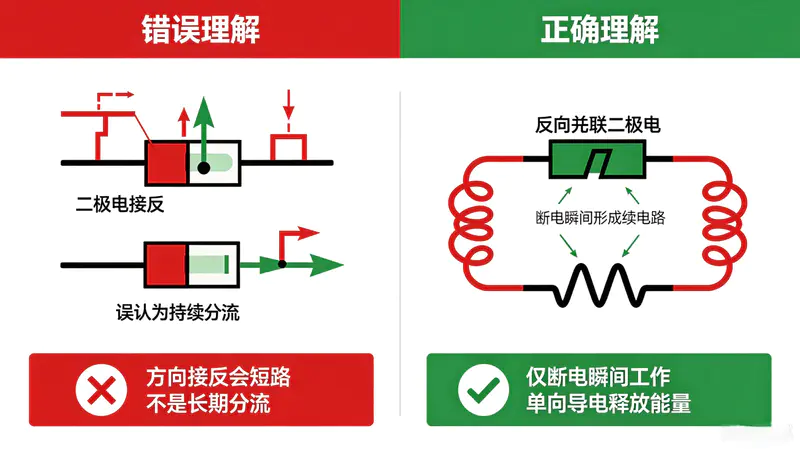
A lot of students here are prone to two cognitive errors。
First error zone: the diode is considered to act as a pressure relief or diversion to reduce the voltage at both ends of the coil. In practice, the diodes do not change the voltage of the relays at normal working hours and work only briefly at a time of power outage。
Second error: just turn the diodes straight into the circuit. Once the diode direction is reversed, the electrostatic diode directly leads to short circuits and the circuits fail. So it has to be reversed and linked to both ends of the online loop, and the direction must never be wrong。

The revolving diodes take full advantage of their single-director electrical properties and use a small component to solve the problem of electrons cutting high voltage. It's also very classic protection in electronicsCircuit designI don't know. There is no need for complex quantitative calculations at the junior secondary level, but we need to understand the physical patterns behind the phenomenon and learn to analyse circuits in combination with two knowledge points: electromagnetic induction, and monopolistic conductivity。
When we do this, we should not be content to remember one conclusion. Ask one more "why" to clarify the role of each element, the time period of the work, and not to lose sight of an innovative science-purge map。
In addition to relays protecting circuits, what applications have you seen for diodes? Welcome to the comment section
♪ first three physics ♪









