


DiodeIt's an important element of electrical science. Put the diodes in complex circuits, and students get sick! The core principle is that one-way conductivity, with currents flowing only from the diode orthodox and from the negative poles; in turn, the currents do not pass, which amounts to a breakout, like a valve that allows only one-way movement。
I. Introduction
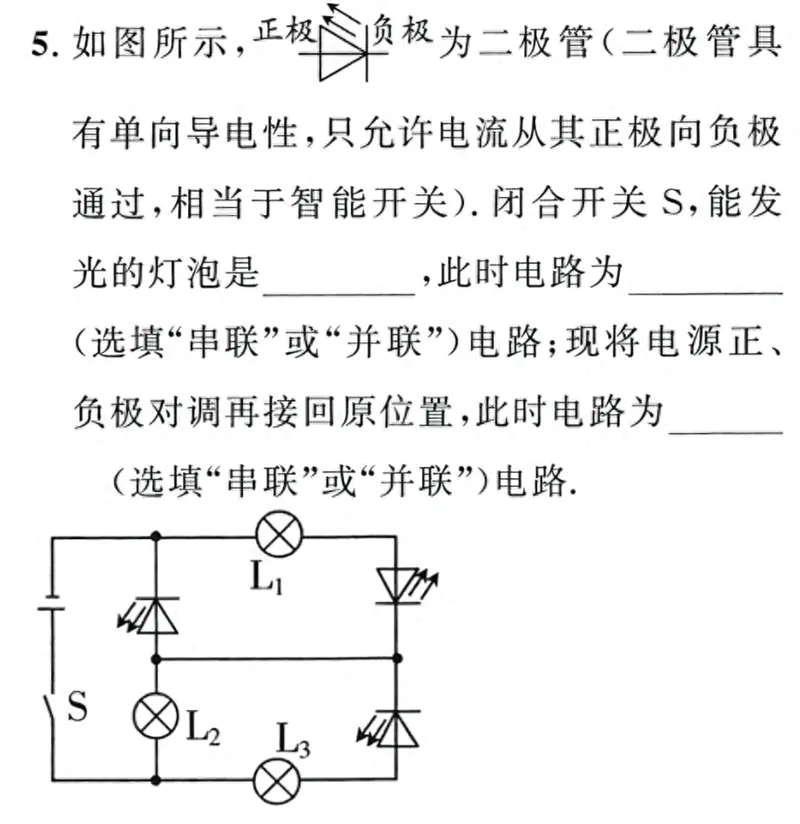
Ii. Dismantling the problem
1. First step: to determine whether the diode conduit or the deadline
(b) a positive current flow along the power source: currents flow from the positive and negative poles of the diode, which are catheters, equivalent to a conduit
The power flow is negative, positive, and the diode is closed, which is equivalent to a break-off, and the secondary road is directly out of reach。
2. Second step: the bypass through which the cut-off route is removed
Only the lycée-guided circuits are retained, and the secondary roads to which the lycées are located are ignored。
3. Third step: serial recognition
- seriality: the current has only one path, passing through all appliances
- accompanying: there are several separate branches of the current, and the circuits do not affect each other
First state of the subject (normal power connection):
The upper secondary diode is the positive guide, the l1 route; the left side diode is closed and the l2 is cut off; the lower diode is closed and the l3 is cut off。
There is only l1 light, and the current has only one path, which is a serial circuit。
After a positive-negative converse:
The whole circuit's all reverse。
The left-hand diode is direct, l2 route; the lower diode is direct, l3 route; the upper diode is closed and the l1 road is broken。
At that time, the currents were divided into two separate bypass roads, passing through l2 and l3, respectively, belonging to the combined circuit。
Iii. Possible points
1. Mistake 1: treat the diode as a normal guide, without distinguishing between positive and negative poles, and directly consider the light bulbs to be all lit。
Pipe avoidance: it is important to look at the direction of the current, the reverse diode is cut directly and the bypass is disabled。
2. Erection 2: after a positive and negative switch in the power source, forget the simultaneous reverse of all diode conduits。
Power alignment, complete reverse direction of incoming and outgoing flow of all diodes, and complete change of conductivity and cut-off status。
3. Wrong area 3: no effective feeder will be screened, and the cut-off feeder will be used to determine the combination。
Skills: by the end of the diode = broken circuit, the subject is covered directly by the route and only guides the route before the string is judged and linked。
Iv. Revision recommendations
1. Reconcile the diodes: it's a negative-in and negative-out, and it's off the road。
2. It is important to draw electric currents on the drawings with pens and not blind eyes。
3. Changes in the polarity of the power supply, with all diodes re-judgementing, do not follow the first conclusion。
There's a lot of kids in the diode circuits who can get mixed up. Message from comment section
♪ secondary physics ♪Linked circuits# physical error #Secondary physicsSpecial circuits









