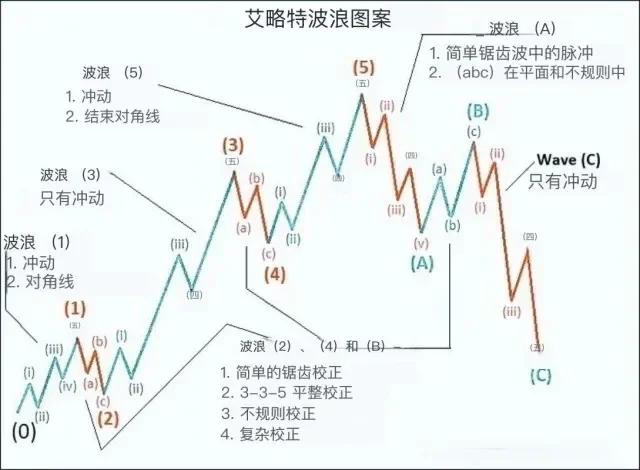
ElliotWave theory"the wave." it looks at it as: five waves push + three waves adjust。
Waves 1, 2, 3, 4 and 5: in the direction of the main trend, called driving waves/driving waves。
Waves a, b, c: reversing the main trend, called adjustment waves。
If the main trend is upward, it is 1-2-3-4-5 upward, and the a-b-c echo。
If the main trend is falling, it is 1-2-3-4-5 falling and a-b-c rebounding。
You say "a wave 1, a wave 2, a wave 3, a wave 4, a wave 5", which usually means "a wave" is broken down into five small waves; and "b" and "c" are the same and continue to be broken down。
All the waves, profit and loss points

Three rules to remember
Wave 2 cannot break the starting point of wave 1, otherwise it may not be a backlash, but rather a reversal of the trend。
Three waves cannot be the shortest of one, three, five waves, usually the strongest。
A four-wave low does not allow access to a one-wave high-point zone, otherwise the standard push structure may not be established。
How can we be more stable
First look at the big cycle, then look at the small cycle: weekline, dayline main wave, 60 minutes or less to find the point of sale。
Three waves have to be positive: the major profit-making stage when the targets are high, before they are high。
5 waves need to guard against deviations: high price but not high turnover or mcds, with no gain or gain considered。
Wave b is not greedy: the rebound is often weak and prone to temptation。
Wave c does not follow the knife: participation is to be considered when the bottom of wave c shows indentation, deviation, steady signal。
And know its limits
The biggest problem with wave theory is that it is highly subjective, with the same pattern, and different people may count different waves. So it's more appropriate as a trend position andRisk controlFramework, it is not recommended that trade be decided by a single “square wave”. When dealing with actual transactions, it would be preferable to combine turnover, line, mcd, supporting pressure and warehouse management。
If you are looking at unit a, the methodology is of relatively higher reference value for index, well-moved blue-chilling shares; for small capitalization shares, stockholdings, st shares, wave shapes are prone to distortion and greater risk。