


Let's look at the real picture of the moment。
Zirconium refers to a round-twilight concussion between 3,700 and 3800, with transactions ranging from 1. 4 to 1. 5 trillion and an increase of over 3,300 shares. Every day, votes come out of a pattern of “looks like a major upswing”, and every day they “count and fall”。
It's not a loss, it's a wave。
You learnWave theoryOn the back, one wave rises, two waves turn back, three waves rise, four waves adjust, five waves surf. You're on the k line, counting to the third wave, and you think, "the main wave is coming," and you're going in. And it turned out to be a wave of failure, and you were framed. You count again to the fifth wave, and you feel like you're adjusting, and you sell. And then it extends, you sell flying。
Count the waves to dizziness, and the number gets worse。
I've been out of stock for over a decade, the first eight years, and the account went down from 500,000 to 120,000. Five years later, i didn't count the waves, i looked at the structure. The account only began to stabilize profits。
Wave theory is not a wave, it's a structure. The waves are eight, but each one is different. It's the rhythm, not the count。
This matter is completely clear today。
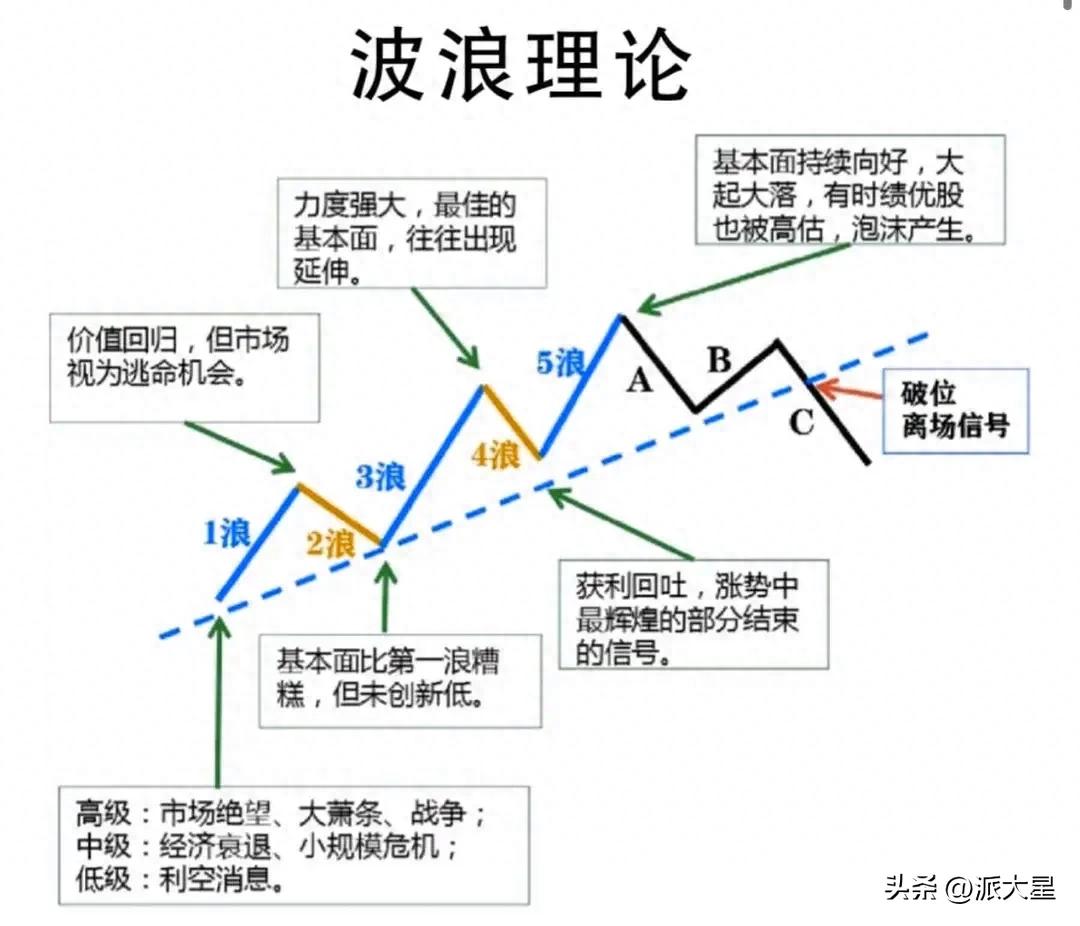
Let's get this straight: what's the wave theory
At the heart of wave theory is that markets operate at a “five-wave-driven, three-wave-adjusted” pace。
Five waves drive: one wave up, two waves up, three waves up, four waves up, five waves up。
There are three waves of adjustment: a waves fall, b waves rebound, c waves fall。
Five plus three, eight. Like waves, waves, waves, rises and falls。
But the problem is: eight shots of the waves, each of which is different in size, time, shape。
One wave may rise by three days and three waves by three months. Two waves could turn back by 10 per cent, four waves by two months. You die of the third wave, but the third wave can be extended, failed and turned into the fifth wave。
The more accurate you are, the more mistaken you are. Because waves come out, not counting。
The first core: the structure doesn't look at numbers -- push or adjust
Most people learn wave theory, and the first thing is numbers: what wave is it now
This is the most useless。
What you should look at is structure: are you going to push the wave or adjust it
The high points are rising, the low points are rising, the temperature of the trade is increasing and the trend is moving. Characteristics of adjusting waves: high points down or flat, low points down or flat, bartering and twitching。
You look at the structure, and you look at "the wave is pushed up or down." look at the numbers, look at "this wave is the wave."。
The former are facts, while the latter are figures。
The criteria for judgement: raising the height, raising the low point, matching the volume, is driving the wave. High-downs, low-downs, volume shrinks. The structure is 100 times more important than the number。
Second core: no point in the rhythm -- eight beats are more important than precise points
The most fascinating part of wave theory is that it gives you the illusion of "precision."。
“the target of the 3rd wave is 1. 618 times more than the 1st wave”, “the 4th wave cannot break a 1st wave”. The more accurate you count the points with the calculator, the more you feel you have the truth。
But the market does not follow the calculator。
The waves were eight-shot, but each one was different in strength, time, height. You're looking at the rhythm: is the drive over, is the adjustment over。
The signal that drives the wave's end: the amount can fail, the heights don't rise, the top of the k-line turns. Adjusts the signal of the end of the wave: volume shrinks to the ground, the low dot does not move down, and the bottom turns on the k-line。
You look at the rhythm, you look at "is this beat over?" you look at the spot, you look at "where should this shoot go."。
The former listens to waves, the latter counts waves. You're right. The waves don't listen to you。
Critic criteria: catalysing wave-view failure and top reverse, adjusting wave-view stability and bottom reverse. The rhythm is reliable。
The third core: the waves don't look at the waves -- the whole structure is important
This is one of the most valuable and neglected aspects of wave theory。
What do you mean, wave structure is intact? The five waves that drive the waves are over, or the three waves that adjust them。
You don't need to know exactly what wave it is. All you need to know is, is this structure gone。
It's a sign that the wave ends: the five waves are clearly structured, they can pass through, and the last wave turns at the top. The three waves are clearly structured, they can shrink to the ground, and the last wave turns at the bottom。
You look at the wave, you look at the structure. Look at the wave, look at "i'm counting right."。
The structure is complete, the direction is on. The structure is incomplete and continues to wait。
Criterion: the upper end of the five waves is the failure of the five waves. It's the bottom. The structural integrity ratio is important。
All three cores are satisfied. That's the complete wave structure
Look at the structure, give you direction. Look at the rhythm, tell you the stage. Look at the wave, tell you it's incomplete。
The three core rings are tied together。
The structure is the drive wave, the rhythm is the match, the wave is the end of the wave -- three things happen simultaneously, and that's the top signal。
The structure is a wave of adjustments, the rhythm of the earth is steady, the wave of three waves is over — three things happen simultaneously, and that's the bottom signal。
An exclusive dismantling: why the "squares" hurt most people
Because the waves give you the illusion of precision。
You count to the third wave, and you think, "the main wave is coming, and you're in." and then the third wave spread, and you can't hold it, sell it. Or the third wave fails, you're covered。
The more accurate you are, the more easily you get kidnapped。
The core of wave theory is not numbers, but structures. It is the structure that drives waves and adjusts them. The whole of the five waves is the structure. Quantification is the rhythm。
You count the waves, you count the waves. You look at the structure, you look at the "was it gone or not."。
The former is guessing, the latter is waiting. That's right, you think you're a genius. Wrong guess, you blame the market for not following the theory. You make the right money. Wait a minute, you're breaking up。
The waves are eight, but each one is different. It's the rhythm, not the count。
Check the current disk: how the wave structure works
Recent oscillations range from 3,700 to 3800, with transactions ranging from 1. 4 to 1. 5 trillion and an increase of over 3,300 shares。
First look: look at the structure. Open the k-line to see if it's a push or a adjuster. Highs, lows, highs, goods. High-downs, low-downs, volume shrinks。
Second: watch the rhythm. Whether the wave can fail or not, or whether the wave can shrink. Quantification is at the heart of the rhythm。
Third, look at the wave. Are you done driving the waves? Have you finished adjusting the waves? Structural integrity is the prerequisite for the choice of direction。
When you're done, you know it's time to wait. Count the waves to the few waves, it doesn't matter。
Three of the easiest pits
Pit one: the death note: "it's wave one." you count to the third wave, you think the main wave's coming in. And it spreads, fails, transforms. Waves are coming, not counting。
Pipe ii: count points with calculator. You count three waves at 1. 618 times the size of one wave, and you count to decimal. The market does not follow the calculator. Watch the rhythm, no spot。
Pipe three: the structure is running. It's not over yet. You think it's almost over. It's not over yet. You think it's almost over, buy it in advance. Structural integrity is the prerequisite for the choice of direction。
Say something to your heart
What's the wave theory? Wave eight beats, waves are not an end, wave structures are the core。
The structure doesn't look at numbers, the rhythm doesn't look at points, the waves don't look at waves. The three core rings are tied together。
You don't need to count to a few. You need to see if the structure's finished. You don't need to be precise. You need to listen to the rhythm of the eight beats. You don't have to prove yourself correctly. You need to wait for the structure to be complete。
The tickets you're holding, are they pushing or adjusting? Is the structure gone? Let's talk about what you found out。









